

Kerala Beyond 2030 Policy Briefs

Opening Kerala’s Factory Floors to Women
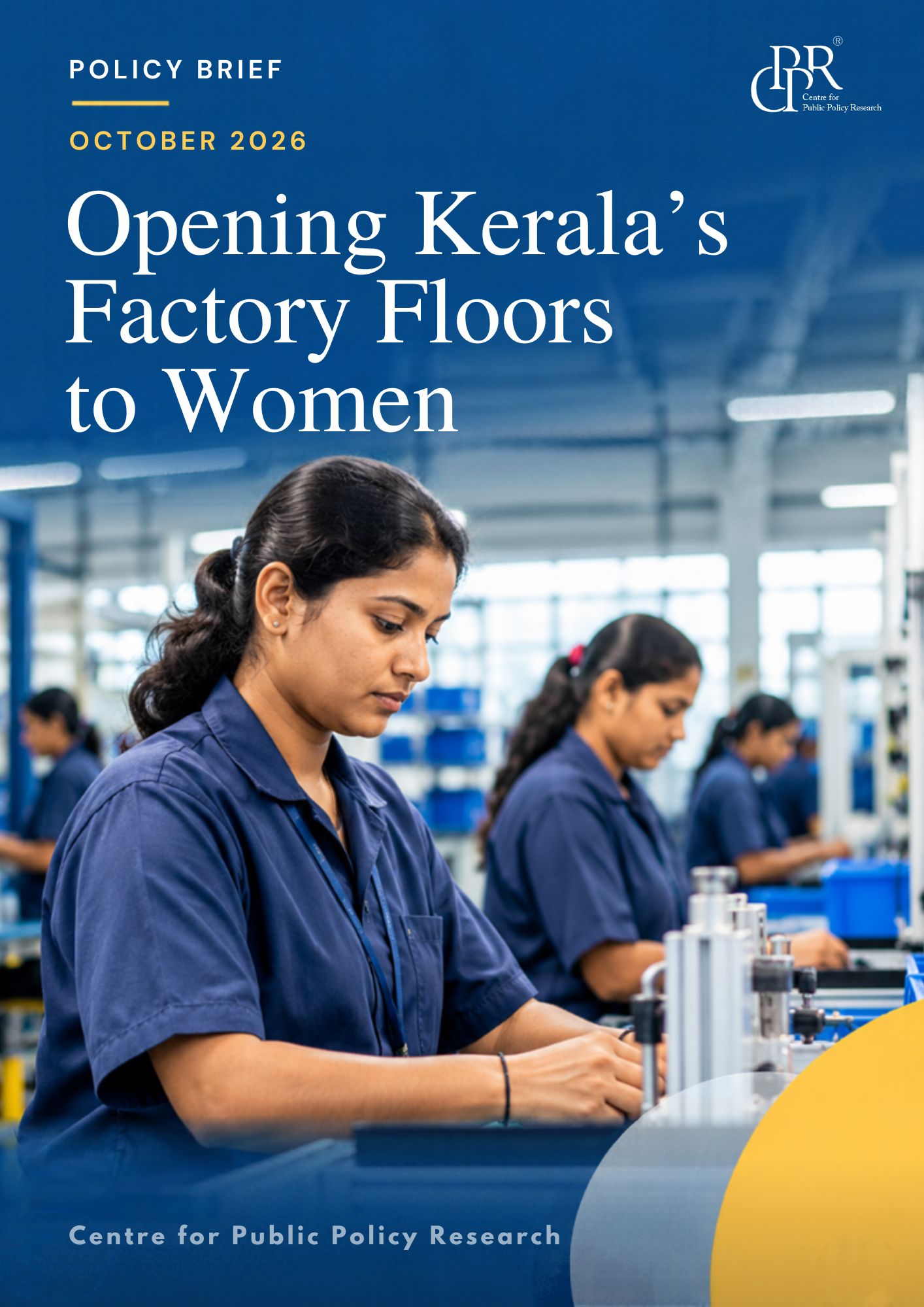
Kerala’s women are among the best educated in India. Female literacy stands at 92%, women outnumber men among graduates, and girls outperform boys in school-leaving exams. Even so, only about 29% of women were employed in 2023–24, and women make up 63.89% of the state’s registered job seekers. Part of the reason lies in the law. The Factories Act 1948 and the Kerala Factories Rules 1957 barred women from night shifts and from work classed as “dangerous.” The OSH Code 2020 has now replaced the old Act, and Kerala’s Draft OSH Rules 2021 lift the night-shift ban. But they attach costly conditions for employers and keep women out of 13 categories of work, from electroplating and glass to cashew and coir processing. The result is that women stay largely absent from higher-productivity sectors such as machinery, metals, automobiles and transport equipment. In those sectors, their share of the workforce is often below 10%.
This CPPR policy brief sets out specific amendments to the Draft Rules. It recommends limiting dangerous-operation restrictions to pregnant and lactating women and adolescents, and making consent for night work gender-neutral. It also calls for practical transport and security standards in place of vague or duplicative requirements, and for mandated representation of women on the State OSH Advisory Board. The brief argues that Kerala’s large pool of educated, job-ready women is an underused asset for attracting investment. It asks the state to act as a facilitator rather than a barrier, building workplaces that are safe for everyone instead of shutting women out.
Policy Brief
- CPPR Media&PR
- CPPR Media&PR
- CPPR Media&PR
- CPPR Media&PR
- CPPR Media&PR
- CPPR Media&PR
- CPPR Media&PR
- CPPR Media&PR
- CPPR Media&PR
- CPPR Media&PR
- CPPR Media&PR
- CPPR Media&PR
- CPPR Media&PR
- CPPR Media&PR
- CPPR Media&PR
- CPPR Media&PR
- CPPR Media&PR
- CPPR Media&PR
- CPPR Media&PR
- CPPR Media&PR
- CPPR Media&PR
- CPPR Media&PR
- CPPR Media&PR
- CPPR Media&PR
- CPPR Media&PR
- CPPR Media&PR
- CPPR Media&PR
- CPPR Media&PR
- CPPR Media&PR
- CPPR Media&PR
- CPPR Media&PR
- CPPR Media&PR
- CPPR Media&PR
- CPPR Media&PR
- CPPR Media&PR
- CPPR Media&PR
- CPPR Media&PR
- CPPR Media&PR
- CPPR Media&PR
- CPPR Media&PR
- CPPR Media&PR
- CPPR Media&PR
- CPPR Media&PR
- CPPR Media&PR
- CPPR Media&PR
- CPPR Media&PR
- CPPR Media&PR
- CPPR Media&PR
- CPPR Media&PR
- CPPR Media&PR
- CPPR Media&PR
- CPPR Media&PR
- CPPR Media&PR
- CPPR Media&PR
- CPPR Media&PR
- CPPR Media&PR
- CPPR Media&PR
- CPPR Media&PR
- CPPR Media&PR
- CPPR Media&PR
- CPPR Media&PR
- CPPR Media&PR
- CPPR Media&PR
- CPPR Media&PR
- CPPR Media&PR
- CPPR Media&PR
- CPPR Media&PR
- CPPR Media&PR
- CPPR Media&PR
- CPPR Media&PR
- CPPR Media&PR
- CPPR Media&PR
- CPPR Media&PR
- CPPR Media&PR
- CPPR Media&PR
- CPPR Media&PR
- CPPR Media&PR
- CPPR Media&PR
- CPPR Media&PR
- CPPR Media&PR
- CPPR Media&PR
- CPPR Media&PR
- CPPR Media&PR
- CPPR Media&PR
- CPPR Media&PR
- CPPR Media&PR
- CPPR Media&PR
- CPPR Media&PR
- CPPR Media&PR
- CPPR Media&PR
- CPPR Media&PR
- CPPR Media&PR
- CPPR Media&PR
- CPPR Media&PR
- CPPR Media&PR
- CPPR Media&PR
- CPPR Media&PR
- CPPR Media&PR
- CPPR Media&PR
- CPPR Media&PR
- CPPR Media&PR
- CPPR Media&PR
- CPPR Media&PR
- CPPR Media&PR
- CPPR Media&PR
- CPPR Media&PR
- CPPR Media&PR
- CPPR Media&PR
- CPPR Media&PR
- CPPR Media&PR
- CPPR Media&PR
- CPPR Media&PR
- CPPR Media&PR
- CPPR Media&PR
- CPPR Media&PR
- CPPR Media&PR
- CPPR Media&PR
- CPPR Media&PR
- CPPR Media&PR
- CPPR Media&PR
- CPPR Media&PR
- CPPR Media&PR
- CPPR Media&PR
- CPPR Media&PR
- CPPR Media&PR
- CPPR Media&PR
- CPPR Media&PR
- CPPR Media&PR
- CPPR Media&PR
- CPPR Media&PR
- CPPR Media&PR
- CPPR Media&PR
- CPPR Media&PR
- CPPR Media&PR
- CPPR Media&PR
- CPPR Media&PR
- CPPR Media&PR
- CPPR Media&PR
- CPPR Media&PR
- CPPR Media&PR
- CPPR Media&PR
- CPPR Media&PR
- CPPR Media&PR
- CPPR Media&PR
- CPPR Media&PR
- CPPR Media&PR
- CPPR Media&PR
- CPPR Media&PR
- CPPR Media&PR
- CPPR Media&PR
- CPPR Media&PR
- CPPR Media&PR
- CPPR Media&PR
- CPPR Media&PR
- CPPR Media&PR
- CPPR Media&PR
- CPPR Media&PR
- CPPR Media&PR
- CPPR Media&PR
- CPPR Media&PR
- CPPR Media&PR
- CPPR Media&PR
- CPPR Media&PR
- CPPR Media&PR
- CPPR Media&PR
- CPPR Media&PR
- CPPR Media&PR
- CPPR Media&PR
- CPPR Media&PR
- CPPR Media&PR
- CPPR Media&PR
- CPPR Media&PR
- CPPR Media&PR
- CPPR Media&PR
- CPPR Media&PR
- CPPR Media&PR
- CPPR Media&PR
- CPPR Media&PR
- CPPR Media&PR
- CPPR Media&PR
- CPPR Media&PR
- CPPR Media&PR
- CPPR Media&PR
- CPPR Media&PR
- CPPR Media&PR
- CPPR Media&PR
- CPPR Media&PR
- CPPR Media&PR
- CPPR Media&PR
- CPPR Media&PR
- CPPR Media&PR
- CPPR Media&PR
- CPPR Media&PR
- CPPR Media&PR
- CPPR Media&PR
- CPPR Media&PR
- CPPR Media&PR
- CPPR Media&PR
- CPPR Media&PR
- CPPR Media&PR
- CPPR Media&PR
- CPPR Media&PR
- CPPR Media&PR
- CPPR Media&PR
- CPPR Media&PR
- CPPR Media&PR
- CPPR Media&PR
- CPPR Media&PR
- CPPR Media&PR
- CPPR Media&PR
- CPPR Media&PR
- CPPR Media&PR
- CPPR Media&PR
- CPPR Media&PR
- CPPR Media&PR
- CPPR Media&PR
- CPPR Media&PR
- CPPR Media&PR
- CPPR Media&PR
- CPPR Media&PR
- CPPR Media&PR
- CPPR Media&PR
- CPPR Media&PR
- CPPR Media&PR
- CPPR Media&PR
- CPPR Media&PR
- CPPR Media&PR
- CPPR Media&PR
- CPPR Media&PR
- CPPR Media&PR
- CPPR Media&PR
- CPPR Media&PR
- CPPR Media&PR
- CPPR Media&PR
- CPPR Media&PR
- CPPR Media&PR
- CPPR Media&PR
- CPPR Media&PR
- CPPR Media&PR
- CPPR Media&PR
- CPPR Media&PR
- CPPR Media&PR
- CPPR Media&PR
- CPPR Media&PR
- CPPR Media&PR
- CPPR Media&PR
- CPPR Media&PR
- CPPR Media&PR
- CPPR Media&PR
- CPPR Media&PR
- CPPR Media&PR
- CPPR Media&PR
- CPPR Media&PR
- CPPR Media&PR
- CPPR Media&PR
- CPPR Media&PR
- CPPR Media&PR
- CPPR Media&PR
- CPPR Media&PR
- CPPR Media&PR
- CPPR Media&PR
- CPPR Media&PR
- CPPR Media&PR
- CPPR Media&PR
- CPPR Media&PR
- CPPR Media&PR
- CPPR Media&PR
- CPPR Media&PR
- CPPR Media&PR
- CPPR Media&PR
- CPPR Media&PR
- CPPR Media&PR
- CPPR Media&PR
- CPPR Media&PR
- CPPR Media&PR
- CPPR Media&PR
- CPPR Media&PR
- CPPR Media&PR
- CPPR Media&PR
- CPPR Media&PR
- CPPR Media&PR
- CPPR Media&PR
- CPPR Media&PR
- CPPR Media&PR
- CPPR Media&PR
- CPPR Media&PR
- CPPR Media&PR
- CPPR Media&PR
- CPPR Media&PR
- CPPR Media&PR
- CPPR Media&PR
- CPPR Media&PR
- CPPR Media&PR
- CPPR Media&PR
- CPPR Media&PR
- CPPR Media&PR
- CPPR Media&PR
- CPPR Media&PR
- CPPR Media&PR
- CPPR Media&PR
- CPPR Media&PR
- CPPR Media&PR
- CPPR Media&PR
- CPPR Media&PR
- CPPR Media&PR
- CPPR Media&PR
- CPPR Media&PR
- CPPR Media&PR
- CPPR Media&PR
- CPPR Media&PR
- CPPR Media&PR
- CPPR Media&PR
- CPPR Media&PR
- CPPR Media&PR
- CPPR Media&PR
- CPPR Media&PR
- CPPR Media&PR
- CPPR Media&PR
- CPPR Media&PR
- CPPR Media&PR
- CPPR Media&PR
- CPPR Media&PR
- CPPR Media&PR
- CPPR Media&PR
- CPPR Media&PR
- CPPR Media&PR
- CPPR Media&PR
- CPPR Media&PR
- CPPR Media&PR
- CPPR Media&PR
- CPPR Media&PR
- CPPR Media&PR
- CPPR Media&PR
- CPPR Media&PR
- CPPR Media&PR
- CPPR Media&PR
- CPPR Media&PR
- CPPR Media&PR
- CPPR Media&PR
- CPPR Media&PR
- CPPR Media&PR
- CPPR Media&PR
- CPPR Media&PR
- CPPR Media&PR
- CPPR Media&PR
- CPPR Media&PR
- CPPR Media&PR
- CPPR Media&PR
- CPPR Media&PR
- CPPR Media&PR
- CPPR Media&PR
- CPPR Media&PR
- CPPR Media&PR
- CPPR Media&PR
- CPPR Media&PR
- CPPR Media&PR
- CPPR Media&PR
- CPPR Media&PR
- CPPR Media&PR
- CPPR Media&PR
- CPPR Media&PR
- CPPR Media&PR
- CPPR Media&PR
- CPPR Media&PR
- CPPR Media&PR
- CPPR Media&PR
- CPPR Media&PR
- CPPR Media&PR
- CPPR Media&PR
- CPPR Media&PR
- CPPR Media&PR
- CPPR Media&PR
- CPPR Media&PR
- CPPR Media&PR
- CPPR Media&PR
- CPPR Media&PR
- CPPR Media&PR
- CPPR Media&PR
- CPPR Media&PR
- CPPR Media&PR
- CPPR Media&PR
- CPPR Media&PR
- CPPR Media&PR
- CPPR Media&PR
- CPPR Media&PR
- CPPR Media&PR
- CPPR Media&PR
- CPPR Media&PR
- CPPR Media&PR
- CPPR Media&PR
- CPPR Media&PR
- CPPR Media&PR
- CPPR Media&PR
- CPPR Media&PR
- CPPR Media&PR
- CPPR Media&PR
- CPPR Media&PR
- CPPR Media&PR
- CPPR Media&PR
- CPPR Media&PR
- CPPR Media&PR
- CPPR Media&PR
- CPPR Media&PR
- CPPR Media&PR
- CPPR Media&PR
- CPPR Media&PR
- CPPR Media&PR
- CPPR Media&PR
- CPPR Media&PR
- CPPR Media&PR
- CPPR Media&PR
- CPPR Media&PR
- CPPR Media&PR
- CPPR Media&PR
- CPPR Media&PR
- CPPR Media&PR
- CPPR Media&PR
- CPPR Media&PR
- CPPR Media&PR
- CPPR Media&PR
- CPPR Media&PR
- CPPR Media&PR
- CPPR Media&PR
- CPPR Media&PR
- CPPR Media&PR
- CPPR Media&PR
- CPPR Media&PR
- CPPR Media&PR
- CPPR Media&PR
- CPPR Media&PR
- CPPR Media&PR
- CPPR Media&PR
- CPPR Media&PR
- CPPR Media&PR
- CPPR Media&PR
- CPPR Media&PR
- CPPR Media&PR
- CPPR Media&PR
- CPPR Media&PR
- CPPR Media&PR
- CPPR Media&PR
- CPPR Media&PR
- CPPR Media&PR
- CPPR Media&PR
- CPPR Media&PR
- CPPR Media&PR
- CPPR Media&PR
- CPPR Media&PR
- CPPR Media&PR
- CPPR Media&PR
- CPPR Media&PR
- CPPR Media&PR
- CPPR Media&PR
- CPPR Media&PR
- CPPR Media&PR
- CPPR Media&PR
