All Events

From Remittance Dependence to Investment-Led Growth: Policy Choices for Kerala After the 2026 GCC Crisis
August 6, 2026
Rethinking Kochi’s Nightlife: D Dhanuraj
August 12, 2026Event Report — Strengthening Public Bus Transport in Indian Cities | CPPR
ABOUT THE TOPIC
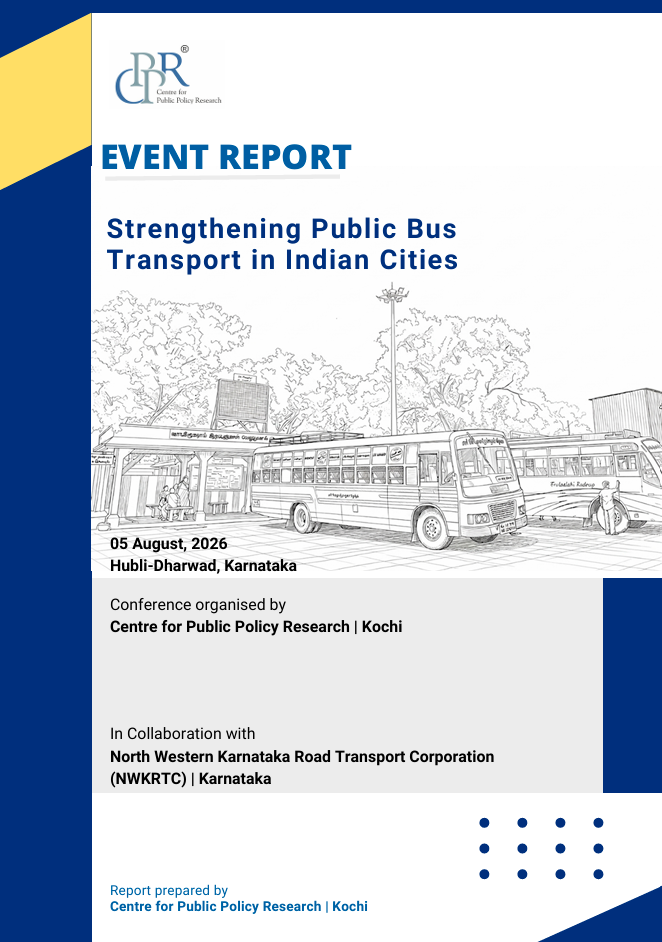
The Centre for Public Policy Research (CPPR), Kochi, in collaboration with the North Western Karnataka Road Transport Corporation (NWKRTC), organised a stakeholder conference titled “Strengthening Public Bus Transport in Indian Cities” on 5 August 2026 at Hubballi-Dharwad, Karnataka. The conference presented findings from CPPR’s national-level study, Role of Markets in Indian Road Transport System, supported by the Templeton World Charity Foundation.
The conference brought together senior officials and technical representatives from NWKRTC, HDBRTS and the Directorate of Urban Land Transport (DULT). CPPR presented demand-estimation findings based on a survey of 10,353 commuters across 87 locations in five cities, covering mobility patterns, current and potential demand, first- and last-mile connectivity, modal shift potential, fleet requirements, and commuter preferences.
The discussions highlighted a significant gap between existing bus supply and demand in Hubballi-Dharwad. While buses account for 76.5% of commuting trips, current ridership meets only 54% of estimated current demand, with potential demand rising substantially if service and connectivity improve. The city also recorded the highest potential demand among the five cities studied.
First- and last-mile connectivity emerged as a key challenge. Commuters in Hubballi-Dharwad face connectivity costs equivalent to 195% of the base bus fare, making the overall door-to-door journey more expensive than travelling the same distance by two-wheeler. The discussion also identified substantial potential for modal shift, particularly among users of shared intermediate public transport.
The conference concluded with discussions on fleet expansion, improved first- and last-mile connectivity, retention of existing bus users, and service improvements. NWKRTC officials acknowledged the identified gaps, and the Managing Director directed that CPPR’s data be consolidated into a document to support increasing the fleet from the current 30 buses per lakh population to 76 buses per lakh population to meet current demand.
The conference reinforced the need for demand-responsive fleet expansion, stronger first- and last-mile integration, and sustained improvements in public bus services to make urban mobility more accessible, efficient and responsive to commuter needs.