
Projects

EP 09 | Governance of the Shared Intermediate Public Transport Sector in Small and Medium Cities | Policy Beyond Mobility
December 12, 2025
D Dhanuraj of CPPR on the Kerala Local Body Election Results 2025
December 17, 2025Deregulating Building and Fire Rules for Improving Supply and Affordability of Urban Poor Housing in India

Context
India is projected to face an affordable housing deficit of 31.2 million units by 2030, with rural migrants and low-income urban households disproportionately affected. While land scarcity, rising input costs, and rapid urbanisation are widely acknowledged drivers of this shortage, the role of rigid building bye-laws, development control regulations, and fire safety norms remains insufficiently examined.
In many Indian cities, these regulations constrain buildable land through restrictive Floor Space Index limits, excessive setback and open space requirements, rigid parking norms, and prescriptive fire safety standards. Together, they increase construction costs substantially, reduce viable built-up area, and discourage private sector participation in low-margin affordable housing projects.
As a result, formal housing supply remains inadequate, pushing the urban poor into slums, informal settlements, and overcrowded rental housing with poor safety and living conditions.
This study proposes a comparative analysis of Kerala, Goa, and Andhra Pradesh to assess how state- and city-level building regulations shape the affordability and adequacy of urban housing for low-income groups. It critically examines whether calibrated regulatory reform can enable vertical and infill development, unlock underutilised urban land, and reduce per-unit housing costs without compromising safety and public health.
Drawing on regulatory analysis, stakeholder consultations, and comparative case studies from jurisdictions that have implemented successful reforms, the project seeks to develop evidence-based policy recommendations.
The overarching aim is to inform urban housing policy by demonstrating how context-sensitive deregulation can expand formal housing supply, improve living conditions for the urban poor, and contribute to more inclusive and sustainable urban development.
Project Objectives
- To analyse state-level building bye-laws, development control regulations, and fire safety norms in Kerala, Goa, and Andhra Pradesh, and assess their impact on housing supply, construction costs, and affordability for low-income urban households.
- To examine the potential of regulatory relaxation and rationalisation in enabling vertical and infill development, stimulating private sector investment, and reducing per-unit costs in affordable housing projects, while identifying associated safety and health risks.
- To develop evidence-based, context-specific policy recommendations through comparative case studies and stakeholder engagement, aimed at balancing safety considerations with the urgent need to expand affordable, adequate, and dignified housing for the urban poor.
EVENT
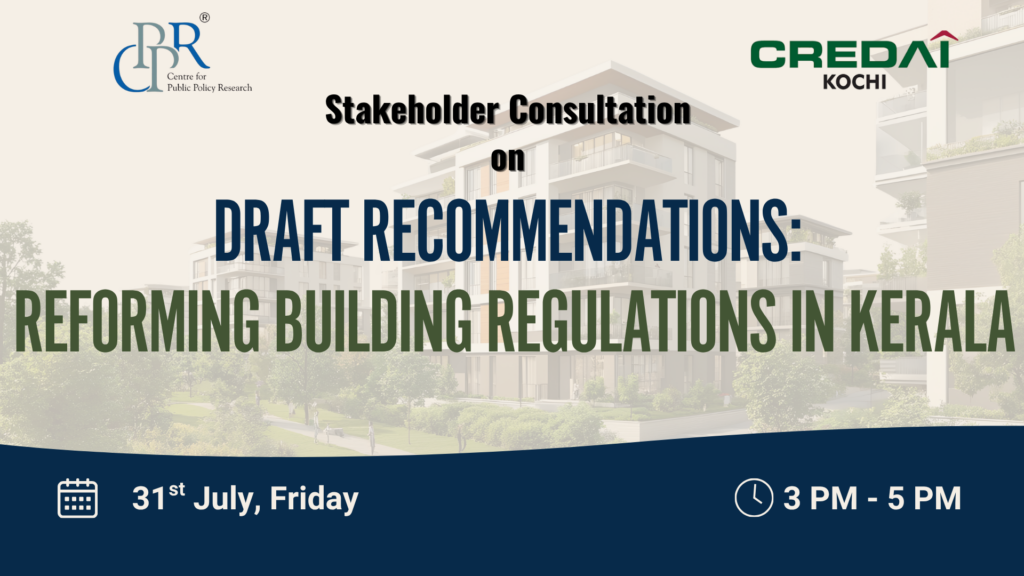
PUBLICATIONS
ARTICLES

REPORTS & PAPERS


IMAGE GALLERY