

Podcasts

“Outdated bus routes hobble rapidly changing ‘new’ Kochi,” D Dhanuraj Comments on changing commuting patterns.
March 10, 2026
Study Highlights Gap Between Assault Cases Filed by Women and Justice Delivery in India
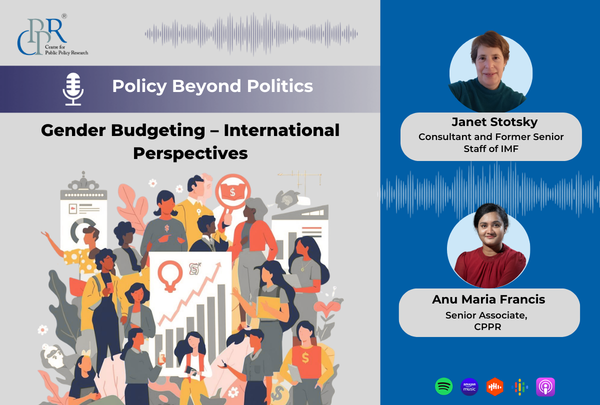
March 10, 2026EP 71| Gender Budgeting – International Perspectives| Policy Beyond Politics
1. INTRODUCTION & RATIONALE
This podcast examines whether fiscal systems, particularly tax structures, have mitigated or reinforced gender inequities over the past three decades. While gender budgeting has gained global policy visibility, empirical evidence suggests that fiscal frameworks often remain formally gender neutral yet substantively unequal in impact. The discussion interrogates how income taxation, consumption taxes, and social contributions shape labour force participation, unpaid care burdens, and intra-household distribution, and whether fiscal reform has produced measurable redistributive gains for women.
A central theme of the episode is the distinction between symbolic and substantive gender budgeting. Many governments publish gender budget statements or adopt tagging mechanisms, yet only a limited number integrate gender analysis into budget preparation, revenue design, expenditure review, and performance monitoring. The conversation explores the institutional conditions that determine this divergence, including political leadership, bureaucratic capacity, transparency standards, and legislative scrutiny.
The episode also turns to the comparatively neglected revenue dimension of gender budgeting. It assesses how gender analysis can be embedded within mainstream macro-fiscal frameworks without weakening fiscal discipline, and considers which tax design reforms hold transformative potential. Drawing on international comparative experience, the discussion reflects on the political and institutional factors that enable gender budgeting to become structurally embedded rather than remaining a peripheral policy instrument.
2. Key Objectives
The episode aims to:
- Examine the analytical and empirical evidence on whether fiscal systems — particularly tax structures — have reduced or perpetuated gender inequities over the past three decades.
- Distinguish between substantive and symbolic gender budgeting, and identify what institutional conditions separate the two.
- Explore how gender analysis can be integrated into mainstream macro-fiscal frameworks without compromising fiscal discipline.
- Illuminate the underexamined revenue side of gender budgeting and assess which tax design reforms carry the greatest transformative potential.
- Draw on international comparative experience to identify the political and institutional factors that determine whether gender budgeting becomes institutionally embedded or remains peripheral.
3. Key Discussion Themes and Questions
The conversation will be structured around the following substantive questions:
- In your early work on gender bias in tax systems, you demonstrate that fiscal policy is rarely gender neutral. Three decades later, do you believe tax systems have meaningfully reduced implicit gender bias, particularly in emerging economies? Where do structural distortions persist?
- What distinguishes substantive gender budgeting from symbolic or checklist-driven approaches that many governments have adopted?
- How should finance ministries integrate gender analysis into macro-fiscal frameworks without diluting core fiscal discipline objectives?
- Why has the revenue dimension remained underexamined in gender budgeting practice, and what tax design reforms would have the most transformative impact?
- Drawing from comparative experiences, what political and institutional conditions determine whether gender budgeting initiatives become embedded within medium-term fiscal frameworks rather than remaining as ministry-specific exercises?
PROFILE OF PANELLISTS
Janet Stotsky,
Consultant and Former Senior Staff of the IMF
Janet Stotsky is a consultant specializing in applied public policies and women and development. She is a former senior staff of the International Monetary Fund, where she was a fiscal and macroeconomics expert. She led missions to developing countries on macroeconomic and fiscal topics and negotiations for IMF lending programs. She led the IMF’s first work on gender budgeting and organized its first conference on gender and macroeconomics. She previously worked for the U.S. Treasury and taught at Rutgers and American Universities. She has published widely on macroeconomics, fiscal, and gender-related topics, including a 2020 book, Using Fiscal Policies and Public Financial Management to Promote Gender Equality: International Perspectives (London: Routledge). She has a PhD from Stanford University and a B.A. from Princeton University, both in economics.
#PolicyBeyondPolitics is available on
