


Strengthening India’s Sodium-Ion Battery Ecosystem: D Dhanuraj
August 6, 2026
Event Report — Strengthening Public Bus Transport in Indian Cities | CPPR
August 12, 2026From Remittance Dependence to Investment-Led Growth: Policy Choices for Kerala After the 2026 GCC Crisis
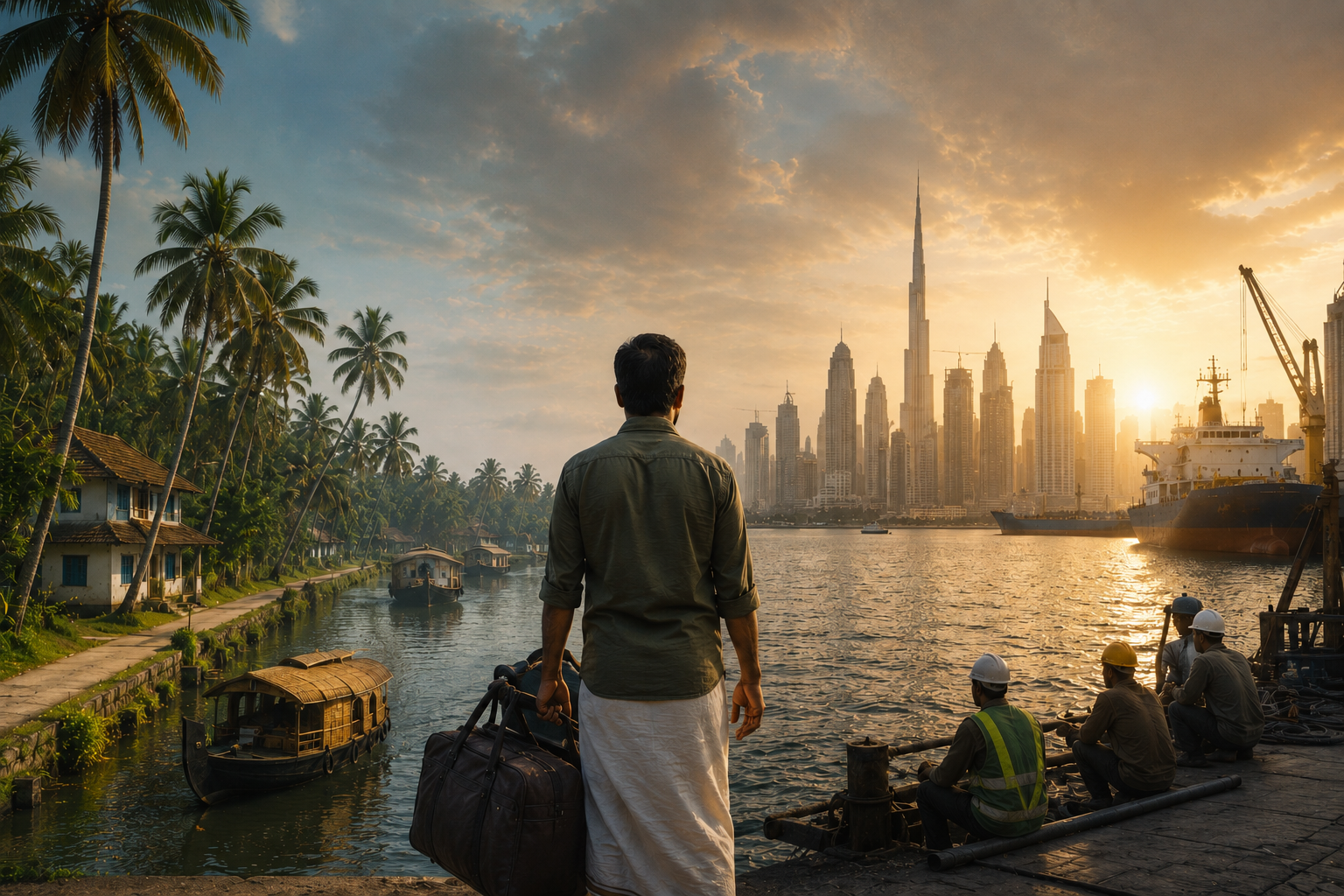
When geopolitical tensions escalate across the Gulf region, the consequences are felt in hundreds of households in Kerala, which depend on remittances to meet their daily needs. Early 2026 US-led military strikes on Iran and subsequent airspace closures over Dubai, Doha, and Abu Dhabi exposed Kerala’s remittance vulnerability (Al Jazeera, 2026). This vulnerability is structurally entrenched; it’s the cumulative result of a labour market, education system, and household economy organized around Gulf migration as the primary route to income security (Kannan & Hari, 2020; Zachariah & Rajan, 2011). Frequent Strait of Hormuz disruptions and surging crude oil prices compressed long-projected risks into weeks, emphasizing the urgent need to reconfigure Kerala’s economic structure.
Gulf migration offered Kerala a rational solution – a way to bridge the gap between its high literacy rates and the state’s limited capacity to absorb educated workers locally. By allowing educated youth to earn premium overseas wages, this temporary safety valve eventually evolved into a central pillar of the state’s economy.
India as a whole is shifting away from Gulf dependence toward the US (27.7%) and UK (10.8%), with remittances hitting US$118.7 billion (≈₹10.14 lakh crore) in 2023–24. However, Kerala receives around ₹2.16 lakh crore annually from its global diaspora, of whom 80% reside in GCC countries (KMS, 2023).
Although GCC workers generally earn lower per capita wages than migrants in advanced economies, Kerala’s share of India’s GCC-origin remittances jumped from 10.2% in 2020–21 to 19.7% in 2023–24 (RBI, 2025). Within Kerala, inflows are geographically concentrated, with Kollam (17.8%) overtaking Malappuram (16.2%) as the top recipient district in 2023 (KMS, 2023).
Kerala’s economy is organized around Gulf wages due to scarce domestic alternatives. In Malappuram, over half of households rely on 3.5 lakh emigrants, deeply tying local society to Gulf income (Panancheri, 2025). However, occupational patterns reveal severe vulnerability: 76.9% of Kerala’s emigrants are labour migrants, with men concentrated in sales (12.9%), transport (11.0%), and construction (2.7%) (KMS, 2023). Featuring low bargaining power, minimal contract security, and high substitutability, this workforce remains acutely exposed to regional and global economic downturns.
COVID-19 stress-tested Kerala’s absorptive capacity when 1.4 million non-resident Keralites returned between 2020 and 2021 due to job losses and unsafe conditions (Rajan & Pattath, 2022). The core issue was the speed of this compressed, involuntary shock. Returnees faced simultaneous income and job loss, yet reintegration support lagged without a dedicated rehabilitation policy even a year later (Rajan & Pattath, 2022). This gap between repatriation and reintegration highlights a critical concern for 2026: a major GCC crisis would test not whether Kerala can bring its diaspora home, but whether it can absorb them.
The current crisis is projected to cut inward remittances by 20% (Joseph, 2025). While rupee depreciation provides temporary relief, welfare schemes and short-term measures merely treat symptoms, leaving structural dependence unaddressed. Simultaneously, panic risks triggering a liquidity paradox. Kerala’s banks already hold over ₹2.93 lakh crore in NRI deposits (SLBC Kerala, 2025). A defensive surge of funds parked in savings rather than productively invested will lock away crucial capital, deepening economic stagnation rather than fostering resilience.
To mitigate economic uncertainty, Kerala must build a shock-resilient workforce. Emerging corridors to Germany, Canada, Japan, and Australia offer diversification, but pathways like the EU Blue Card target highly skilled professionals, remaining inaccessible to Kerala’s semi-skilled GCC majority. Rather than merely chasing new corridors, Kerala must invest in upskilling through vocational training, language programs, and credential recognition frameworks. Without these structural investments, migration diversification remains aspirational regardless of how many bilateral MOUs India signs.
The government’s first step in this direction appears in the Kerala Budget 2026, where Chief Minister V D Satheesan announced a shift from a remittance-dependent economy toward an investment-driven one, anchored by a Pravasi Investment Company channelling NRI funds into startups, healthcare, and tourism, alongside an Investment Advisory Council, an Invest Kerala cell, and a Global Job Watch Tower. The vision is set; the diaspora’s aspirations are being called home; what follows is the roadmap to house them.
Turning that vision into reality depends on the institutions already in place. NORKA and ODEPC were designed to ease migration and assist during disruptions, yet neither appears equipped for the scale and speed this crisis demands. Kerala’s policy architecture isn’t a blank slate – NDPREM, Skill Upgradation & Reintegration Training, and the Kerala Pravasi Mission already address reintegration. The gap lies in reach, not absence: NDPREM had only 1,200 beneficiaries in FY 2023-24, with ₹18 crore expended, and a state committee found many returnees unaware the scheme exists, resulting in poor uptake (Kumar, 2025). The state must scale and publicize these mechanisms. Expanding NDPREM through awareness drives and startup facilitation offers a low-cost strategy to maximize existing NORKA and district-level capacity.
Kerala should mandate Pravasi Welfare Offices in top migrant-sending taluks, coordinating with NORKA to decentralize support. Leveraging existing panchayat infrastructure makes this targeted, moderate-cost welfare delivery highly feasible. Gulf dependence stems from social norms and networks framing it as the default choice. To reshape this, youth need accurate, actionable information on diverse international opportunities, making global migration literacy essential for informed career choices beyond the GCC.
The GCC crisis of 2026 has exposed the realities of the structural dependence of Kerala over the years. The state that has enormously benefited from the GCC remittances owes them more than a helpline number and a welfare scheme. The choice in front of the government is not about managing the dependence, but about resolving it.
The ambition is real, even if the runway is long: Kerala’s aggregate debt stands at ₹5.07 lakh crore, and the state’s own revised Budget for 2026-27 was presented against a ₹20,500 crore revenue shortfall (Onmanorama, 2026). The state’s fiscal strategy remains conservative, and its diaspora is still being asked to fund the very transition to reduce dependence.
What Kerala does with this constrained fiscal space will determine whether the transition is genuine or merely rhetorical. In the long run, Kerala’s economic strength will be measured not by the volume of remittances it receives, but by its ability to convert global uncertainties into opportunities for sustainable growth.
References
- Al Jazeera. (2026, May 3). UAE lifts all air traffic restrictions introduced since Iran war. https://www.aljazeera.com/news/2026/5/3/uae-lifts-all-air-traffic-restrictions-introduced-since-iran-war
- International Institute of Migration and Development (IIMAD). Kerala Migration Survey 2023: Kerala Migration Report 2023. Thiruvananthapuram: International Institute of Migration and Development, 2024. https://iimad.org/wp-content/uploads/2024/06/KMS-2023-Report.pdf
- K. J. Joseph, “Kerala Likely to See 20% Drop in Remittances as West Asia War Drags On,” FLAME University, June 2025. https://www.flame.edu.in/in-the-media/kerala-likely-to-see-20-drop-in-remittances-as-west-asia-war-drags-on
- Kannan, K. P., and K. S. Hari. “Revisiting Kerala’s Gulf Connection: Half a Century of Emigration, Remittances and Their Macroeconomic Impact, 1972–2020.” The Indian Journal of Labour Economics 63, no. 4 (2020): 941–967. https://doi.org/10.1007/s41027-020-00280-z
- Zachariah, K. C., and S. Irudaya Rajan. “Impact of Remittances of Non-Resident Keralites on Kerala’s Economy and Society.” The Indian Journal of Labour Economics 54, no. 3 (2011): 503–526.
- Rajan, S. I., & Pattath, B. (2022). Distress return migration amid COVID-19: Kerala’s response. Asian and Pacific Migration Journal, 31(2), 176–189. https://doi.org/10.1177/01171968221106391
- State Level Bankers’ Committee, Kerala. (2025, March). NRI deposits in Kerala banks [Data reported in news media]. As cited in Onmanorama. (2025, May 29). Kerala sees record-breaking inflow from NRIs. https://www.onmanorama.com/news/business/2025/05/29/nri-remittance-record-kerala-deposits.html
- Reserve Bank of India. (2025, March 19). Changing dynamics of India’s remittances: Insights from the Sixth Round of India’s Remittances Survey. RBI Bulletin. https://rbi.org.in/Scripts/BS_ViewBulletin.aspx?Id=23260
- Panancheri, Ashraf. “Gulf Migration Dynamics: Kerala State versus Malappuram District.” International Journal of Multidisciplinary Research Review 11, no. 9 (September 2025): 73–82. http://www.ijmdrr.com/admin/downloads/021020257.pdf.
- Gulf Today. “New Age Kerala: CM Satheesan Unveils Budget, Seeks NRI Partnership for State’s Development.” June 19, 2026. https://www.gulftoday.ae/business/2026/06/19/new-age-kerala-cm-satheesan-unveils-budget-seeks-nri-partnership-for-states-development.
- Kumar, D. V. (2025, November 13). Kerala CM’s Gulf outreach meets a stark reminder: Returnee expatriates still await promised support. The South First. https://thesouthfirst.com/kerala/kerala-cms-gulf-outreach-meets-a-stark-reminder-returnee-expatriates-still-await-promised-support/
Anuja A. Narendran is a research intern at the Centre for Public Policy Research, Kochi.
Views expressed by the author are personal and need not reflect or represent the views of the Centre for Public Policy Research.

- CPPR Media&PR
- CPPR Media&PR
- CPPR Media&PR
- CPPR Media&PR
- CPPR Media&PR
- CPPR Media&PR
- CPPR Media&PR
- CPPR Media&PR
- CPPR Media&PR
- CPPR Media&PR
- CPPR Media&PR
- CPPR Media&PR
- CPPR Media&PR
- CPPR Media&PR
- CPPR Media&PR
- CPPR Media&PR
- CPPR Media&PR
- CPPR Media&PR
- CPPR Media&PR
- CPPR Media&PR
- CPPR Media&PR
- CPPR Media&PR
- CPPR Media&PR
- CPPR Media&PR
- CPPR Media&PR
- CPPR Media&PR
- CPPR Media&PR
- CPPR Media&PR
- CPPR Media&PR
- CPPR Media&PR
- CPPR Media&PR
- CPPR Media&PR
- CPPR Media&PR
- CPPR Media&PR
- CPPR Media&PR
- CPPR Media&PR
- CPPR Media&PR
- CPPR Media&PR
- CPPR Media&PR
- CPPR Media&PR
- CPPR Media&PR
- CPPR Media&PR
- CPPR Media&PR
- CPPR Media&PR
- CPPR Media&PR
- CPPR Media&PR
- CPPR Media&PR
- CPPR Media&PR
- CPPR Media&PR
- CPPR Media&PR
- CPPR Media&PR
- CPPR Media&PR
- CPPR Media&PR
- CPPR Media&PR
- CPPR Media&PR
- CPPR Media&PR
- CPPR Media&PR
- CPPR Media&PR
- CPPR Media&PR
- CPPR Media&PR
- CPPR Media&PR
- CPPR Media&PR
- CPPR Media&PR
- CPPR Media&PR
- CPPR Media&PR
- CPPR Media&PR
- CPPR Media&PR
- CPPR Media&PR
- CPPR Media&PR
- CPPR Media&PR
- CPPR Media&PR
- CPPR Media&PR
- CPPR Media&PR
- CPPR Media&PR
- CPPR Media&PR
- CPPR Media&PR
- CPPR Media&PR
- CPPR Media&PR
- CPPR Media&PR
- CPPR Media&PR
- CPPR Media&PR
- CPPR Media&PR
- CPPR Media&PR
- CPPR Media&PR
- CPPR Media&PR
- CPPR Media&PR
- CPPR Media&PR
- CPPR Media&PR
- CPPR Media&PR
- CPPR Media&PR
- CPPR Media&PR
- CPPR Media&PR
- CPPR Media&PR
- CPPR Media&PR
- CPPR Media&PR
- CPPR Media&PR
- CPPR Media&PR
- CPPR Media&PR
- CPPR Media&PR
- CPPR Media&PR
- CPPR Media&PR
- CPPR Media&PR
- CPPR Media&PR
- CPPR Media&PR
- CPPR Media&PR
- CPPR Media&PR
- CPPR Media&PR
- CPPR Media&PR
- CPPR Media&PR
- CPPR Media&PR
- CPPR Media&PR
- CPPR Media&PR
- CPPR Media&PR
- CPPR Media&PR
- CPPR Media&PR
- CPPR Media&PR
- CPPR Media&PR
- CPPR Media&PR
- CPPR Media&PR
- CPPR Media&PR
- CPPR Media&PR
- CPPR Media&PR
- CPPR Media&PR
- CPPR Media&PR
- CPPR Media&PR
- CPPR Media&PR
- CPPR Media&PR
- CPPR Media&PR
- CPPR Media&PR
- CPPR Media&PR
- CPPR Media&PR
- CPPR Media&PR
- CPPR Media&PR
- CPPR Media&PR
- CPPR Media&PR
- CPPR Media&PR
- CPPR Media&PR
- CPPR Media&PR
- CPPR Media&PR
- CPPR Media&PR
- CPPR Media&PR
- CPPR Media&PR
- CPPR Media&PR
- CPPR Media&PR
- CPPR Media&PR
- CPPR Media&PR
- CPPR Media&PR
- CPPR Media&PR
- CPPR Media&PR
- CPPR Media&PR
- CPPR Media&PR
- CPPR Media&PR
- CPPR Media&PR
- CPPR Media&PR
- CPPR Media&PR
- CPPR Media&PR
- CPPR Media&PR
- CPPR Media&PR
- CPPR Media&PR
- CPPR Media&PR
- CPPR Media&PR
- CPPR Media&PR
- CPPR Media&PR
- CPPR Media&PR
- CPPR Media&PR
- CPPR Media&PR
- CPPR Media&PR
- CPPR Media&PR
- CPPR Media&PR
- CPPR Media&PR
- CPPR Media&PR
- CPPR Media&PR
- CPPR Media&PR
- CPPR Media&PR
- CPPR Media&PR
- CPPR Media&PR
- CPPR Media&PR
- CPPR Media&PR
- CPPR Media&PR
- CPPR Media&PR
- CPPR Media&PR
- CPPR Media&PR
- CPPR Media&PR
- CPPR Media&PR
- CPPR Media&PR
- CPPR Media&PR
- CPPR Media&PR
- CPPR Media&PR
- CPPR Media&PR
- CPPR Media&PR
- CPPR Media&PR
- CPPR Media&PR
- CPPR Media&PR
- CPPR Media&PR
- CPPR Media&PR
- CPPR Media&PR
- CPPR Media&PR
- CPPR Media&PR
- CPPR Media&PR
- CPPR Media&PR
- CPPR Media&PR
- CPPR Media&PR
- CPPR Media&PR
- CPPR Media&PR
- CPPR Media&PR
- CPPR Media&PR
- CPPR Media&PR
- CPPR Media&PR
- CPPR Media&PR
- CPPR Media&PR
- CPPR Media&PR
- CPPR Media&PR
- CPPR Media&PR
- CPPR Media&PR
- CPPR Media&PR
- CPPR Media&PR
- CPPR Media&PR
- CPPR Media&PR
- CPPR Media&PR
- CPPR Media&PR
- CPPR Media&PR
- CPPR Media&PR
- CPPR Media&PR
- CPPR Media&PR
- CPPR Media&PR
- CPPR Media&PR
- CPPR Media&PR
- CPPR Media&PR
- CPPR Media&PR
- CPPR Media&PR
- CPPR Media&PR
- CPPR Media&PR
- CPPR Media&PR
- CPPR Media&PR
- CPPR Media&PR
- CPPR Media&PR
- CPPR Media&PR
- CPPR Media&PR
- CPPR Media&PR
- CPPR Media&PR
- CPPR Media&PR
- CPPR Media&PR
- CPPR Media&PR
- CPPR Media&PR
- CPPR Media&PR
- CPPR Media&PR
- CPPR Media&PR
- CPPR Media&PR
- CPPR Media&PR
- CPPR Media&PR
- CPPR Media&PR
- CPPR Media&PR
- CPPR Media&PR
- CPPR Media&PR
- CPPR Media&PR
- CPPR Media&PR
- CPPR Media&PR
- CPPR Media&PR
- CPPR Media&PR
- CPPR Media&PR
- CPPR Media&PR
- CPPR Media&PR
- CPPR Media&PR
- CPPR Media&PR
- CPPR Media&PR
- CPPR Media&PR
- CPPR Media&PR
- CPPR Media&PR
- CPPR Media&PR
- CPPR Media&PR
- CPPR Media&PR
- CPPR Media&PR
- CPPR Media&PR
- CPPR Media&PR
- CPPR Media&PR
- CPPR Media&PR
- CPPR Media&PR
- CPPR Media&PR
- CPPR Media&PR
- CPPR Media&PR
- CPPR Media&PR
- CPPR Media&PR
- CPPR Media&PR
- CPPR Media&PR
- CPPR Media&PR
- CPPR Media&PR
- CPPR Media&PR
- CPPR Media&PR
- CPPR Media&PR
- CPPR Media&PR
- CPPR Media&PR
- CPPR Media&PR
- CPPR Media&PR
- CPPR Media&PR
- CPPR Media&PR
- CPPR Media&PR
- CPPR Media&PR
- CPPR Media&PR
- CPPR Media&PR
- CPPR Media&PR
- CPPR Media&PR
- CPPR Media&PR
- CPPR Media&PR
- CPPR Media&PR
- CPPR Media&PR
- CPPR Media&PR
- CPPR Media&PR
- CPPR Media&PR
- CPPR Media&PR
- CPPR Media&PR
- CPPR Media&PR
- CPPR Media&PR
- CPPR Media&PR
- CPPR Media&PR
- CPPR Media&PR
- CPPR Media&PR
- CPPR Media&PR
- CPPR Media&PR
- CPPR Media&PR
- CPPR Media&PR
- CPPR Media&PR
- CPPR Media&PR
- CPPR Media&PR
- CPPR Media&PR
- CPPR Media&PR
- CPPR Media&PR
- CPPR Media&PR
- CPPR Media&PR
- CPPR Media&PR
- CPPR Media&PR
- CPPR Media&PR
- CPPR Media&PR
- CPPR Media&PR
- CPPR Media&PR
- CPPR Media&PR
- CPPR Media&PR
- CPPR Media&PR
- CPPR Media&PR
- CPPR Media&PR
- CPPR Media&PR
- CPPR Media&PR
- CPPR Media&PR
- CPPR Media&PR
- CPPR Media&PR
- CPPR Media&PR
- CPPR Media&PR
- CPPR Media&PR
- CPPR Media&PR
- CPPR Media&PR
- CPPR Media&PR
- CPPR Media&PR
- CPPR Media&PR
- CPPR Media&PR
- CPPR Media&PR
- CPPR Media&PR
- CPPR Media&PR
- CPPR Media&PR
- CPPR Media&PR
- CPPR Media&PR
- CPPR Media&PR
- CPPR Media&PR
- CPPR Media&PR
- CPPR Media&PR
- CPPR Media&PR
- CPPR Media&PR
- CPPR Media&PR
- CPPR Media&PR
- CPPR Media&PR
- CPPR Media&PR
- CPPR Media&PR
- CPPR Media&PR
- CPPR Media&PR
- CPPR Media&PR
- CPPR Media&PR
- CPPR Media&PR
- CPPR Media&PR
- CPPR Media&PR
- CPPR Media&PR
- CPPR Media&PR
- CPPR Media&PR
- CPPR Media&PR
- CPPR Media&PR
- CPPR Media&PR
- CPPR Media&PR
- CPPR Media&PR
- CPPR Media&PR
- CPPR Media&PR
- CPPR Media&PR
- CPPR Media&PR
- CPPR Media&PR
- CPPR Media&PR
- CPPR Media&PR
- CPPR Media&PR
- CPPR Media&PR
- CPPR Media&PR
- CPPR Media&PR
- CPPR Media&PR
- CPPR Media&PR
- CPPR Media&PR
- CPPR Media&PR
- CPPR Media&PR
- CPPR Media&PR
- CPPR Media&PR
- CPPR Media&PR
- CPPR Media&PR
- CPPR Media&PR
- CPPR Media&PR
- CPPR Media&PR
- CPPR Media&PR
- CPPR Media&PR
- CPPR Media&PR
- CPPR Media&PR
- CPPR Media&PR
- CPPR Media&PR
- CPPR Media&PR
- CPPR Media&PR
- CPPR Media&PR
- CPPR Media&PR
- CPPR Media&PR
- CPPR Media&PR
- CPPR Media&PR
- CPPR Media&PR
- CPPR Media&PR
- CPPR Media&PR
- CPPR Media&PR
- CPPR Media&PR
- CPPR Media&PR
- CPPR Media&PR
- CPPR Media&PR
- CPPR Media&PR
- CPPR Media&PR
- CPPR Media&PR
- CPPR Media&PR
- CPPR Media&PR
- CPPR Media&PR
- CPPR Media&PR
- CPPR Media&PR
- CPPR Media&PR
- CPPR Media&PR
- CPPR Media&PR
- CPPR Media&PR
- CPPR Media&PR
- CPPR Media&PR
- CPPR Media&PR
- CPPR Media&PR
- CPPR Media&PR
- CPPR Media&PR
- CPPR Media&PR
- CPPR Media&PR
- CPPR Media&PR
- CPPR Media&PR
- CPPR Media&PR
- CPPR Media&PR
- CPPR Media&PR
- CPPR Media&PR
- CPPR Media&PR
- CPPR Media&PR
