


#DecodingthePolls Ep.45 | Narratives, Numbers & Power: Decoding Tamil Nadu and West Bengal | CPPR
April 24, 2026
Strategic Resilience and India’s Energy Security Amidst West Asia Volatility
April 24, 2026Redefining Energy Security: From Barrels and BTUs to Materials and Data
In Short
- India’s energy security doctrine is structurally misaligned with the material realities of its own clean energy transition.
- Import dependency has shifted from oil fields to mineral supply chains, with no equivalent institutional response.
- China’s dominance in critical mineral refining makes supply diversification structurally difficult, not merely diplomatically inconvenient.
- Digitalisation of India’s grid has created an exploitable attack surface that existing security frameworks do not adequately cover.
- Without integrating minerals, cyber resilience, and climate risk into a single framework, India’s energy vulnerability is not declining; it is relocating.
For most of the past five decades, the grammar of energy security was written in barrels and British Thermal Units (BTUs). Policymakers conceptualised vulnerability through import dependence ratios, the politics of producer regions, and the chokepoint geography of the Strait of Hormuz and the Malacca Strait. That framework served its purpose in an era when the central variable was whether oil and gas would flow uninterrupted from well to refinery to consumer. It is, however, increasingly insufficient for the structural moment India now occupies.
India is simultaneously the world’s third-largest oil importer, the fourth-largest renewable energy producer by installed capacity, and a country with 100 percent import dependency on several minerals that are foundational to the very clean energy infrastructure it is building. This is not a contradiction it can be papered over with diplomatic energy diversification or strategic petroleum reserves. It is a structural condition that demands a new conceptual architecture for energy security, one that incorporates material security, cyber and data resilience, and climate-driven transition risk alongside the traditional hydrocarbon concerns. Without integrating minerals, cyber resilience, and climate risk into a single framework, India’s energy vulnerability is not declining; it is relocating.
The Limits of the Barrel-Centric Paradigm
The classical formulation of energy security, availability, affordability, accessibility, and acceptability was designed for a world in which the primary threat was a physical disruption to fossil fuel supply. India’s institutional architecture still reflects this origin. The Ministry of Petroleum and Natural Gas, the strategic petroleum reserve managed by the Indian Strategic Petroleum Reserve Limited, and the diplomatic emphasis on diversifying oil and LNG contracts are all instruments built for that threat environment.
What they fail to address is a structural shift, according to the IEA’s Global Critical Minerals Outlook 2024, under the Net Zero scenario, demand for critical minerals nearly triples by 2030 and grows to over 3.5 times current levels by 2050, with lithium seeing an eightfold increase by 2040. India’s 500 GW non-fossil fuel target by 2030 is, at its material foundation, a lithium, cobalt, nickel, copper, and rare earth story. According to the Institute for Energy Economics and Financial Analysis (IEEFA, 2024), India’s import dependency on critical minerals will likely continue, as demand is expected to more than double by 2030, while domestic mines will take more than a decade to start producing. A country that cannot secure its mineral inputs cannot complete its energy transition, regardless of how many gigawatts it tenders.
Material Security: The New Import Dependency
The table below illustrates how India’s energy security vulnerability profile has shifted. The familiar fossil fuel exposure remains, but a structurally analogous set of dependencies has emerged around critical minerals, with one critical difference: the refining chokepoint is far more concentrated than any oil producer bloc.
Table 1: India’s Energy Security Vulnerability Profile
| Dimension | Key Exposure | Current Policy Focus | Critical Gap | Policy Maturity |
| Fuels | ~87% crude import dependency; Hormuz chokepoint exposure | SPR, LNG contract diversification, bilateral diplomacy | Integration with transition planning | Established |
| Materials | 100% import dependency for Li, Co, Ni; China-dominated refining | NCMM launched 2024; KABIL overseas acquisitions | No dedicated midstream or stockpile strategy | Developing |
| Digital | SCADA systems, load dispatch centres, and smart meter rollout | CSIRT-Power was established in April 2023; the SOC at GRID-INDIA | No sector-specific cyber standards for energy procurement | Early Stage |
| Climate | Heatwave demand spikes, monsoon disruption to hydro, and coal stranding risk | NDC commitments: 500 GW RE target by 2030 | Transition risk is not mainstreamed into energy security planning | Early Stage |
Sources: IEEFA (2024), Ministry of Power, CSEP (2025), MNRE (2025)
According to the Centre for Social and Economic Progress (CSEP, 2025), India has allocated USD 3.94 billion in support of the National Critical Mineral Mission (NCMM) over seven years between 2024 and 2031, with the twin objectives of securing India’s critical mineral supplies and strengthening value chains. This is a meaningful first step. What the NCMM has not yet done is formally embed critical mineral security within energy security planning as an equivalent concern to oil and gas supply. The two policy conversations remain institutionally separated.
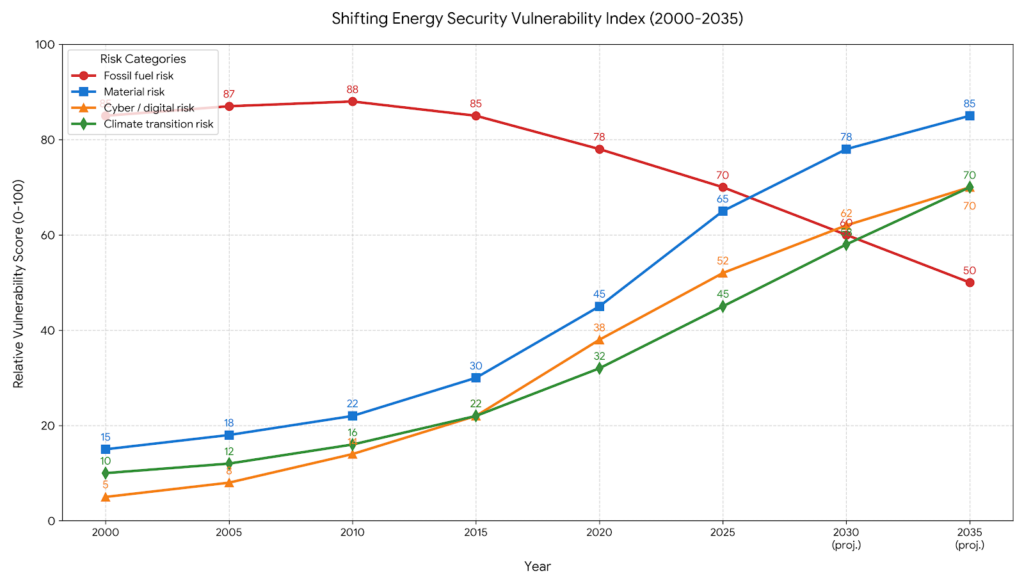
The Projected Shift in India’s Vulnerability Profile The chart below presents an illustrative vulnerability index across four dimensions from 2000 to 2035. As fossil fuel dependency gradually declines with the energy transition, material and digital dependency rises to fill its place. The data points below are directional representations grounded in IEA, IEEFA, and government data rather than a formal modelled output.
(Figure 1)
Shifting Energy Security Vulnerability Index (Illustrative, 2000-2035)
| Year | 2000 | 2005 | 2010 | 2015 | 2020 | 2025 | 2030 (proj.) | 2035 (proj.) |
| Fossil fuel risk | 85 | 87 | 88 | 85 | 78 | 70 | 60 | 50 |
| Material risk | 15 | 18 | 22 | 30 | 45 | 65 | 78 | 85 |
| Cyber / digital risk | 5 | 8 | 14 | 22 | 38 | 52 | 62 | 70 |
| Climate transition risk | 10 | 12 | 16 | 22 | 32 | 45 | 58 | 70 |
Illustrative index (0-100 scale). Directional representation based on IEA Global Critical Minerals Outlook 2024/2025, IEEFA (2024), MNRE (2025). Not a modelled output.
Cyber and Data: The Third Chokepoint
The digitalisation of India’s power grid has quietly introduced a new category of vulnerability that the classical framework has no language for. According to a Ministry of Power statement (March 2024), 30 out of 35 State Load Despatch Centres had conducted Vulnerability Assessment and Penetration Testing cybersecurity audits in the past five years. That leaves five state load dispatch centres unaudited, and the audit record itself does not address the deeper question of hardware and software provenance in grid control systems.
The significance of the 2020 Mumbai grid disruption lies less in what was definitively proven and more in what it revealed structurally. According to the cybersecurity firm Recorded Future (2021), coordinated targeting of Indian load dispatch centers was identified, with intrusions overlapping previous Indian energy sector targeting using the same infrastructure, attributed to state-backed actors. Whether or not that specific event was caused by a cyberattack, the underlying architecture was demonstrably accessible to external actors. An energy security framework that does not treat grid control systems as a strategic asset, subject to procurement vetting, software auditing, and supply chain transparency requirements, is operating with a structural blind spot.
The Transition Paradox
According to the Ministry of New and Renewable Energy (MNRE, November 2025), India achieved 51.5 percent of its total installed electricity capacity from non-fossil fuel sources, five years ahead of its 2030 Paris Agreement commitment. This is a genuine achievement. It also deepens, rather than resolves, the material dependency problem. Every gigawatt of solar capacity requires silicon, silver, and aluminum. Every EV battery requires lithium and cobalt. Every wind turbine magnet requires neodymium and dysprosium.
According to the IEA’s Global Critical Minerals Outlook 2025, the average market share of the top three refining nations for copper, lithium, nickel, cobalt, graphite, and rare earth elements rose to 86 percent in 2024, up from 82 percent in 2020. Based on current policy settings and investment trends, this share is projected to decline only marginally over the next decade. Diversification, in other words, is not happening fast enough to reduce the exposure India is accumulating through its own clean energy ambitions.
Toward a Systemic Framework
What India requires is not simply more policy on each of these dimensions separately. It needs a conceptual integration, a systemic notion of energy security that treats fuels, materials, digital infrastructure, and climate risk as interacting variables within a single analytical frame rather than as separate sectoral concerns managed by separate ministries.
Concretely, this means three things. First, the National Critical Mineral Mission should be formally incorporated within India’s energy security architecture, not merely its industrial policy architecture. Second, sector-specific cybersecurity standards for energy procurement, including source code verification requirements for imported SCADA and grid management software, should be developed with the urgency that physical infrastructure protection receives. Third, India’s NDC commitments and its 2070 net-zero target need to be stress-tested against transition risk scenarios, including the implications of global carbon border mechanisms on its energy-intensive export sectors.
India has spent five decades building institutions and doctrines to secure its oil supply. The next five decades will require building the institutional capacity to secure its electrons, its data, and the materials from which both are made. The conceptual shift must precede the institutional one. That shift has not yet been made with sufficient clarity or urgency..
Key Sources
- IEA, Global Critical Minerals Outlook 2024 and 2025. Paris: International Energy Agency.
- IEEFA, India’s Hunt for Critical Minerals (2024). Institute for Energy Economics and Financial Analysis.
- CSEP, The Role of Critical Minerals Stockpiles in India’s Energy and National Security (December 2025). Centre for Social and Economic Progress.
- Goldman Sachs Research, Resource Realism: The Geopolitics of Critical Mineral Supply Chains (2023).
- Recorded Future / Insikt Group, RedEcho: Chinese State-Sponsored Group Targets Indian Power Sector (February 2021).
- Ministry of New and Renewable Energy (MNRE), Government of India, Press Information Bureau (November 2025).
- Ministry of Power, Government of India, Cybersecurity of Power Grids, PIB Statement (March 2024).
Amrendra Pratap Singh is a Research Intern at the Centre for Public Policy Research (CPPR), India.
Views expressed by the authors are personal and need not reflect or represent the views of the Centre for Public Policy Research (CPPR).

- CPPR Media&PR
- CPPR Media&PR
- CPPR Media&PR
- CPPR Media&PR
- CPPR Media&PR
- CPPR Media&PR
- CPPR Media&PR
- CPPR Media&PR
- CPPR Media&PR
- CPPR Media&PR
- CPPR Media&PR
- CPPR Media&PR
- CPPR Media&PR
- CPPR Media&PR
- CPPR Media&PR
- CPPR Media&PR
- CPPR Media&PR
- CPPR Media&PR
- CPPR Media&PR
- CPPR Media&PR
- CPPR Media&PR
- CPPR Media&PR
- CPPR Media&PR
- CPPR Media&PR
- CPPR Media&PR
- CPPR Media&PR
- CPPR Media&PR
- CPPR Media&PR
- CPPR Media&PR
- CPPR Media&PR
- CPPR Media&PR
- CPPR Media&PR
- CPPR Media&PR
- CPPR Media&PR
- CPPR Media&PR
- CPPR Media&PR
- CPPR Media&PR
- CPPR Media&PR
- CPPR Media&PR
- CPPR Media&PR
- CPPR Media&PR
- CPPR Media&PR
- CPPR Media&PR
- CPPR Media&PR
- CPPR Media&PR
- CPPR Media&PR
- CPPR Media&PR
- CPPR Media&PR
- CPPR Media&PR
- CPPR Media&PR
- CPPR Media&PR
- CPPR Media&PR
- CPPR Media&PR
- CPPR Media&PR
- CPPR Media&PR
- CPPR Media&PR
- CPPR Media&PR
- CPPR Media&PR
- CPPR Media&PR
- CPPR Media&PR
- CPPR Media&PR
- CPPR Media&PR
- CPPR Media&PR
- CPPR Media&PR
- CPPR Media&PR
- CPPR Media&PR
- CPPR Media&PR
- CPPR Media&PR
- CPPR Media&PR
- CPPR Media&PR
- CPPR Media&PR
- CPPR Media&PR
- CPPR Media&PR
- CPPR Media&PR
- CPPR Media&PR
- CPPR Media&PR
- CPPR Media&PR
- CPPR Media&PR
- CPPR Media&PR
- CPPR Media&PR
- CPPR Media&PR
- CPPR Media&PR
- CPPR Media&PR
- CPPR Media&PR
- CPPR Media&PR
- CPPR Media&PR
- CPPR Media&PR
- CPPR Media&PR
- CPPR Media&PR
- CPPR Media&PR
- CPPR Media&PR
- CPPR Media&PR
- CPPR Media&PR
- CPPR Media&PR
- CPPR Media&PR
- CPPR Media&PR
- CPPR Media&PR
- CPPR Media&PR
- CPPR Media&PR
- CPPR Media&PR
- CPPR Media&PR
- CPPR Media&PR
- CPPR Media&PR
- CPPR Media&PR
- CPPR Media&PR
- CPPR Media&PR
- CPPR Media&PR
- CPPR Media&PR
- CPPR Media&PR
- CPPR Media&PR
- CPPR Media&PR
- CPPR Media&PR
- CPPR Media&PR
- CPPR Media&PR
- CPPR Media&PR
- CPPR Media&PR
- CPPR Media&PR
- CPPR Media&PR
- CPPR Media&PR
- CPPR Media&PR
- CPPR Media&PR
- CPPR Media&PR
- CPPR Media&PR
- CPPR Media&PR
- CPPR Media&PR
- CPPR Media&PR
- CPPR Media&PR
- CPPR Media&PR
- CPPR Media&PR
- CPPR Media&PR
- CPPR Media&PR
- CPPR Media&PR
- CPPR Media&PR
- CPPR Media&PR
- CPPR Media&PR
- CPPR Media&PR
- CPPR Media&PR
- CPPR Media&PR
- CPPR Media&PR
- CPPR Media&PR
- CPPR Media&PR
- CPPR Media&PR
- CPPR Media&PR
- CPPR Media&PR
- CPPR Media&PR
- CPPR Media&PR
- CPPR Media&PR
- CPPR Media&PR
- CPPR Media&PR
- CPPR Media&PR
- CPPR Media&PR
- CPPR Media&PR
- CPPR Media&PR
- CPPR Media&PR
- CPPR Media&PR
- CPPR Media&PR
- CPPR Media&PR
- CPPR Media&PR
- CPPR Media&PR
- CPPR Media&PR
- CPPR Media&PR
- CPPR Media&PR
- CPPR Media&PR
- CPPR Media&PR
- CPPR Media&PR
- CPPR Media&PR
- CPPR Media&PR
- CPPR Media&PR
- CPPR Media&PR
- CPPR Media&PR
- CPPR Media&PR
- CPPR Media&PR
- CPPR Media&PR
- CPPR Media&PR
- CPPR Media&PR
- CPPR Media&PR
- CPPR Media&PR
- CPPR Media&PR
- CPPR Media&PR
- CPPR Media&PR
- CPPR Media&PR
- CPPR Media&PR
- CPPR Media&PR
- CPPR Media&PR
- CPPR Media&PR
- CPPR Media&PR
- CPPR Media&PR
- CPPR Media&PR
- CPPR Media&PR
- CPPR Media&PR
- CPPR Media&PR
- CPPR Media&PR
- CPPR Media&PR
- CPPR Media&PR
- CPPR Media&PR
- CPPR Media&PR
- CPPR Media&PR
- CPPR Media&PR
- CPPR Media&PR
- CPPR Media&PR
- CPPR Media&PR
- CPPR Media&PR
- CPPR Media&PR
- CPPR Media&PR
- CPPR Media&PR
- CPPR Media&PR
- CPPR Media&PR
- CPPR Media&PR
- CPPR Media&PR
- CPPR Media&PR
- CPPR Media&PR
- CPPR Media&PR
- CPPR Media&PR
- CPPR Media&PR
- CPPR Media&PR
- CPPR Media&PR
- CPPR Media&PR
- CPPR Media&PR
- CPPR Media&PR
- CPPR Media&PR
- CPPR Media&PR
- CPPR Media&PR
- CPPR Media&PR
- CPPR Media&PR
- CPPR Media&PR
- CPPR Media&PR
- CPPR Media&PR
- CPPR Media&PR
- CPPR Media&PR
- CPPR Media&PR
- CPPR Media&PR
- CPPR Media&PR
- CPPR Media&PR
- CPPR Media&PR
- CPPR Media&PR
- CPPR Media&PR
- CPPR Media&PR
- CPPR Media&PR
- CPPR Media&PR
- CPPR Media&PR
- CPPR Media&PR
- CPPR Media&PR
- CPPR Media&PR
- CPPR Media&PR
- CPPR Media&PR
- CPPR Media&PR
- CPPR Media&PR
- CPPR Media&PR
- CPPR Media&PR
- CPPR Media&PR
- CPPR Media&PR
- CPPR Media&PR
- CPPR Media&PR
- CPPR Media&PR
- CPPR Media&PR
- CPPR Media&PR
- CPPR Media&PR
- CPPR Media&PR
- CPPR Media&PR
- CPPR Media&PR
- CPPR Media&PR
- CPPR Media&PR
- CPPR Media&PR
- CPPR Media&PR
- CPPR Media&PR
- CPPR Media&PR
- CPPR Media&PR
- CPPR Media&PR
- CPPR Media&PR
- CPPR Media&PR
- CPPR Media&PR
- CPPR Media&PR
- CPPR Media&PR
- CPPR Media&PR
- CPPR Media&PR
- CPPR Media&PR
- CPPR Media&PR
- CPPR Media&PR
- CPPR Media&PR
- CPPR Media&PR
- CPPR Media&PR
- CPPR Media&PR
- CPPR Media&PR
- CPPR Media&PR
- CPPR Media&PR
- CPPR Media&PR
- CPPR Media&PR
- CPPR Media&PR
- CPPR Media&PR
- CPPR Media&PR
- CPPR Media&PR
- CPPR Media&PR
- CPPR Media&PR
- CPPR Media&PR
- CPPR Media&PR
- CPPR Media&PR
- CPPR Media&PR
- CPPR Media&PR
- CPPR Media&PR
- CPPR Media&PR
- CPPR Media&PR
- CPPR Media&PR
- CPPR Media&PR
- CPPR Media&PR
- CPPR Media&PR
- CPPR Media&PR
- CPPR Media&PR
- CPPR Media&PR
- CPPR Media&PR
- CPPR Media&PR
- CPPR Media&PR
- CPPR Media&PR
- CPPR Media&PR
- CPPR Media&PR
- CPPR Media&PR
- CPPR Media&PR
- CPPR Media&PR
- CPPR Media&PR
- CPPR Media&PR
- CPPR Media&PR
- CPPR Media&PR
- CPPR Media&PR
- CPPR Media&PR
- CPPR Media&PR
- CPPR Media&PR
- CPPR Media&PR
- CPPR Media&PR
- CPPR Media&PR
- CPPR Media&PR
- CPPR Media&PR
- CPPR Media&PR
- CPPR Media&PR
- CPPR Media&PR
- CPPR Media&PR
- CPPR Media&PR
- CPPR Media&PR
- CPPR Media&PR
- CPPR Media&PR
- CPPR Media&PR
- CPPR Media&PR
- CPPR Media&PR
- CPPR Media&PR
- CPPR Media&PR
- CPPR Media&PR
- CPPR Media&PR
- CPPR Media&PR
- CPPR Media&PR
- CPPR Media&PR
- CPPR Media&PR
- CPPR Media&PR
- CPPR Media&PR
- CPPR Media&PR
- CPPR Media&PR
- CPPR Media&PR
- CPPR Media&PR
- CPPR Media&PR
- CPPR Media&PR
- CPPR Media&PR
- CPPR Media&PR
- CPPR Media&PR
- CPPR Media&PR
- CPPR Media&PR
- CPPR Media&PR
- CPPR Media&PR
- CPPR Media&PR
- CPPR Media&PR
- CPPR Media&PR
- CPPR Media&PR
- CPPR Media&PR
- CPPR Media&PR
- CPPR Media&PR
- CPPR Media&PR
- CPPR Media&PR
- CPPR Media&PR
- CPPR Media&PR
- CPPR Media&PR
- CPPR Media&PR
- CPPR Media&PR
- CPPR Media&PR
- CPPR Media&PR
- CPPR Media&PR
- CPPR Media&PR
- CPPR Media&PR
- CPPR Media&PR
- CPPR Media&PR
- CPPR Media&PR
- CPPR Media&PR
- CPPR Media&PR
- CPPR Media&PR
- CPPR Media&PR
- CPPR Media&PR
- CPPR Media&PR
- CPPR Media&PR
- CPPR Media&PR
- CPPR Media&PR
- CPPR Media&PR
- CPPR Media&PR
- CPPR Media&PR
- CPPR Media&PR
- CPPR Media&PR
- CPPR Media&PR
- CPPR Media&PR
- CPPR Media&PR
- CPPR Media&PR
- CPPR Media&PR
- CPPR Media&PR
- CPPR Media&PR
- CPPR Media&PR
- CPPR Media&PR
- CPPR Media&PR
- CPPR Media&PR
- CPPR Media&PR
- CPPR Media&PR
- CPPR Media&PR
- CPPR Media&PR
- CPPR Media&PR
- CPPR Media&PR
- CPPR Media&PR
- CPPR Media&PR
- CPPR Media&PR
- CPPR Media&PR
- CPPR Media&PR
- CPPR Media&PR
- CPPR Media&PR
- CPPR Media&PR
- CPPR Media&PR
- CPPR Media&PR
- CPPR Media&PR
- CPPR Media&PR
- CPPR Media&PR
- CPPR Media&PR
- CPPR Media&PR
- CPPR Media&PR
- CPPR Media&PR
- CPPR Media&PR
- CPPR Media&PR
- CPPR Media&PR
- CPPR Media&PR
- CPPR Media&PR
- CPPR Media&PR
- CPPR Media&PR
- CPPR Media&PR
- CPPR Media&PR
- CPPR Media&PR
- CPPR Media&PR
- CPPR Media&PR
- CPPR Media&PR
- CPPR Media&PR
- CPPR Media&PR
- CPPR Media&PR
