


Low-Fee Private Schools in Telangana: Rethinking Quality, Equity, and Regulation
December 29, 2025
Low fee private schools in Kerala : Regulation, Access and Quality
December 29, 2025Equity, Access, and Quality: Leveraging Low-Fee Private Schools for Outcome-Focused Education in Karnataka
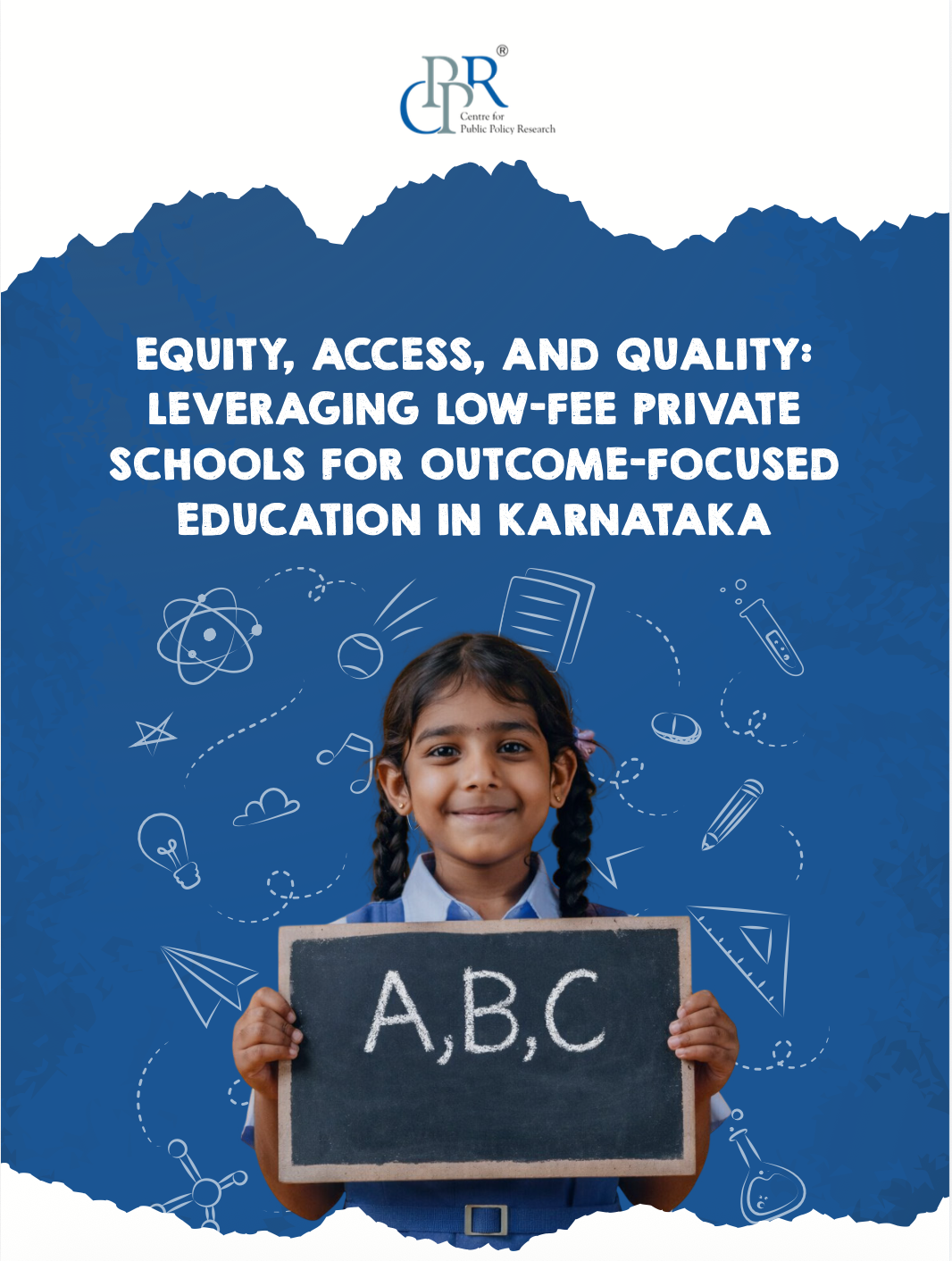
Private participation in school education has grown steadily in Karnataka over the past decade, with Low-Fee Private Schools (LFPS) forming the backbone of this expansion. These unaided institutions serve low- and lower-middle-income households, typically charging ₹400–₹3,500 per month or operating at a per-pupil expenditure lower than government schools. Karnataka now hosts more than 25,000 private schools, reflecting strong parental demand for affordable English-medium education. However, the regulatory environment remains heavily input-driven. Infrastructure and land norms, especially in urban and peri-urban areas, inflate fixed costs and divert resources away from teaching and learning. Layered administrative requirements, approvals, renewals, and inspections reduce the time and capacity school leaders can devote to academic quality. These well-meaning regulations often produce compliance-oriented behaviour rather than real improvements in learning.
Key recommendations include:
- Create a distinct category for budget schools with context-sensitive norms that retain essential safety and hygiene standards while allowing flexibility in infrastructure requirements.
- Relax contiguous land norms by permitting schools to operate from clustered buildings within a defined radius, as long as structures are safe, accessible, and used exclusively for education.
- Modify land lease and playground rules by allowing five-year renewable leases for primary schools and permitting playground access through MoUs with nearby public facilities within 500 metres.
- Allow unrecognised schools structured access to government facilities. Enable shared infrastructure models, such as school-to-school collaboration to use labs, libraries, ICT rooms, and sports facilities to help budget schools access otherwise unaffordable resources.
- Reduce the financial and administrative burden of NOC rules by lowering fees and removing short validity periods so schools can complete affiliation once all requirements are met.
- Tie recognition to measurable learning gains by linking quality assurance to year-on-year progress in teaching and learning rather than infrastructure compliance.
- Support learning improvement through mentorship programmes, instructional coaching, and curriculum/assessment support targeted at low-performing private schools.
- Promote transparent reporting of learning outcomes to strengthen accountability and enable parents to make informed school choices.
- Introduce contextual TET relaxations with structured coaching, hybrid preparation models, and more reattempts to widen the qualified teacher pool without diluting standards.
- Permit flexible, adaptive curricula to enable remedial support and differentiated instruction.
- Promote innovation via targeted grants and incentives tied to improvements in learning outcomes.
- Exempt LFPS from cost-based fee fixation and adopt a self-declaration model with parental oversight.
Implementing these reforms will shift the regulatory focus from inputs to outcomes, simplify compliance, and strengthen the capacity of LFPS to deliver quality education.
Nissy Solomon is an Hon. Trustee (Research & Projects), Dr D Dhanuraj is the Founder-Chairman and Afiya Biju is a former Research Assistant, at the Centre for Public Policy Research (CPPR), Kochi, India.
Views expressed by the authors are personal and need not reflect or represent the views of the Centre for Public Policy Research.

Nissy Solomon is Hon. Trustee (Research & Programs) at CPPR. She has a background in Economics with a master’s degree in Public Policy from the National Law School of India University, Bangalore. After graduation and prior to her venture into the public policy domain, she worked as a Geographic Information Systems (GIS) Analyst with Nokia-Heremaps. Her postgraduate research explored the interface of GIS in Indian healthcare planning. She is broadly interested in Public Policy, Economic Development and Spatial Analysis for policymaking.
-
Nissy Solomon
-
Nissy Solomon
-
Nissy Solomon
-
Nissy Solomon
-
Nissy Solomon
-
Nissy Solomon
-
Nissy Solomon
-
Nissy Solomon
-
Nissy Solomon
-
Nissy Solomon
-
Nissy Solomon
-
Nissy Solomon
-
Nissy Solomon
-
Nissy Solomon
-
Nissy Solomon
-
Nissy Solomon
-
Nissy Solomon
-
Nissy Solomon
-
Nissy Solomon
-
Nissy Solomon
-
Nissy Solomon
-
Nissy Solomon
-
Nissy Solomon
-
Nissy Solomon

Dr Dhanuraj is the Chairman of CPPR. His core areas of expertise are in international relations, urbanisation, urban transport & infrastructure, education, health, livelihood, law, and election analysis. He can be contacted by email at [email protected] or on Twitter @dhanuraj.
-
D Dhanuraj
-
D Dhanuraj
-
D Dhanuraj
-
D Dhanuraj
-
D Dhanuraj
-
D Dhanuraj
-
D Dhanuraj
-
D Dhanuraj
-
D Dhanuraj
-
D Dhanuraj
-
D Dhanuraj
-
D Dhanuraj
-
D Dhanuraj
-
D Dhanuraj
-
D Dhanuraj
-
D Dhanuraj
-
D Dhanuraj
-
D Dhanuraj
-
D Dhanuraj
-
D Dhanuraj
-
D Dhanuraj
-
D Dhanuraj
-
D Dhanuraj
-
D Dhanuraj
-
D Dhanuraj
-
D Dhanuraj
-
D Dhanuraj
-
D Dhanuraj
-
D Dhanuraj
