


Kerala Assembly Polls 2026: D Dhanuraj and G Gopakumar on shifting campaign strategies
March 31, 2026
Why Shared Mobility Services Cannot Legally Operate in Kerala: Structural Constraints within the Stage–Contract Carriage Framework
April 7, 2026Beyond the Posts: Decoding BJP and TMC’s Social Media Strategies
Setting the Context
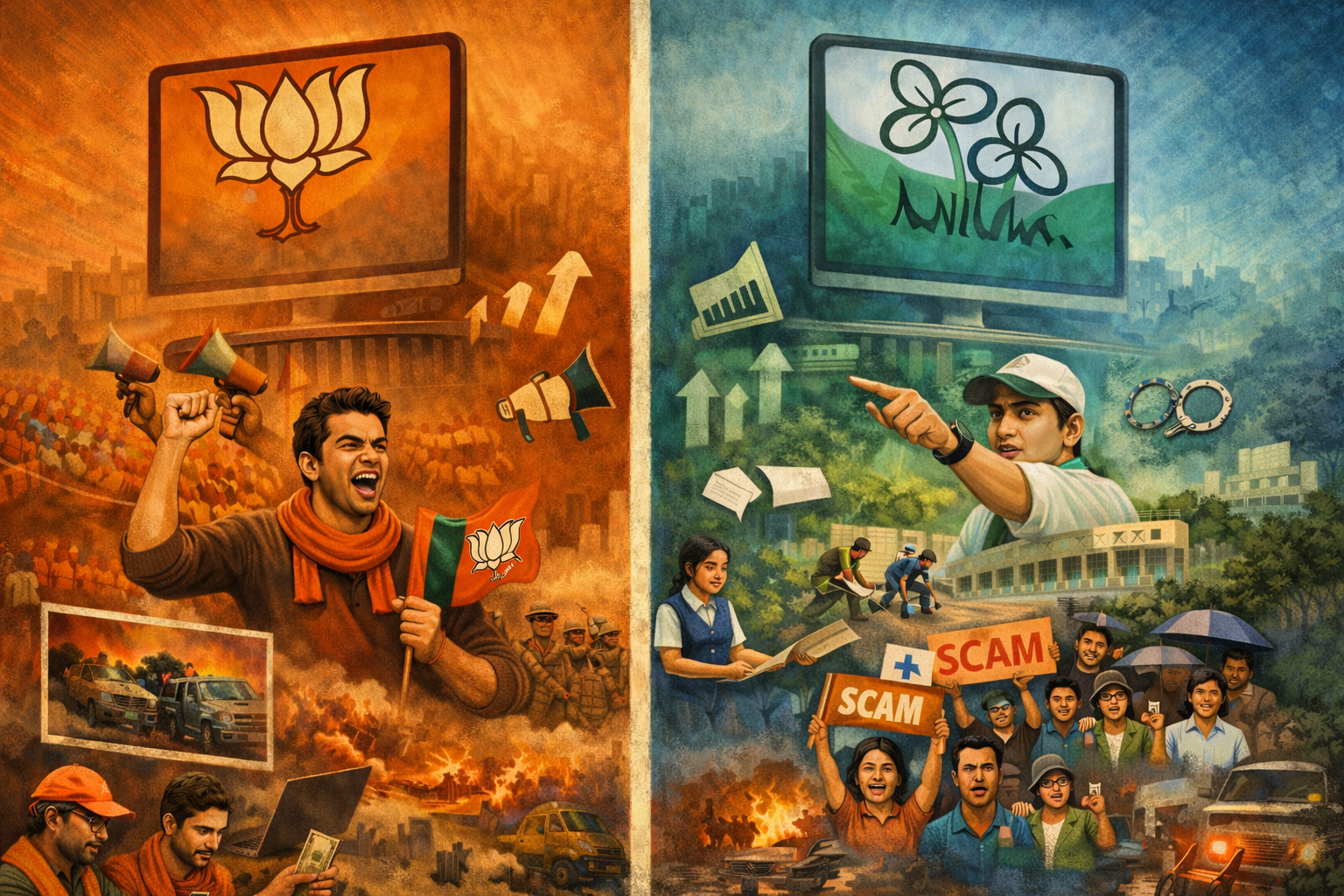
With elections increasingly shaped by digital platforms, social media has become a key site of political communication, narrative construction, and voter engagement. In the context of West Bengal, the online communication strategies of the Bharatiya Janata Party (BJP) and the Trinamool Congress (TMC) provide important insights into how parties frame issues, mobilise support, and target opponents in the run-up to elections.
As electoral competition becomes more digitally mediated, platforms such as Instagram and Twitter are no longer used merely for campaign visibility. They function as spaces where parties construct narratives, respond to opponents, shape emotional perception, and attempt to influence political opinion in real time.
This comparison seeks to understand how the BJP and the TMC differ in their social media communication ahead of elections, particularly in terms of political messaging, narrative construction, emotional framing, and strategic use of political contestation.
Scope and Approach
This study focuses on the social media communication of the BJP and TMC in West Bengal during the pre-election period from January to March 2026. The analysis is limited to content posted on the parties’ official Instagram and Twitter accounts, which were selected because they represent the most visible and politically active platforms used by both parties, while much of the content shared across other platforms tends to be repeated in a similar form. A total of 100 posts from each party were examined, covering formats such as static posts, videos, reels, and text-based creatives.
Each post was manually classified in Excel using a structured coding framework based on key dimensions such as narrative, intent, emotional appeal, tone, and opponent targeting. Additional variables related to the type and basis of political critique were also recorded. The coded dataset was then analysed comparatively using Python to identify recurring patterns and differences in the communication strategies of the two parties.
Analytical Framework
To examine these differences, the content was analysed across five major dimensions:
- Narrative Strategy: what themes or issues the parties focus on
- Intent Structure: the underlying purpose of the content
- Attack Strategy: how opposition critique is framed and deployed
- Emotional Appeal: the emotions parties attempt to evoke
- Tone Strategy: the communication style used to deliver messages
Taken together, these dimensions help move beyond surface level content and reveal the deeper strategic design of each party’s digital communication.
How BJP and TMC Communicate Differently
Narrative Strategy: Anchored vs Flexible Communication
The narrative structures of the two parties reveal a clear strategic difference.
TMC’s communication is heavily anchored in governance, with the overwhelming majority of its posts centred around governance related themes. However, this does not indicate a purely development oriented communication strategy. Instead, governance often functions as a recurring frame through which political contestation is carried out.
BJP, in contrast, displays a more balanced narrative structure, with governance and opposition critique both occupying substantial space. This suggests a more narratively flexible communication pattern in which no single theme fully dominates the party’s messaging.
For instance, a TMC post on the Banglar Yuba Sathi scheme framed youth employment support as a governance initiative, but the messaging simultaneously positioned the party as the protector of Bengali youth against an allegedly hostile Centre. In this way, governance was not presented in a purely administrative sense, but as part of a broader political contest.
Similarly, a BJP post highlighting the candidate list of TMC and alleged scam linked figures illustrates how its communication frequently combines opposition critique with governance related accusations. Rather than foregrounding its own developmental agenda, the post used corruption and candidate selection to construct a negative counter narrative against the ruling party.
Overall, TMC appears to rely on a narrative anchoring strategy, using governance as a stable communication base, while BJP follows a narrative diversification strategy, allowing greater adaptability across political contexts.
Intent Structure: Single Purpose vs. Multi-Purpose Messaging
A major difference emerges when examining the intent behind communication.
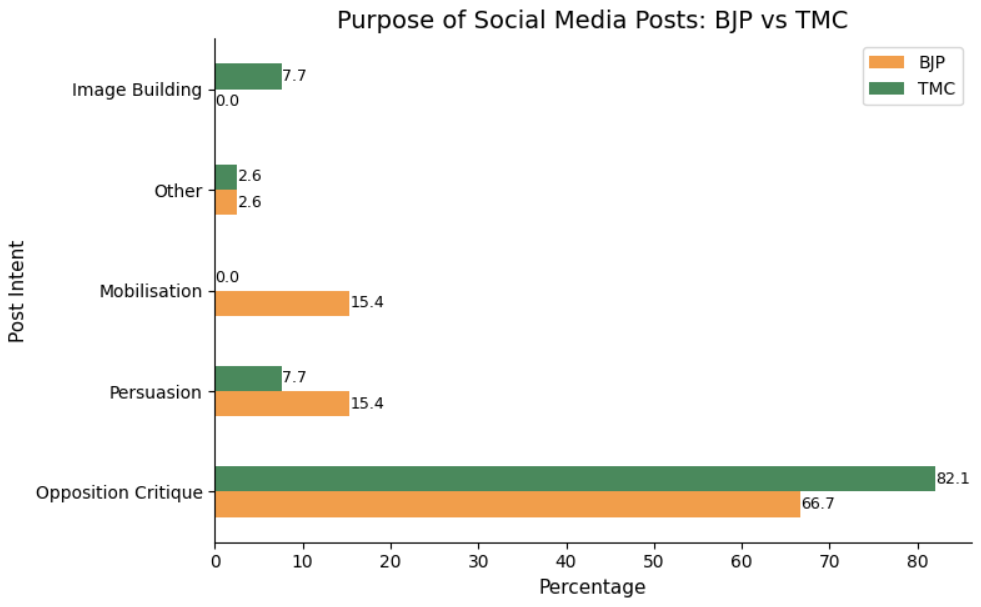
For TMC, opposition critique accounts for approximately 82.1% of the analysed posts, making it by far the dominant communicative purpose. This remains true even in posts that are framed around governance. In other words, while the party often appears to be talking about development, administration, or governance related issues, the underlying purpose of much of this content is still to criticise the opposition. This reveals a significant mismatch between narrative and intent: what appears governance oriented on the surface often functions as adversarial political messaging in practice.
BJP also shows a strong presence of opposition oriented communication, with around 66.7% of posts falling under opposition critique. However, unlike TMC, BJP’s intent structure is more distributed. In addition to critique, approximately 15.4% of the BJP’s posts are mobilisation oriented, while another 15.4% are persuasion oriented. This suggests that the BJP’s social media strategy is not limited to criticising the opponent, but also includes efforts to energise supporters and influence undecided audiences.
Overall, the comparison suggests that TMC’s communication is functionally concentrated, with a large majority of posts serving a single political purpose. BJP, by contrast, demonstrates a more multi functional communication pattern, where critique coexists with voter activation and persuasive messaging. For instance, if 100 posts were analysed, roughly 82 TMC posts would be directed toward opposition critique, compared to about 67 BJP posts, while the BJP would allocate a visibly larger share of its communication to persuasion and mobilisation.
Graph Interpretation:
This graph visually reinforces an important distinction in TMC’s communication strategy. While TMC’s posts are largely framed through governance at the narrative level, their underlying communicative intent is predominantly opposition critique. In other words, the party often appears to be talking about governance, but is frequently using that frame to politically target the opposition. BJP, while also critique oriented, shows a more distributed intent structure, with clearer space for mobilisation and persuasion. This supports the argument that TMC’s communication is more functionally concentrated, whereas BJP’s communication is more electorally diversified.
Emotional Appeal: Mobilisation vs Defensive Framing
Emotional appeal plays a central role in the communication strategies of both parties, but the kinds of emotions they rely on differ in meaningful ways.
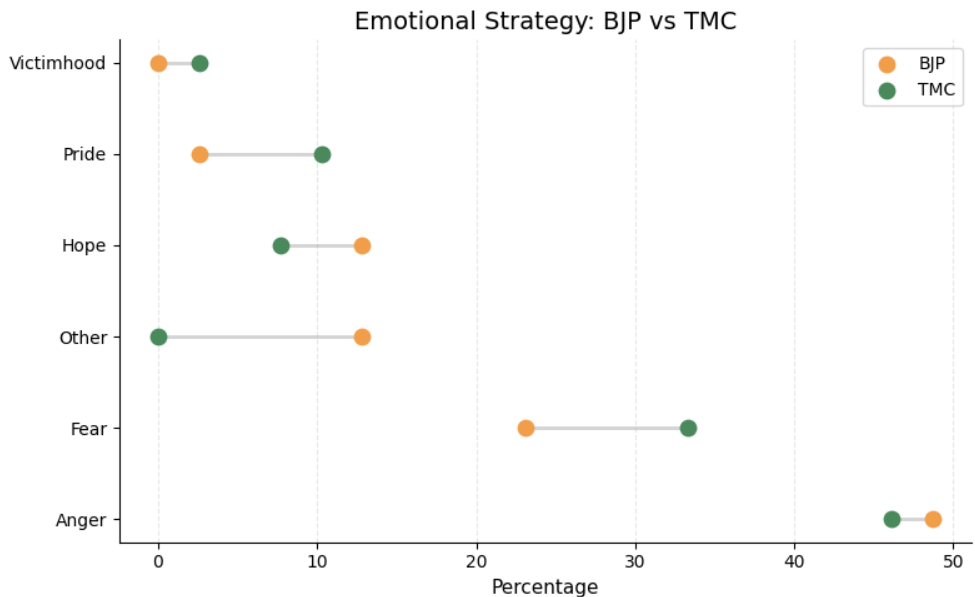
Both BJP and TMC rely considerably on anger in their emotional messaging, suggesting that confrontation and political contestation are important features of the election period social media communication. However, the difference lies in the secondary emotional layers each party builds around this core emotional frame.
BJP’s communication combines anger with elements such as hope, suggesting a mobilisation oriented emotional strategy aimed at energising and directing political support. TMC, in contrast, places greater emphasis on fear, pride, and victimhood, producing a more defensive and identity based emotional framework.
This suggests that BJP uses emotion primarily for activation and mobilisation, while the TMC uses emotion for defensive political framing and identity consolidation.
Graph Interpretation:
This graph highlights the emotional architecture of each party’s communication. While anger remains a shared foundation for both BJP and TMC, the graph clearly shows divergence in the secondary emotional strategies employed by each. BJP’s stronger presence of hope suggests a more mobilisation oriented emotional framework, while TMC’s higher use of fear, pride, and victimhood points to a more defensive and identity driven communication strategy. The graph therefore adds psychological depth to the comparative analysis and helps explain how the two parties attempt to shape voter perception differently.
Tone Strategy: Adaptive vs Consistent Communication
Tone analysis reveals another significant difference in how the two parties communicate.
BJP demonstrates notable tonal variation, combining aggressive, emotional, sarcastic, and formal styles across different posts. This suggests a strategically adaptive communication style in which tone is adjusted depending on the context and intended effect.
TMC, in contrast, is dominated by a consistently aggressive tone, with relatively less tonal variation across its content. This indicates a more concentrated confrontational style of communication.
This distinction suggests that the BJP follows a multitone adaptive strategy, while the TMC relies on a consistent aggressive communication style. In strategic terms, the BJP appears more flexible in how it delivers its messaging, whereas the TMC appears more fixed and focused in tone.
Attack and Non-Attack Strategy
Both parties rely heavily on attack based communication, but they differ in how political confrontation is framed.
BJP’s attacks are more strongly structured around governance failures, corruption, violence, and broader issue based critique. This indicates a more policy and issue oriented attack strategy. TMC’s attack patterns, by contrast, appear more contextual and event driven, often tied to specific incidents, identity based framing, or reactive political situations.
An equally important difference appears in non-attack content. When the BJP is not attacking, its communication tends to become more emotional, suggesting a deliberate effort to build voter connection outside of direct confrontation. TMC’s non-attack content, on the other hand, is more promotional, focusing on image building and political legitimacy.
Taken together, this suggests that the BJP uses attack and non-attack communication as part of a broader strategic cycle, whereas the TMC’s communication remains more tightly organised around political contestation and defence.
At a Glance: BJP vs TMC
| Dimension | BJP | TMC | Key Comparative Insight |
| Narrative Strategy | Governance ≈ 49%; Opposition Critique ≈ 44% | Governance ≈ 80% | BJP’s narrative is more balanced, while TMC is heavily governance anchored |
| Intent Structure | Opposition Critique ≈ 67%; Mobilisation and Persuasion both visible | Opposition Critique ≈ 82% | BJP uses multi purpose communication, whereas TMC remains overwhelmingly critique driven |
| Emotional Appeal | Anger dominant; Hope relatively stronger | Anger dominant; Fear, Pride, and Victimhood relatively stronger | BJP’s emotional strategy is more mobilisation oriented, while TMC’s is more defensive and identity based |
| Tone Strategy | Aggressive ≈ 55%; Emotional ≈ 30%; more tonal variation | Aggressive ≈ 65%; less tonal variation | BJP demonstrates greater tonal adaptability, while TMC relies on a more fixed confrontational style |
| Attack Structure | More governance, corruption, and violence based | More event driven and mixed attack framing | BJP’s attacks are more policy oriented, while TMC’s are more situational and reactive |
Table: Comparative Communication Models of BJP and TMC (n=100)
What This Tells Us
Bringing these findings together, two distinct communication models emerge.
TMC’s digital communication can be understood as a critique driven governance model. On the surface, its messaging appears governance based, but functionally, much of it is directed toward political attack and opposition critique. This communication is reinforced by a consistently aggressive tone and a defensive emotional framework built around fear, pride, and victimhood.
BJP, in contrast, reflects an adaptive electoral communication model. Its communication is more balanced in narrative structure, broader in intent, and more flexible in tone and emotional appeal. Rather than functioning only as a vehicle for attack, the BJP’s social media strategy appears designed to attack, mobilise, persuade, and expand support simultaneously.
Overall, the comparison suggests that the difference between the BJP and the TMC lies not only in what they communicate, but in how strategically and functionally social media is used as a political instrument ahead of elections.
Mehuli Dutta is a Research Intern at the Centre for Public Policy Research, Kochi.
Views expressed by the authors are personal and need not reflect or represent the views of the Centre for Public Policy Research.

- CPPR Media&PR
- CPPR Media&PR
- CPPR Media&PR
- CPPR Media&PR
- CPPR Media&PR
- CPPR Media&PR
- CPPR Media&PR
- CPPR Media&PR
- CPPR Media&PR
- CPPR Media&PR
- CPPR Media&PR
- CPPR Media&PR
- CPPR Media&PR
- CPPR Media&PR
- CPPR Media&PR
- CPPR Media&PR
- CPPR Media&PR
- CPPR Media&PR
- CPPR Media&PR
- CPPR Media&PR
- CPPR Media&PR
- CPPR Media&PR
- CPPR Media&PR
- CPPR Media&PR
- CPPR Media&PR
- CPPR Media&PR
- CPPR Media&PR
- CPPR Media&PR
- CPPR Media&PR
- CPPR Media&PR
- CPPR Media&PR
- CPPR Media&PR
- CPPR Media&PR
- CPPR Media&PR
- CPPR Media&PR
- CPPR Media&PR
- CPPR Media&PR
- CPPR Media&PR
- CPPR Media&PR
- CPPR Media&PR
- CPPR Media&PR
- CPPR Media&PR
- CPPR Media&PR
- CPPR Media&PR
- CPPR Media&PR
- CPPR Media&PR
- CPPR Media&PR
- CPPR Media&PR
- CPPR Media&PR
- CPPR Media&PR
- CPPR Media&PR
- CPPR Media&PR
- CPPR Media&PR
- CPPR Media&PR
- CPPR Media&PR
- CPPR Media&PR
- CPPR Media&PR
- CPPR Media&PR
- CPPR Media&PR
- CPPR Media&PR
- CPPR Media&PR
- CPPR Media&PR
- CPPR Media&PR
- CPPR Media&PR
- CPPR Media&PR
- CPPR Media&PR
- CPPR Media&PR
- CPPR Media&PR
- CPPR Media&PR
- CPPR Media&PR
- CPPR Media&PR
- CPPR Media&PR
- CPPR Media&PR
- CPPR Media&PR
- CPPR Media&PR
- CPPR Media&PR
- CPPR Media&PR
- CPPR Media&PR
- CPPR Media&PR
- CPPR Media&PR
- CPPR Media&PR
- CPPR Media&PR
- CPPR Media&PR
- CPPR Media&PR
- CPPR Media&PR
- CPPR Media&PR
- CPPR Media&PR
- CPPR Media&PR
- CPPR Media&PR
- CPPR Media&PR
- CPPR Media&PR
- CPPR Media&PR
- CPPR Media&PR
- CPPR Media&PR
- CPPR Media&PR
- CPPR Media&PR
- CPPR Media&PR
- CPPR Media&PR
- CPPR Media&PR
- CPPR Media&PR
- CPPR Media&PR
- CPPR Media&PR
- CPPR Media&PR
- CPPR Media&PR
- CPPR Media&PR
- CPPR Media&PR
- CPPR Media&PR
- CPPR Media&PR
- CPPR Media&PR
- CPPR Media&PR
- CPPR Media&PR
- CPPR Media&PR
- CPPR Media&PR
- CPPR Media&PR
- CPPR Media&PR
- CPPR Media&PR
- CPPR Media&PR
- CPPR Media&PR
- CPPR Media&PR
- CPPR Media&PR
- CPPR Media&PR
- CPPR Media&PR
- CPPR Media&PR
- CPPR Media&PR
- CPPR Media&PR
- CPPR Media&PR
- CPPR Media&PR
- CPPR Media&PR
- CPPR Media&PR
- CPPR Media&PR
- CPPR Media&PR
- CPPR Media&PR
- CPPR Media&PR
- CPPR Media&PR
- CPPR Media&PR
- CPPR Media&PR
- CPPR Media&PR
- CPPR Media&PR
- CPPR Media&PR
- CPPR Media&PR
- CPPR Media&PR
- CPPR Media&PR
- CPPR Media&PR
- CPPR Media&PR
- CPPR Media&PR
- CPPR Media&PR
- CPPR Media&PR
- CPPR Media&PR
- CPPR Media&PR
- CPPR Media&PR
- CPPR Media&PR
- CPPR Media&PR
- CPPR Media&PR
- CPPR Media&PR
- CPPR Media&PR
- CPPR Media&PR
- CPPR Media&PR
- CPPR Media&PR
- CPPR Media&PR
- CPPR Media&PR
- CPPR Media&PR
- CPPR Media&PR
- CPPR Media&PR
- CPPR Media&PR
- CPPR Media&PR
- CPPR Media&PR
- CPPR Media&PR
- CPPR Media&PR
- CPPR Media&PR
- CPPR Media&PR
- CPPR Media&PR
- CPPR Media&PR
- CPPR Media&PR
- CPPR Media&PR
- CPPR Media&PR
- CPPR Media&PR
- CPPR Media&PR
- CPPR Media&PR
- CPPR Media&PR
- CPPR Media&PR
- CPPR Media&PR
- CPPR Media&PR
- CPPR Media&PR
- CPPR Media&PR
- CPPR Media&PR
- CPPR Media&PR
- CPPR Media&PR
- CPPR Media&PR
- CPPR Media&PR
- CPPR Media&PR
- CPPR Media&PR
- CPPR Media&PR
- CPPR Media&PR
- CPPR Media&PR
- CPPR Media&PR
- CPPR Media&PR
- CPPR Media&PR
- CPPR Media&PR
- CPPR Media&PR
- CPPR Media&PR
- CPPR Media&PR
- CPPR Media&PR
- CPPR Media&PR
- CPPR Media&PR
- CPPR Media&PR
- CPPR Media&PR
- CPPR Media&PR
- CPPR Media&PR
- CPPR Media&PR
- CPPR Media&PR
- CPPR Media&PR
- CPPR Media&PR
- CPPR Media&PR
- CPPR Media&PR
- CPPR Media&PR
- CPPR Media&PR
- CPPR Media&PR
- CPPR Media&PR
- CPPR Media&PR
- CPPR Media&PR
- CPPR Media&PR
- CPPR Media&PR
- CPPR Media&PR
- CPPR Media&PR
- CPPR Media&PR
- CPPR Media&PR
- CPPR Media&PR
- CPPR Media&PR
- CPPR Media&PR
- CPPR Media&PR
- CPPR Media&PR
- CPPR Media&PR
- CPPR Media&PR
- CPPR Media&PR
- CPPR Media&PR
- CPPR Media&PR
- CPPR Media&PR
- CPPR Media&PR
- CPPR Media&PR
- CPPR Media&PR
- CPPR Media&PR
- CPPR Media&PR
- CPPR Media&PR
- CPPR Media&PR
- CPPR Media&PR
- CPPR Media&PR
- CPPR Media&PR
- CPPR Media&PR
- CPPR Media&PR
- CPPR Media&PR
- CPPR Media&PR
- CPPR Media&PR
- CPPR Media&PR
- CPPR Media&PR
- CPPR Media&PR
- CPPR Media&PR
- CPPR Media&PR
- CPPR Media&PR
- CPPR Media&PR
- CPPR Media&PR
- CPPR Media&PR
- CPPR Media&PR
- CPPR Media&PR
- CPPR Media&PR
- CPPR Media&PR
- CPPR Media&PR
- CPPR Media&PR
- CPPR Media&PR
- CPPR Media&PR
- CPPR Media&PR
- CPPR Media&PR
- CPPR Media&PR
- CPPR Media&PR
- CPPR Media&PR
- CPPR Media&PR
- CPPR Media&PR
- CPPR Media&PR
- CPPR Media&PR
- CPPR Media&PR
- CPPR Media&PR
- CPPR Media&PR
- CPPR Media&PR
- CPPR Media&PR
- CPPR Media&PR
- CPPR Media&PR
- CPPR Media&PR
- CPPR Media&PR
- CPPR Media&PR
- CPPR Media&PR
- CPPR Media&PR
- CPPR Media&PR
- CPPR Media&PR
- CPPR Media&PR
- CPPR Media&PR
- CPPR Media&PR
- CPPR Media&PR
- CPPR Media&PR
- CPPR Media&PR
- CPPR Media&PR
- CPPR Media&PR
- CPPR Media&PR
- CPPR Media&PR
- CPPR Media&PR
- CPPR Media&PR
- CPPR Media&PR
- CPPR Media&PR
- CPPR Media&PR
- CPPR Media&PR
- CPPR Media&PR
- CPPR Media&PR
- CPPR Media&PR
- CPPR Media&PR
- CPPR Media&PR
- CPPR Media&PR
- CPPR Media&PR
- CPPR Media&PR
- CPPR Media&PR
- CPPR Media&PR
- CPPR Media&PR
- CPPR Media&PR
- CPPR Media&PR
- CPPR Media&PR
- CPPR Media&PR
- CPPR Media&PR
- CPPR Media&PR
- CPPR Media&PR
- CPPR Media&PR
- CPPR Media&PR
- CPPR Media&PR
- CPPR Media&PR
- CPPR Media&PR
- CPPR Media&PR
- CPPR Media&PR
- CPPR Media&PR
- CPPR Media&PR
- CPPR Media&PR
- CPPR Media&PR
- CPPR Media&PR
- CPPR Media&PR
- CPPR Media&PR
- CPPR Media&PR
- CPPR Media&PR
- CPPR Media&PR
- CPPR Media&PR
- CPPR Media&PR
- CPPR Media&PR
- CPPR Media&PR
- CPPR Media&PR
- CPPR Media&PR
- CPPR Media&PR
- CPPR Media&PR
- CPPR Media&PR
- CPPR Media&PR
- CPPR Media&PR
- CPPR Media&PR
- CPPR Media&PR
- CPPR Media&PR
- CPPR Media&PR
- CPPR Media&PR
- CPPR Media&PR
- CPPR Media&PR
- CPPR Media&PR
- CPPR Media&PR
- CPPR Media&PR
- CPPR Media&PR
- CPPR Media&PR
- CPPR Media&PR
- CPPR Media&PR
- CPPR Media&PR
- CPPR Media&PR
- CPPR Media&PR
- CPPR Media&PR
- CPPR Media&PR
- CPPR Media&PR
- CPPR Media&PR
- CPPR Media&PR
- CPPR Media&PR
- CPPR Media&PR
- CPPR Media&PR
- CPPR Media&PR
- CPPR Media&PR
- CPPR Media&PR
- CPPR Media&PR
- CPPR Media&PR
- CPPR Media&PR
- CPPR Media&PR
- CPPR Media&PR
- CPPR Media&PR
- CPPR Media&PR
- CPPR Media&PR
- CPPR Media&PR
- CPPR Media&PR
- CPPR Media&PR
- CPPR Media&PR
- CPPR Media&PR
- CPPR Media&PR
- CPPR Media&PR
- CPPR Media&PR
- CPPR Media&PR
- CPPR Media&PR
- CPPR Media&PR
- CPPR Media&PR
- CPPR Media&PR
- CPPR Media&PR
- CPPR Media&PR
- CPPR Media&PR
- CPPR Media&PR
- CPPR Media&PR
- CPPR Media&PR
- CPPR Media&PR
- CPPR Media&PR
- CPPR Media&PR
- CPPR Media&PR
- CPPR Media&PR
- CPPR Media&PR
- CPPR Media&PR
- CPPR Media&PR
- CPPR Media&PR
- CPPR Media&PR
- CPPR Media&PR
- CPPR Media&PR
- CPPR Media&PR
- CPPR Media&PR
- CPPR Media&PR
- CPPR Media&PR
- CPPR Media&PR
- CPPR Media&PR
- CPPR Media&PR
- CPPR Media&PR
- CPPR Media&PR
- CPPR Media&PR
- CPPR Media&PR
- CPPR Media&PR
- CPPR Media&PR
- CPPR Media&PR
- CPPR Media&PR
- CPPR Media&PR
- CPPR Media&PR
- CPPR Media&PR
- CPPR Media&PR
- CPPR Media&PR
- CPPR Media&PR
- CPPR Media&PR
- CPPR Media&PR
- CPPR Media&PR
- CPPR Media&PR
- CPPR Media&PR
- CPPR Media&PR
- CPPR Media&PR
- CPPR Media&PR
- CPPR Media&PR
- CPPR Media&PR
- CPPR Media&PR
- CPPR Media&PR
- CPPR Media&PR
