

Articles

D Dhanuraj on Kerala’s Changing Electoral Landscape
June 18, 2026
Sailing the MAHASAGAR Together India-Maldives Relations
June 22, 2026Not another subsidy package — Kerala needs a blueprint for 2030
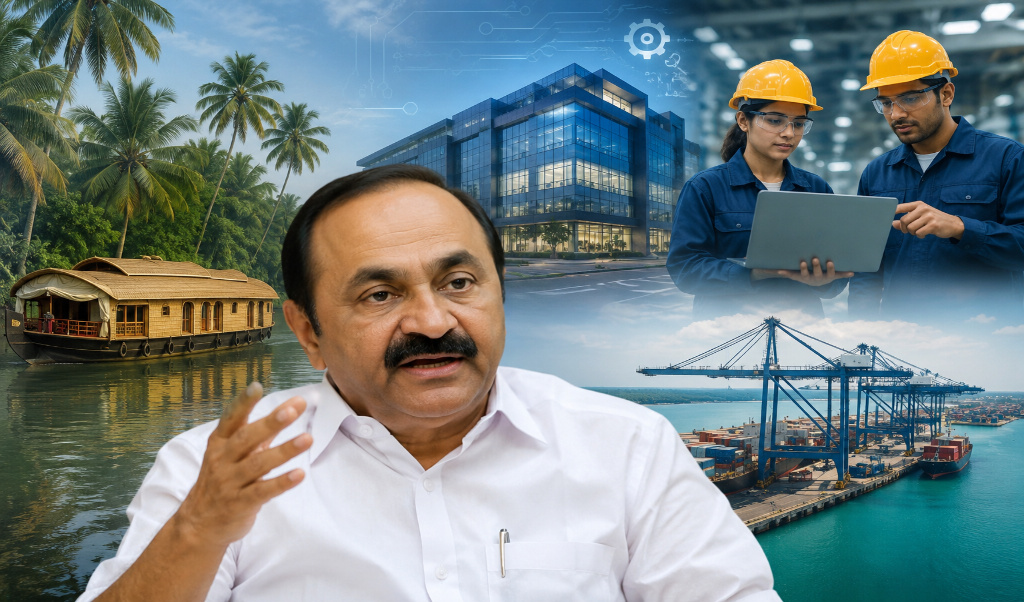
As Kerala’s new government presents its first Budget, this article argues that the state cannot compete through subsidies alone. Instead, Kerala must build a credible investment ecosystem based on regulatory certainty, labour flexibility, innovation, industry-academia collaboration, and quality of life to attract global firms and retain its talent. The piece outlines a blueprint for a more competitive, knowledge-driven Kerala by 2030.
As the V D Satheesan government presents its first Budget tomorrow, it inherits a paradox few Indian states present. Kerala’s most talented young people build their careers in Bengaluru, Dubai, and Dublin — anywhere but Kerala! Kerala produces world-class human capital and exports it, and has never built the firms that could employ this talent locally at scale.
Kerala does not lack investment summits or industry-supporting policies. It has a credibility deficit.
Global capital reads the state through decades of perception — militant unionism, nokku kooli (the infamous gawking fees demanded by headload workers), and projects stalled by agitation. The number of industrial disputes has decreased significantly, but public perception of the situation has deteriorated. Maharashtra and Gujarat can outbid Kerala on subsidies and land; Kerala, its debt consuming more than a third of its income, cannot win that auction. What it can is still produce regulatory quality, speed, and predictability.
The government should legislate a modern flexibility framework: full recognition of flexible employment; clear rules for gig and remote work; and permission for firms with fewer than 300 employees to retrench with negotiated compensation. Pair these proposals with fast-track labour courts and arbitration to settle disputes within six months.
Crucially, Kerala must signal openness to technology and global talent replacing conventional labour wherever the change raises productivity and incomes; a smaller, higher-skilled, better-paid workforce serves Kerala better than a larger one. Flexibility with dignity is not a concession to capital; it is the precondition for the formal, high-wage jobs Kerala’s graduates now seek elsewhere.
Kerala’s land prices are among India’s highest relative to income, with no cheap periphery. It cannot conjure a thousand contiguous acres near Hosur and should stop pretending otherwise. The solution is to focus on vertical competition: having land banks that are pre-approved with clear titles, high Floor Space Index (FSI), a completely digital registry, and a shift towards sectors that require less land and are more knowledge-based — like technology, financial services, design, and biotech — where the skills of Kerala’s people are the true value.
The single-window system needs statutory teeth: a 30-day clock after which clearances stand deemed approved, dedicated managers for large investments, and risk-based digital inspections replacing the predatory departmental visit. Equally important is exit: a firm that can wind up online within 30 days risks capital far more readily than one that fears being trapped. Easy closure is the most underrated investment incentive in India.
Every incentive must be published, time-bound, and linked to jobs, capital and exports. Case-by-case negotiation through ministers’ offices is not industrial policy; it is patronage. Here lies the deeper shift: Kerala must stop being the provider of industry — through KSIDC, KINFRA, and a graveyard of loss-making enterprises — and become its regulator and enabler, judged by the firms it attracts rather than the assets it owns.
Kerala’s sharpest advantage is its universities and research talent, yet industry and academia remain strangers. It should fund formal industry-academia linkages — joint laboratories, sponsored chairs, doctoral programmes — backed by public R&D grants, shared innovation infrastructure, and IP support that cut the cost of frontier work for firms that locate here. This is the offer no rival state can match: not cheaper land, but a state that co-invests in innovation.
Kerala should declare openly that it is building for higher-end technologies, that it will absorb global talent rather than guard against it, and guarantee the conditions — schools, healthcare, housing, connectivity — that make world-class researchers stay. Talent follows not subsidy but the quality of life and the density of ideas.
Rules on paper already exist; Vizhinjam’s eight-year ordeal is what investors remember. These reforms must be enacted by statute, not executive order, so they survive a change of government. It should spend its political capital landing two or three demonstrative global investments — protected, fast-tracked, and visibly scaled — because nothing rewrites a 40-year narrative faster than a conspicuous success. An anchor investor disrupts this circular trap, providing Kerala’s emigrant engineers with a compelling reason to return and advance their careers at home.
The people of Kerala long ago achieved first-world capabilities; its regulatory State never matched their ambition. The blueprint for Kerala 2030 is not another subsidy package — it is a decision to compete based on trust, speed, rules, and ideas, and to let the world’s most productive firms discover what Kerala’s emigrants have always known about its people.
This article was originally published on 18 June 2026 in Deccan Herald. Click here to read the article.
Dr D Dhanuraj is the Chairman at the Centre for Public Policy Research (CPPR), Kochi, Kerala, India.
Views expressed by the authors are personal and need not reflect or represent the views of the Centre for Public Policy Research (CPPR).

Dr Dhanuraj is the Chairman of CPPR. His core areas of expertise are in international relations, urbanisation, urban transport & infrastructure, education, health, livelihood, law, and election analysis. He can be contacted by email at [email protected] or on Twitter @dhanuraj.
