
Articles

What Kerala’s New Government Must Prioritise for Women?
May 28, 2026
What Kerala’s New Government Must Prioritise for Women?
May 31, 2026India must retire the permit raj in public transport
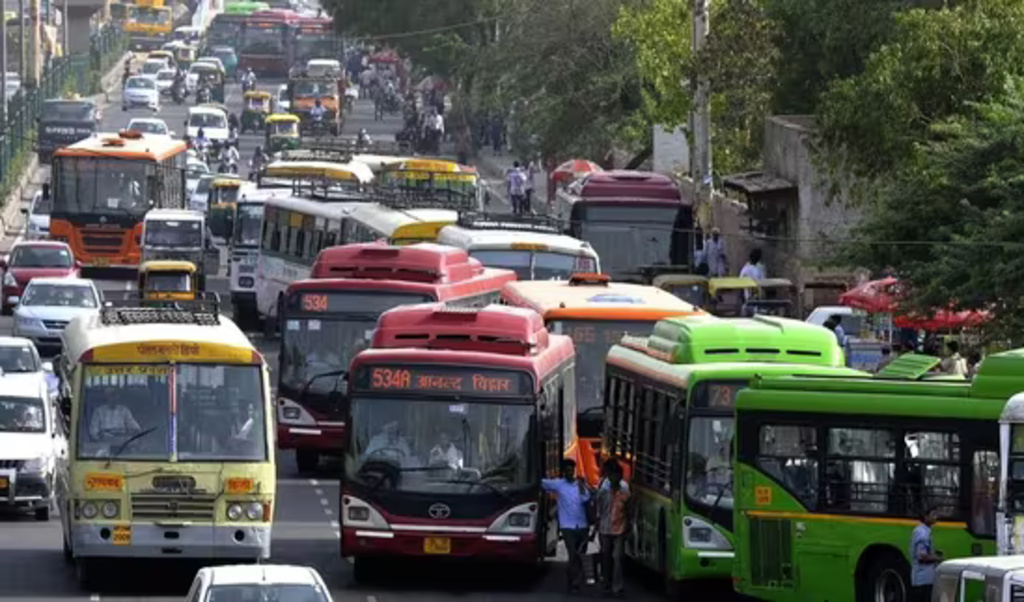
In a recent development, the Union Ministry of Housing and Urban Affairs (MoHUA) has initiated a multi‑state survey across 13 Indian states to examine why urban residents continue to prefer private vehicles to public transport. The survey will assess people’s willingness to walk, cycle, use buses and metro rail, or live closer to transit hubs and will also gather feedback on public trust in the government’s urban planning projects, including concerns over transparency and implementation. The renewed emphasis on mobility outcomes brings into focus a more pressing question: Why does India’s public transport system continue to lag behind private vehicles in appeal, despite sustained investment?
For decades, the Indian bus transport system has been under the heavy grip of the license-permit raj. While MoHUA is working to understand the reasons for low traction in bus transport, one could say that the fundamentals of the regulatory system are archaic and outdated. It has resulted not only in huge supply-side constraints but also in reduced efficiency and quality of the services commuters expect. The Indian commuter has been a victim of a linguistic trap set in 1939. In the corridors of Regional Transport Offices (RTOs), the movement of millions is governed by two archaic phrases: stage carriage and contract carriage. These are not merely administrative categories; they are the invisible walls that prevent Indian public transport from achieving the efficiency and scale seen in the world’s most mobile cities. To truly modernise, India must scrap this artificial binary and transition toward a unified, service-oriented regulatory framework.
Buses that operated as public transport, picking up and dropping off passengers at multiple stops, were classified as stagecoaches. Over time, these services became closely associated with State control and, in many cases, State monopolies. Contract carriages, by contrast, were permitted only if they functioned as private hires and did not compete with regular route-based services, such as stage carriages.
The distinction was born from the Motor Vehicles Act of 1939. Under British rule, the primary objective was to shield the state-run railways from competition posed by emerging private bus operators. The government needed to ensure that private buses didn’t erode the revenue of the State’s massive railway investments. The result was a regulatory system that divided passenger transport into separate categories.
Independent India inherited this framework almost unchanged. The Motor Vehicles Act of 1988 modernised language but preserved the underlying logic. This created a protectionist permit raj. In most Indian states, if a private entrepreneur wants to operate a high-quality, air-conditioned bus service along a busy commuter route, they are often denied a stage carriage permit to protect loss-making state transport undertakings. But if those operators use a contract carriage permit to run app-based or shared passenger services, they can be impounded for permit violation.
This permit system has led to several unintended, stifling consequences. Urban populations have surged, but bus availability has not kept pace. Most STUs are financially strained and unable to expand their fleets at the required scale. Instead of enabling private investment to bridge the gap, the permit system has artificially restricted supply. The commuter pays the price through overcrowding, poor connectivity, and growing dependence on private vehicles.
At the same time, India’s streets are full of illegal para-transit systems. Share-autos, informal minibuses, and pooled mobility services have emerged because formal public transport has failed to meet demand. These services function like stage carriages but often operate under contract permits or in regulatory grey zones. Here again, the contract carriage vs. stage carriage rules compound the problem. Since they are technically illegal or semi-legal, cities cannot fully integrate them into route planning, digital payment systems, safety standards, or data-driven transport networks.
Innovation, too, is trapped in legal limbo. Bus-pooling startups and technology-enabled shared transport systems represent precisely the kind of efficiency Indian cities need—flexible routing, higher occupancy, and optimized resource use. Yet they are treated as regulatory offenders because they don’t fit into the 1939 definition of a bus.
Global experience suggests that when cities stop regulating permit types and start regulating service standards, efficiency skyrockets. The UK’s experience is the most telling. Outside of London, the 1985 Transport Act abolished the need for service-specific licences, allowing any operator to ply a route provided they met safety standards. While this led to mixed outcomes in rural areas, urban centres experienced a substantial increase in service frequency and competition. More successfully, Singapore moved away from rigid, permit-based monopolies toward a model in which the entire city is treated as a unified network. By blurring the lines between ‘who owns the bus?’ and ‘who plans the route,’ they enabled express and feeder services to operate seamlessly, increasing fleet capacity.
The future of public transport cannot be built around whether a vehicle is classified as a stage or contract carriage. It must be built around service quality, accessibility, safety, and efficiency. The country needs a unified Public Service Vehicle framework that replaces the existing binary with a flexible licensing regime. The reform should follow a three-pronged strategy:
- Decoupling the vehicle from the route: A bus should be allowed to act as a school bus in the morning and a public commuter bus during peak hours. Removing the permit barrier would immediately increase the supply of buses without government investment.
- Legalising shared mobility: Legalising shared mobility will ensure seamless transportation in the routes where the big vehicles are not compatible to serve due to the narrow lanes or the lack of financial feasibility. This will address the issues with profit vs non-profit routes. Legalisation will enhance the research and Innovation in vehicle designs and efficiency.
- Open market access with standards: Instead of limiting how many buses can ply a route, the government should regulate how they ply. Governments should focus on emissions, safety, accessibility, interoperability, and data-sharing requirements, not on artificially limiting who can operate.
The logic of 1939 belonged to a world of colonial control, steam-era economics, and protected monopolies. But India in 2026 faces entirely different challenges: rapid urbanisation, climate pressures, rising vehicle ownership, and the urgent need for mass mobility solutions. The Permit Raj has outlived its purpose. It is time India allowed public transport to move forward instead of forcing it to remain parked in history.
Click here to read the article on The Hindustan Times
Dr D Dhanuraj is the Founder-Chairman at the Centre for Public Policy Research (CPPR), Kochi, Kerala, India.
Views expressed by the authors are personal and need not reflect or represent the views of the Centre for Public Policy Research (CPPR).

Dr Dhanuraj is the Chairman of CPPR. His core areas of expertise are in international relations, urbanisation, urban transport & infrastructure, education, health, livelihood, law, and election analysis. He can be contacted by email at [email protected] or on Twitter @dhanuraj.
