
Reports & Papers

Kochi’s Traffic Needs More Than New Roads: D Dhanuraj
August 12, 2026
Event Report — Consultation on Shared Mobility and Intermediate Public Transport (IPT) in Karnataka | CPPR
August 20, 2026Is Kochi Ready for Green Bonds? A Regulatory, Fiscal and Institutional Assessment
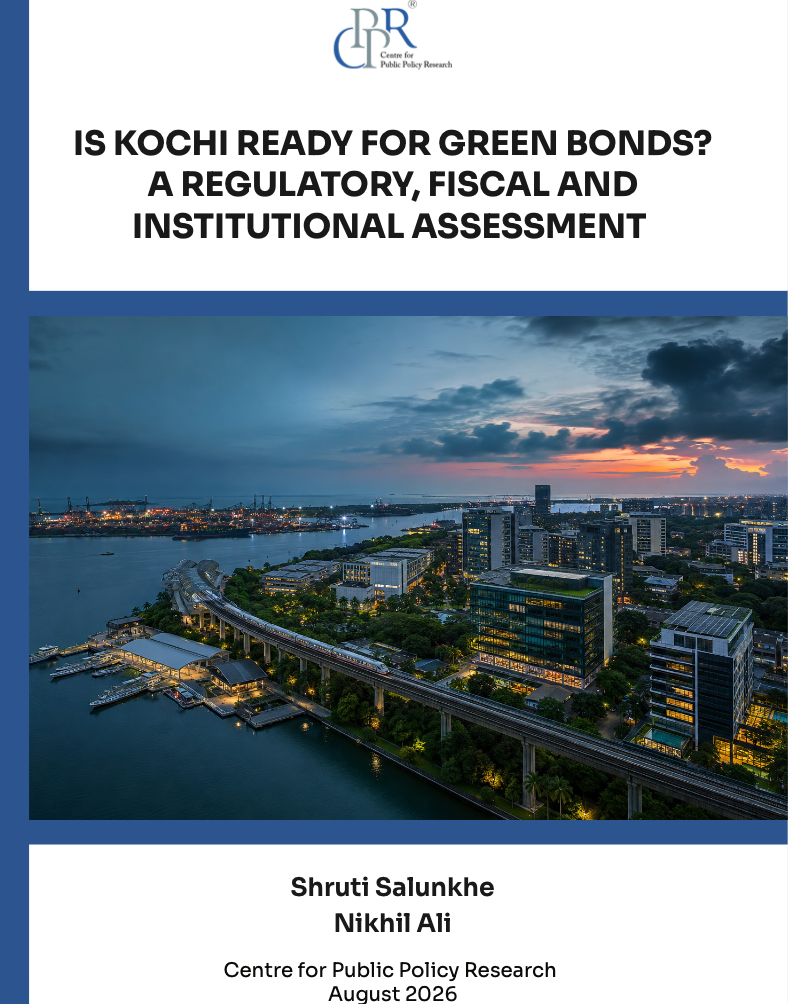
As Indian cities face growing infrastructure and climate-financing needs, municipal green bonds offer a potential pathway to mobilise long-term capital for sustainable and climate-resilient urban development. For Kochi, a low-lying coastal city increasingly exposed to flooding, heat stress and climate risks, access to such financing could play an important role in addressing its infrastructure needs.
This paper assesses whether the Kochi Municipal Corporation (KMC) is ready to enter the municipal green bond market. Using a three-pillar framework covering regulatory, financial and institutional readiness, the study examines KMC’s legal and borrowing framework, fiscal position, revenue capacity, debt profile, service delivery performance, governance systems and institutional preparedness. It also draws on the experience of Indian municipalities that have successfully issued green bonds to identify the conditions required for market access.
The assessment finds that KMC is closer to green bond issuance than its current institutional preparedness may suggest, but significant gaps remain. Regulatory readiness emerges as the strongest pillar, while financial readiness is moderate and institutional readiness remains the weakest. Strengthening own-source revenue, improving service delivery, clarifying jurisdictional responsibilities, completing GIS systems, initiating credit rating processes and establishing a Debt Service Reserve Fund (DSRF) are identified as critical steps towards market readiness.
The paper argues that green bond issuance should not be treated as a one-time financing exercise. Instead, KMC needs a strategically sequenced preparatory phase supported by stronger financial and institutional capacity. The study recommends, among other measures, establishing a dedicated Capital Markets Cell within KMC’s finance department to build expertise in debt and capital markets.
Beyond Kochi, the paper contributes a replicable city-level Green Bond Readiness Framework that can help other Indian Urban Local Bodies assess their preparedness for accessing capital markets. The central message is that bond readiness is multidimensional—and the weakest pillar can ultimately determine whether a municipality can successfully enter the market.
Shruti Salunkhe was a Research Intern at the Centre for Public Policy Research (CPPR), Kochi, Kerala, India.
Nikhil Ali is a Senior Research Associate (Urban) at the Centre for Public Policy Research (CPPR), Kochi, Kerala, India.
Views expressed by the authors are personal and need not reflect or represent the views of the Centre for Public Policy Research.

Nikhil Ali is a Senior Research Associate (Urban) at the Centre for Public Policy Research. He completed his graduation in Civil Engineering from Sree Narayana College of Engineering and is a seasoned Civil Engineer with working experience at Tata Realty and Infrastructure Ltd. With a passion for urban planning, he acquired his master's degree in Urban Planning from Hindustan Institute of Technology and Science, Chennai. His expertise lies in Urban Mobility, land use planning/analysis, and water-sensitive planning.
