Articles

What Kerala’s New Government Must Prioritise for Women?
May 31, 2026
Kerala Girl Student Migration Study
June 5, 2026Free bus rides for women will win a news cycle. States must aim to build transit networks that last
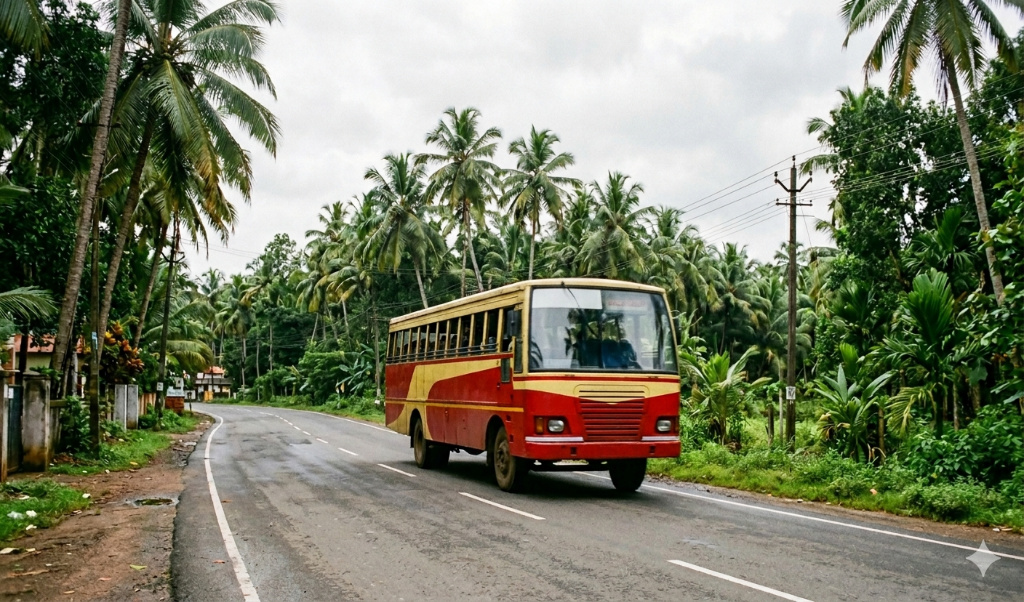
Kerala’s public transport sector is at a crossroads. With the new government scrapping the SilverLine project, proposing a regional rapid-rail corridor, and announcing free KSRTC bus travel for women under the ‘Indira Guarantee’, the policy conversation is once again dominated by headline-grabbing schemes rather than structural fixes. This piece argues that welfare announcements and subsidy-driven interventions—however well-intentioned—cannot substitute for evidence-based reform. What the state truly needs is an independent regulatory authority that levels the playing field for all operators, puts commuter needs at the centre, and builds a public transport network designed to last beyond the next news cycle.
Kerala’s public transport debate is back, on familiar terms. The new government has scrapped the SilverLine, floated a regional rapid-rail corridor in its place, and promised free KSRTC travel for women from June 15 under the ‘Indira Guarantee’. Missing from the new transport minister’s vision is the one input a transport system runs on — verified data on where demand sits, who is being served, and at what cost.
The Kerala State Road Transport Corporation (KSRTC) has been a fiscal white elephant for decades, yet it remains the gravitational centre of every policy conversation. Whatever their intentions, a transport minister is sooner or later pressed to bat for it. The result is a discourse that is murky by design, where the question is rarely ‘what do commuters need?’, and almost always ‘how do we keep KSRTC running?’
The free-travel scheme shows the trap. KSRTC’s estimates put the monthly bill between ₹57 crore for ordinary services and ₹110-112 crore if the entire fleet is covered — a cost the corporation admits it cannot meet without treasury support. Telangana’s Mahalakshmi scheme and Karnataka’s Shakti point to where this ends: ridership surges, the subsidy balloons, and the structural question of who should run the buses, and to what standard, is quietly deferred. Welfare is announced; reform is postponed.
Meanwhile, the network of private bus operators has been hollowed out. Kerala’s private bus fleet has collapsed from ~35,000 vehicles to under 7,300, leaving the state at about 0.50 buses per 1,000 people. This is not a failure of demand. It is the predictable result of a licensing architecture inherited from the Motor Vehicles Act, 1939.
What Kerala needs is not another rescue package but an independent umpire; say, a statutory Kerala Public Transport Regulatory Authority (KPTRA) — an arm’s-length body that licenses, sets standards, and audits the sector on evidence, rather than on the balance sheet of one operator. KSRTC would become an important stakeholder, not the oligopolist that writes the rules.
The KPTRA should dismantle the stage/contract binary and issue a single, unified permit. KSRTC or private operators could bid for routes against identical safety, emission, and frequency benchmarks. The State’s job is to guarantee the quality of the journey. Profitable corridors can be franchised through competitive bidding; the UK’s 1985 deregulation and Singapore’s bus-contracting model offer templates worth adapting.
A standing analytics function should map underserved corridors, rationalise frequencies, and end the over-saturation of a handful of profitable routes — replacing political allocation with published, contestable data. The authority should release position papers, invite public comment, and put its evidence on the record, so that demand, public finance, and service delivery are debated in the open.
At the local level, the framework should licence micro-entrepreneurs to run flexible, shared services that fill last-mile gaps. For long-distance corridors, it should attract well-capitalised operators capable of fielding high-capacity, premium fleets. In congested cities, structured public-private partnerships can deliver Bus Rapid Transit with dedicated lanes and signal priority.
Auto-rickshaws, shared autos, and mini-buses should be recognised as core public transport and brought under targeted permits. A common mobility card, open-data scheduling and unified ticketing should be mandatory for every operator, giving commuters seamless multi-modal trips. The authority should also revive the metropolitan transport bodies envisaged under the KUMTA Act, syncing city plans with statewide standards.
The deeper shift is one of identity. The government must stop behaving as the provider of transport and start acting as its regulator — judging the sector by outcomes, not intentions, and by what commuters experience, not what one corporation’s books require. Free rides and rail headlines win a news cycle; a level playing field, fairly umpired, is what builds a transit network that lasts.
True reform is not a choice between an expensive public monopoly and an unregulated free-for-all — it is the decision to referee the road rather than to own it.
This article was originally published on 03 June 2026 in Deccan Herald. Click here to read the article.
Dr D Dhanuraj is the Founder-Chairman at the Centre for Public Policy Research (CPPR), Kochi, Kerala, India.
Views expressed by the authors are personal and need not reflect or represent the views of the Centre for Public Policy Research (CPPR).

Dr Dhanuraj is the Chairman of CPPR. His core areas of expertise are in international relations, urbanisation, urban transport & infrastructure, education, health, livelihood, law, and election analysis. He can be contacted by email at [email protected] or on Twitter @dhanuraj.
