
Articles

Kerala’s Plantation Crisis: Why Reforms Can’t Wait!
April 29, 2026
Falling Paddy, Rising Crisis: A New Future with Aquaculture
April 30, 2026The Shadow of the Spark: Why Kerala’s Fireworks Regulations are Backfiring
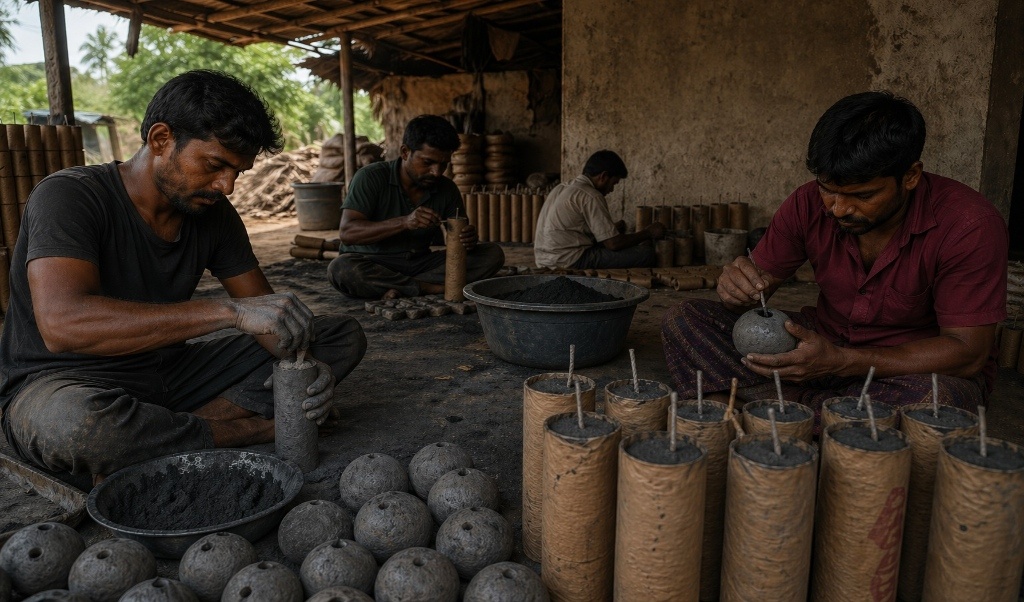
The catastrophic blast in Thrissur in April 2026 was not merely an industrial accident; it was a predictable outcome of a regulatory philosophy that prioritizes prohibition over partnership. As the smoke cleared, the familiar cycle of “Stop Memos,” police raids, and high-level inquiries resumed. However, a deeper analysis suggests that the very stringency of Kerala’s firecracker laws is fueling the volatility it seeks to suppress. By creating a compliance trap, the state has inadvertently traded a regulated formal sector for a dangerous, invisible, and growing informal market.
The Paradox of Over-Regulation
The current regulatory framework in Kerala is a labyrinth of central and state mandates. Between the Petroleum and Explosives Safety Organisation (PESO), the District Administration, the Fire & Rescue Services, and the Police, a manufacturer must navigate a dozen No Objection Certificates (NOCs) to operate legally. On paper, these rules governing everything from lightning arresters to chemical compositions are scientifically sound. In practice, they function as a Compliance Tax that small-scale, traditional artisans simply cannot afford.
When the cost of legality, such as buying large tracts of land to meet mandatory safety distances or investing in expensive Green Cracker formulations, exceeds the economic reality of a seasonal business, the industry does not vanish. It shifts from the registered factory with a fire hydrant to the suburban basement, the makeshift paddy-field hut, and the residential kitchen. This is the Radioactive unintended consequence of over-regulation: the displacement of risk from controlled environments into the heart of the community.
The Thrissur Blast: A Case Study in Informal Growth
The Thrissur tragedy revealed the anatomy of this shadow industry. Because formal manufacturing has become so legally fraught, the sector has fragmented into an assembly model. In this hidden supply chain, raw gunpowder is mixed in one location, fuses are rolled in another, and the final assembly happens in temporary sheds just days before a festival.
These sites are ghosts on the administrative map. They lack the most basic safety infrastructure, such as humidity-controlled storage or static-discharge pads. Furthermore, because these units operate under the fear of police raids, they often work at high speeds, during night hours, or in cramped spaces—all factors that exponentially increase the risk of a spark becoming a disaster. When a blast occurs in this informal sector, the lack of emergency access roads (often a reason why they were denied a license in the first place) prevents fire tenders from reaching the site in time, turning a localized fire into a mass casualty event.
The Policing-First Failure
A critical flaw in the current system is the reliance on the police as the primary auditors of chemical safety. A police officer is trained in law enforcement, not pyrotechnic chemistry. When the state mandates that police verify chemical samples or enforce decibel limits, it often leads to a permit-raj culture characterized by corruption or arbitrary “Stop Memos.”
These memos often come during the peak festival season, the only time artisans can turn a profit. Faced with the choice between financial ruin and illegal production, many choose the latter. This creates a negative feedback loop: more illegal activity leads to more stringent (but poorly executed) laws, which in turn drives more artisans underground.
The Way Forward:
To break this cycle, Kerala must pivot from a punitive model to a facilitative one. The goal should be to make safety the most economically viable path for the traditional pyrotechnician.
1. Creating Safety Clusters:
The state, via agencies like KSIDC, should establish “Firework Industrial Parks.” These parks would offer shared, PESO-compliant infrastructure—specialized bunkers, automated mixing plants, and onsite fire stations. By renting a plug-and-play safe space, a small artisan can comply with safety distances without needing to own five acres of land.
2. Centralized Chemical Procurement:
The government can eliminate the use of volatile, black-market chemicals (like potassium chlorate) by setting up a central agency to bulk-buy and distribute standardized, Green chemical kits. This ensures that the raw materials entering the market are stable and tested.
3. Third-Party Audits & Insurance:
We must decouple safety from policing. Moving toward a system of Certified Safety Auditors and mandatory high-value insurance would create a market-driven incentive for safety. Insurance companies, with their own capital at risk, will conduct far more rigorous and technical audits than a local bureaucrat.
4. Professionalizing the Craft:
We must treat traditional pyrotechnicians as skilled artists rather than potential criminals. Establishing a State Institute of Pyrotechnics to provide certification in modern safety protocols and PPE usage would bridge the gap between traditional skills and modern safety science.
Conclusion
The Thrissur blast is a sobering reminder that we cannot ban our way to safety. As long as there is a cultural demand for fireworks, there will be a supply. Our choice is between a supply that is formal, visible, and insured, or one that is informal, hidden, and lethal. True reform lies not in adding more layers to the labyrinth of licenses, but in building the infrastructure that allows our traditional artisans to step out of the shadows and into the light of a safe, regulated industry. Only then can we ensure that our festivals remain a celebration of life, rather than a mourning of its loss.
Dr D Dhanuraj is the Founder-Chairman at Centre for Public Policy Research (CPPR).
Views expressed by the authors are personal and need not reflect or represent the views of the Centre for Public Policy Research (CPPR).

Dr Dhanuraj is the Chairman of CPPR. His core areas of expertise are in international relations, urbanisation, urban transport & infrastructure, education, health, livelihood, law, and election analysis. He can be contacted by email at [email protected] or on Twitter @dhanuraj.
