

Articles

Xi’s visit and the path toward normalcy in India-China relations
September 21, 2026
BRICS and the Global South: Between Unity and Contradiction
September 22, 2026Market for Disagreement and Road Rage in Kerala
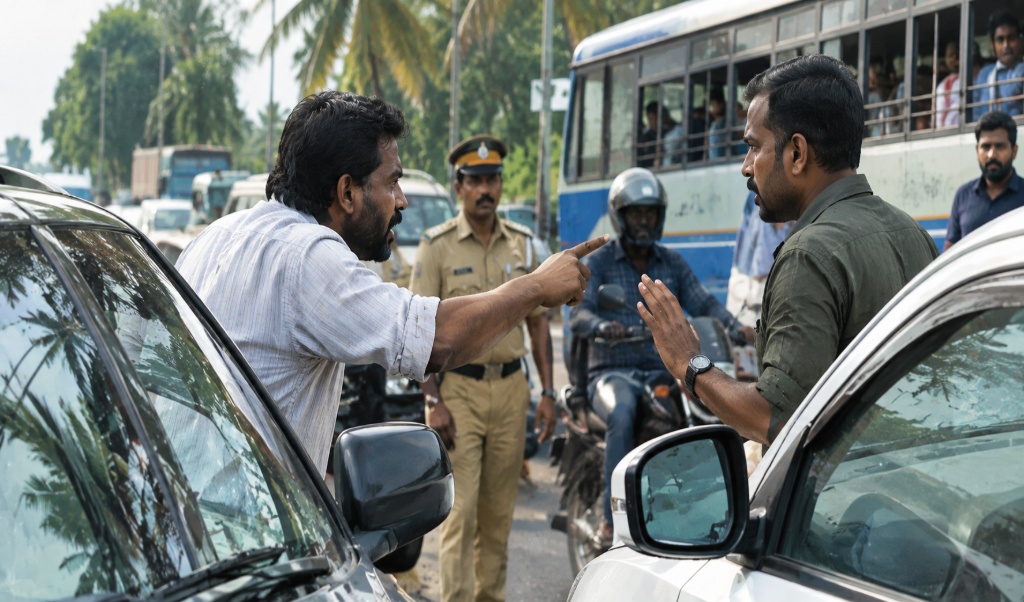
What happens when a traffic disagreement turns into something more? Market for Disagreement and Road Rage in Kerala looks beyond traffic violations and fines to ask why everyday disagreements on Kerala’s roads escalate into confrontation—and whether better systems, technology and incentives can help prevent them before they turn violent.
From AI cameras and public transport to congestion pricing and even the role of bystanders, the article explores an unconventional question: can the “market for disagreement” be redesigned to make Kerala’s roads safer?
Introduction
The reported number of traffic violations in Kerala was one crore in 20251. If there are approximately 2 crore vehicles in the State, the probability that a specific vehicle gets involved in a traffic violation is nearly 50 percent per year assuming uniform distribution. If there is a chance that at least one percent of these incidents turn into violent confrontations, we are now talking about one lakh vehicles involved and if we take into account two vehicles per incident, the number doubles. As noted by the Ministry of Road Transport and Highways (MoRTH), there are around 27 thousand traffic violations per day in Kerala, and given our conservative hypothesis of 1 per cent, violent escalations could reach approximately 270 incidents. These estimates might seem exaggerated. However, in recent times we have started witnessing violent confrontations in road rage incidents in the state. These incidents involved not only private vehicle owners2, but also public transport vehicles often causing inconvenience to parties involved in particular and to the public in general3.
Market for disagreement
Confrontations spring from disagreements among the people involved in road rage incidents. Disagreements occur particularly when parties involved either think that they are right, or they don’t want to admit that they have committed a mistake. Rules, regulations and laws exist to provide indicators towards what is right/wrong in a public space. If any one of the parties involved in a disagreement do not want to admit their mistake, they are literally stretching the legal process, which involves time and cost. In this case, time lapse becomes a cost imposed on disagreement. In light of the increasing number of road rage incidents, the question that we need to ask is-How efficient is the market for disagreement in Kerala in dealing with road rage incidents? Do we need to define and open up this market so that the social cost of violent disagreement is reduced. While Kerala is often hailed as a success story with respect to its socio economic indicators, these incidents often create blemishes in our development narrative. In addition, freedom of mobility is threatened if the probability of such incidents rises.
Markets could facilitate State
It is interesting to note that the state of Kerala attempted to decrease the number of traffic related offences by increasing the number of AI cameras. While cameras could become unbiased witnesses of road rage in public spaces and an easier route to impose fines, it fails to restrict such incidents in the first place as we have seen in the recent cases. Another method would be to shrink the market for disagreement. A significant measure to shrink the market for disagreement is to shrink the space for disagreement between private vehicle owners. An immediate solution is to encourage public transport. However, as we have noted road rage is not restricted to private vehicles alone. The market for traffic disagreement (if it exists at all) is skewed with respect to the heterogeneity of individuals involved in these incidents and various other factors including location of the incident, the time at which these incidents occur (day/night), gender of the individuals and so on. This gives differential powers to the individuals involved resulting in incentives to/not to disagree. The greater the time lag between the incident and response of law and order mechanism, the greater the probability of the incident escalating into violence. Thus if the time lag can be reduced it could at least prevent violent outcomes. Due credit needs to be given to our law and order machinery considering that most of the incidents that could have turned confrontational are indeed deescalated at the right moment. However, we need to think if the reach of these State departments across the roads in Kerala is sufficient. If not, can the market provide solutions to complement State action. So what could be on offer from the market to help the state deal with violent road rage incidents?
What the market could offer
For an efficient market State departments should go beyond issuing challans. While challans identify the problem, what is required are solutions. Recognising departments for the number of issues rectified is a way forward. Technology has helped develop traffic apps which better shapes the disagreement market. These apps allow us to get a picture of the market that we are dealing with (traffic on the road, alternate navigation routes, planning travel and so on) to make our pay offs better. Stakeholders could use these apps to plan their travel. Pricing roads (congestion pricing) and willingness to pay for your impatience also allows to control road rage. In addition, rewarding claims like lower vehicle insurance premium for lesser number of violations etc could boost ethical practices in drivers. In the market for disagreement in road rage incidents, other than the parties involved and the State, a major stakeholder are the witnesses. Most of these incidents are monetised by witnesses ex post by record and circulating these incidents through social media. Why not think about monetising these incidents ex ante that could lead to deescalating violence. A very ambitious plan would include empowering these witnesses to deescalate the conflict by monetising their effort. A successful conflict manager, whose act of recording the incident leading to de-escalation and making it costly to the perpetuator of violence, could be rewarded. Trained and licensed de-escalation volunteers (call them bounty hunters if you will) could go a long way in reducing violent conflicts.
References:
1 https://share.google/BJA4aCyTNGJs2pxhb
2 https://theprint.in/india/three-held-for-attempt-to-murder-after-brutal-road-rage-assault-in-kochi/2997708/; https://www.thehindu.com/news/national/kerala/elderly-man-assaulted-by-group-of-youths-in-road-rage-incident-in-keralas-kannur/article70134773.ece
Rahul V Kumar is a Research Fellow (Market Economics) at the Centre for Public Policy Research (CPPR).
Views expressed by the authors are personal and need not reflect or represent the views of the Centre for Public Policy Research (CPPR).

Rahul V Kumar holds a Research Fellow (Market Economics) at CPPR. He is a postgraduate in Economics and has an MPhil in Applied Economics and International Relations from Jawaharlal Nehru University (New Delhi).
