
Articles

Beyond Welfare: What Kerala’s New Government Must Prioritise for Fisheries and Coastal Communities
May 22, 2026
China’s Diplomatic Signalling During Trump’s 2026 Visit: Thucydides Trap and the “Ganges Line”
May 25, 2026Public Interest and the Vortex of Bus Route Nationalisation
The phrase “public interest” is one of the most frequently invoked justifications in transport policy and perhaps one of the least clearly defined. Under Section 99 of the Motor Vehicles Act, 1988 (and the earlier Section 68C of the Motor Vehicles Act, 1939), state governments are empowered to nationalise road transport services if they believe it is necessary for providing an efficient, adequate, economical and properly coordinated transport system in the public interest. On paper, the objective is clear: public transport should serve people before profits. In practice, however, the interpretation of “public interest” often creates a policy vortex. Once a route is nationalised under this provision, there is almost no practical route back, even when the public itself experiences declining service quality.
This raises an important question: if public transport users are left with fewer buses, poorer frequency and reduced accessibility, can a monopoly still be defended in the name of public interest?
The Historical Promise of Nationalisation
The rationale behind route nationalisation emerged from a welfare-oriented transport philosophy. State Transport Undertakings (STUs) were expected to provide services where private operators may not find commercial viability, like rural routes, socially necessary services, concessional travel for students and vulnerable populations, and for integrated network planning. The law reflects this intent. It assumes that the state, unlike private operators, can balance economics with equity. However, this assumption increasingly demands scrutiny.
India’s State Road Transport Undertakings are under severe financial stress. According to the latest available government review of 58 reporting SRTUs, they recorded a combined net loss of ₹30,191.93 crore in 2022. Such persistent losses are not merely accounting concerns; they directly affect fleet replacement, service reliability, route coverage and operational efficiency. When financial fragility weakens service delivery, the promise of nationalisation begins to diverge from lived reality.
Kerala’s Contradiction: Service Orientation vs Service Availability
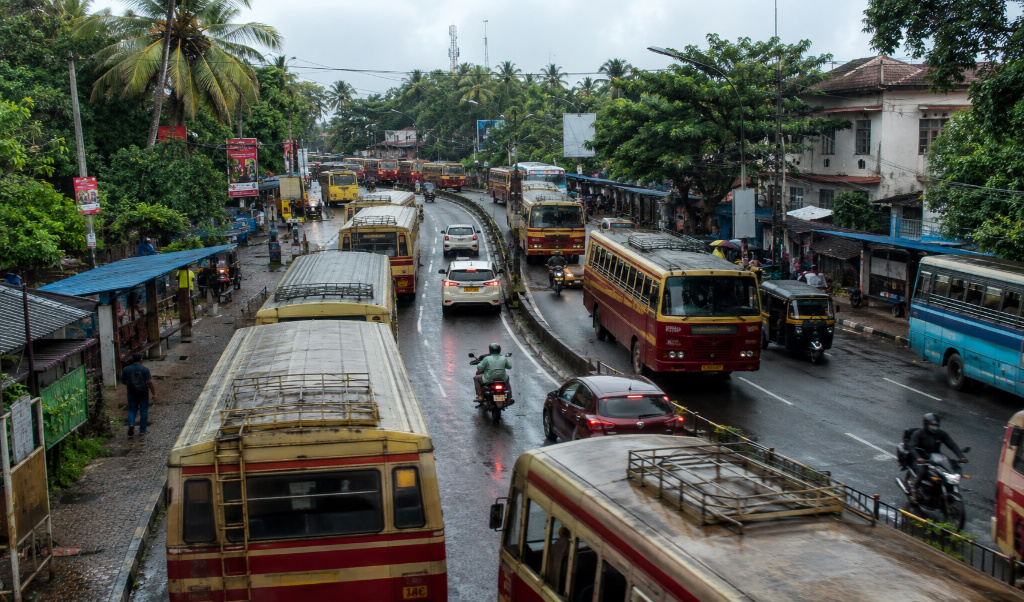
Kerala offers a useful example of this contradiction. State transport discourse often frames Kerala State Road Transport Corporation (KSRTC) as the backbone of affordable mobility. Yet, for a significant share of low-income and daily commuters, especially students and workers, private stage carriage buses remain the actual mobility provider. A student mobility survey conducted in Kochi highlights this clearly: while 48.42 per cent of college student respondents reported using private bus concessions, only 6.33 per cent relied on KSRTC concessions.
Ridership patterns tell a similar story. KSRTC records approximately 24.92 lakh daily riders, while private buses account for nearly 40 lakh passengers. The operational dependence of ordinary commuters are therefore not on the STU alone but significantly on the private stage carriage ecosystem. This creates a policy paradox: private operators are often treated as secondary participants in a sector where they are, in reality, carrying the primary commuter burden.
When “Public Interest” Becomes Legally Irreversible
Once a nationalisation scheme is notified, citing public interest, reversing it becomes extremely difficult, even if users, operators and local communities oppose it later. The legal threshold for proving that nationalisation is no longer in the public interest is exceptionally high.
In Kasargod District Bus Owners Association vs State of Kerala, the court observed that public opinion against STU monopoly alone is not a sufficient ground to cancel a notified scheme. Even dissatisfaction with service delivery does not automatically invalidate the scheme unless it can be demonstrated that the notified arrangement fundamentally fails the statutory tests of efficiency, adequacy, economy and coordination.
This creates what may be called a policy lock-in effect. The state can enter a monopoly through a broad interpretation of public interest, but exiting that monopoly requires a far narrower and more difficult legal standard.
Judicial Interpretation: Public Interest Without Comparative Proof
The courts have consistently reinforced this institutional bias.
In Socorro N. Gracias v. State of Goa (Bombay High Court, 1999), it was argued that nationalisation was not in public interest because the STU lacked the capacity to provide efficient and adequate service. The court held that there could be no direct comparison between an integrated state transport service and individual private operators running isolated routes. The judgement observed that unless the scheme is shown to be inefficient, inadequate, uneconomical or improperly coordinated, it would generally follow that it is in the public interest. This interpretation places a presumption in favour of nationalisation rather than requiring evidence of superior service outcomes.
A Different Public, A Different Mobility Reality
A stronger concern emerges when schemes notified decades ago continue to govern present-day mobility realities without periodic review. While the schemes were developed quoting “public interest”, the “public” for whom these schemes were framed in the 1970s and 1980s is not the same public that depends on transport today.
Kerala itself illustrates this transformation. In the 1970s & 80s, when many nationalisation schemes were conceived, the state had a population of nearly 2 crore; by 2026, that figure has risen to more than 3.6 crore. Settlement patterns that were once largely linear and corridor-based have evolved into dense and continuous built-up corridors, particularly across coastal and midland regions. The distinction between rural and urban has significantly blurred. Alongside this, Kerala’s road network has expanded from nearly 1 lakh kilometres to over 2.3 lakh kilometres, with stronger north–south and east–west connectivity, wider highways, and far more district-level access roads. Transport demand today is therefore shaped by a completely different geography of movement.
Yet, legal scrutiny often remains confined to the original notified route, ignoring the wider changes in settlement, commuting patterns, and parallel route dependencies. A scheme justified as being in “public interest” half a decade ago is thus treated as permanently valid, even when the public it was meant to serve has fundamentally changed.
The Real Policy Question
The debate is not whether private operators should replace public transport institutions. That would be a false binary.
The real question is whether a monopoly should be preserved when plurality delivers better mobility outcomes. If private stage carriage buses are carrying more passengers, serving more students and filling operational gaps left by financially constrained STUs, then excluding them in the name of public interest requires stronger justification than statutory tradition.
Public interest cannot remain a theoretical legal shield. It must be measured against actual accessibility, affordability and service quality. If the public waits longer, travels less and lacks quality service under a monopolised system, then the legitimacy of the monopoly itself must be questioned.
Rethinking Public Interest
Transport policy should move from ownership-based legitimacy to outcome-based legitimacy. The objective should not be whether the operator is public or private, but whether the commuter is served efficiently. Multiple players in the market may often serve public interest better than exclusive state control without operational capacity.
Equally important, public interest cannot be treated as a frozen legal concept tied to the demographic and spatial realities of the 1970s or 80s. With a larger population, continuous built-up settlements, expanded road networks, and far more complex travel demands, the country requires a different understanding of mobility access. If transport demand evolves, the policy instruments governing it must also remain open to review.
Nationalisation should not be treated as a permanent moral virtue. It must be periodically reassessed against present-day service outcomes, commuter dependence, and changing settlement patterns; not merely defended on the strength of historical notification. Because in public transport, public interest should be defined not by who runs the bus, but by whether the bus actually runs.
Nikhil Ali is a Senior Research Associate (Urban) at the Centre for Public Policy Research (CPPR).
Views expressed by the authors are personal and need not reflect or represent the views of the Centre for Public Policy Research (CPPR).

Nikhil Ali is a Senior Research Associate (Urban) at the Centre for Public Policy Research. He completed his graduation in Civil Engineering from Sree Narayana College of Engineering and is a seasoned Civil Engineer with working experience at Tata Realty and Infrastructure Ltd. With a passion for urban planning, he acquired his master's degree in Urban Planning from Hindustan Institute of Technology and Science, Chennai. His expertise lies in Urban Mobility, land use planning/analysis, and water-sensitive planning.
