
Articles

കെ.എസ്.ആ.ർ.ടി.സിക്ക് കോടികൾ, സ്വകാര്യ ബസുകൾക്ക് നിയന്ത്രണങ്ങൾ: കേരളം ബസ് പെർമിറ്റ് സംവിധാനം ഉടച്ചുവാർക്കേണ്ടത് എന്തുകൊണ്ട്?
February 24, 2026
Kerala Assembly Elections 2026: The Battle Lines are Drawn
February 25, 2026Affordable, but not accessible: Karnataka’s rural transport paradox
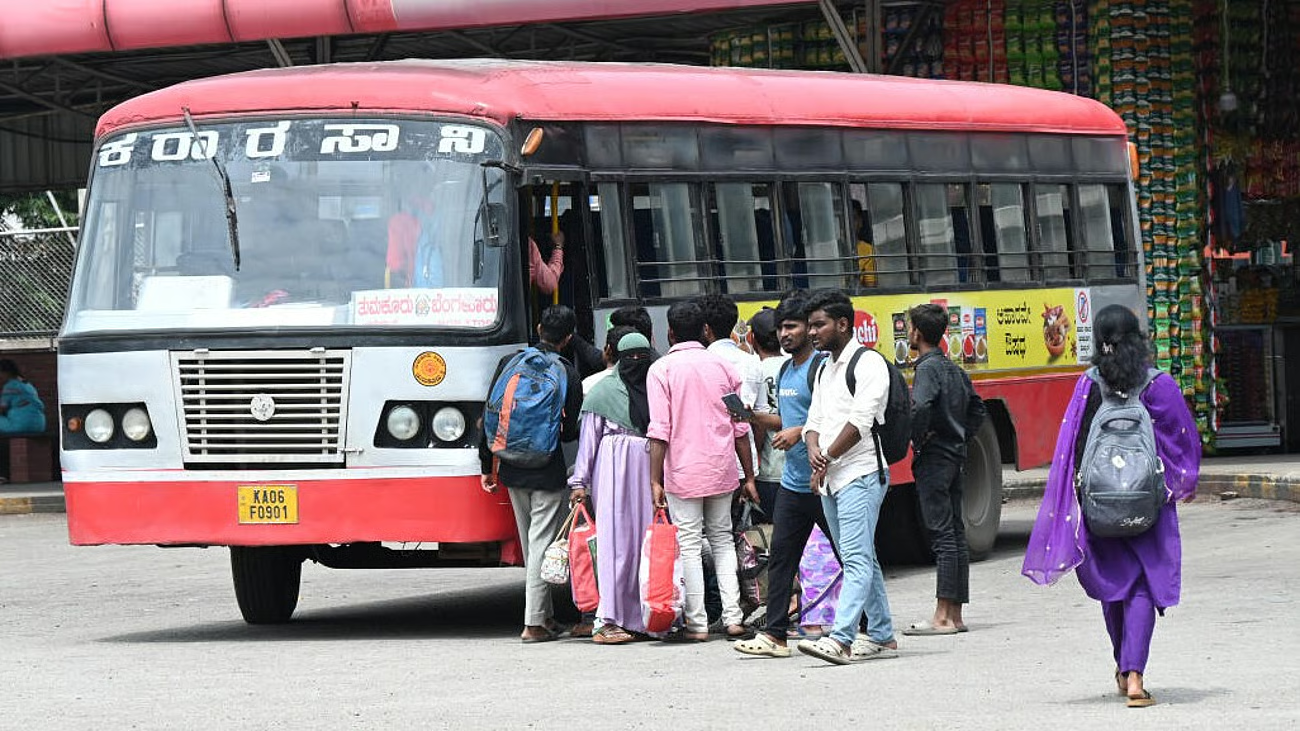
Photo Credit: Deccan Herald
Karnataka has improved transport affordability through subsidies and schemes, yet reliable access remains uneven in rural areas. Using insights from Melukote, this article examines how limited services, regulatory barriers, and weak last-mile connectivity continue to restrict rural mobility despite rising demand.
Karnataka has made significant strides in making public transport affordable, but affordability alone has not translated into reliable access. Accessibility refers to the ease with which people can reach their destinations, whether schools, workplaces, or markets. The Karnataka Economic Survey 2023–24 notes that gaps in road connectivity and public transport services remain a persistent barrier to rural development. Despite multi-year investments in the transport sector aimed at reducing transportation costs, including initiatives such as the Shakti Scheme and subsidised student bus passes, accessibility in terms of service adequacy and network coverage remains uneven in rural Karnataka.
The situation in Melukote, in Mandya district of Karnataka, illustrates this broader structural issue in Karnataka. Limited bus services, few routes, and weak last-mile connectivity have restricted mobility, reflecting that transport supply and regulatory frameworks have not kept pace with growing demand.
In Melukote, the Shakti Scheme has increased women’s patronage of the state buses, with field findings mirroring state-wide study findings that show travel among beneficiaries has increased by up to 65%. Similarly, there is a broader dependence on public transport among rural students, with a survey at Government Degree College, Pandavapura, showing that 90 per cent of students rely on KSRTC buses. While these schemes have made mobility more affordable, they have also intensified pressure on the sole public transport system provided by the Karnataka State Road Transport Corporation (KSRTC).
Affordability ≠ Access
The dependence on public transport would be less problematic if services were frequent and flexible. However, public transport availability in the Melukote region is limited in scale and frequency, leading to peak-hour overcrowding. Many villages lack direct bus service, requiring residents to walk several kilometres to reach the nearest stop.
Limited access forces residents to organise their daily travel around bus timings. For instance, teachers at degree and pre-university colleges reveal that they routinely cut instructional hours short so students can catch the 3:30 PM bus, the last reliable service of the day, which takes students home when there is still daylight. Requests from the community and local leaders for services do not always get met due to KSRTC’s operational constraints. This reflects a broader reality of rural transport demand where services to remote and rural habitations run with low occupancy, making them financially difficult to sustain.
Barriers to private and shared mobility
In principle, gaps in public transport provision could be offset by private or shared mobility services. In practice, such alternatives have failed to emerge at scale due to the rigid distinction between contract carriage (for hire) and stage carriages (public bus) operation in Indian and State laws.
The Melukote region previously had privately operated passenger bus lines operating along several routes. According to the Mandya Regional Transport Officer, many of these operations ceased during the pandemic due to difficulties paying taxes and maintaining vehicles, and the subsequent introduction of the Shakthi Scheme, which diverted a section of fare-paying commuters towards state buses.
Autorickshaws and taxis are commonly available at major bus stations and town centres and often operate as shared vehicles to reduce per-passenger costs. The regulatory provisions for contract carriages under the Motor Vehicles Act, 1988, as currently interpreted, does not formally permit such shared operations, forcing operators either to charge higher per-trip fares or to operate informally with fear of enforcement. In the absence of a supportive legal framework, private and shared transport services are unable to complement public transport, leaving rural travellers dependent on a single overstretched provider.
Recommendations
Affordability-driven mobility without adequate supply fails to ensure meaningful access to rural residents. States like Karnataka must reimagine how they plan and regulate rural transport to address the issue of limited accessibility.
Beyond introducing a few new bus services that again get shut down due to low occupancy, the state must create space for smaller shared-vehicle operators to complement public transport by removing barriers to the operations of these vehicles. The shared autorickshaw and mini-bus models in neighbouring Tamil Nadu, which are regulated differently from stage carriages, offer a useful reference point. The flexibility provided by the Motor Vehicles (Amendment) Act 2019 allows states to take up creative initiatives like this to improve rural mobility and last-mile connectivity. Karnataka’s transport rules must formally recognise shared mobility as a legitimate complement to public transport.
By creating space for smaller shared-vehicle operators to complement public transport, rural mobility can be strengthened without placing additional strain on state transport undertakings.
The article was originally published in Deccan Herald.
Chaithra Ananthakrishna Navada is a Research Associate at the Urban Vertical, and Nissy Solomon is an Hon. Trustee (Research & Projects) at the Centre for Public Policy Research (CPPR), Kochi, Kerala, India.
Views expressed by the authors are personal and need not reflect or represent the views of the Centre for Public Policy Research (CPPR).

Chaithra A Navada is an Associate, Research (Urban) at the Centre for Public Policy Research. She holds a master’s degree in Urban and Regional Planning with a specialization in transportation from the University of California, Los Angeles, and an MA in Development Studies from the Indian Institute of Technology, Madras (IITM).
Her experience spans multimodal transport planning, road safety planning, traffic impact assessments, and policy research aimed at fostering sustainable and equitable urban mobility systems. As a transportation planner, she has contributed to road safety plans for cities and counties in California, Florida, and Texas. She supports projects in the urban and transportation verticals at CPPR, and currently works on a project to improve shared mobility in rural India.

Nissy Solomon is Hon. Trustee (Research & Programs) at CPPR. She has a background in Economics with a master’s degree in Public Policy from the National Law School of India University, Bangalore. After graduation and prior to her venture into the public policy domain, she worked as a Geographic Information Systems (GIS) Analyst with Nokia-Heremaps. Her postgraduate research explored the interface of GIS in Indian healthcare planning. She is broadly interested in Public Policy, Economic Development and Spatial Analysis for policymaking.