
From the blog

The Underreporting Blindspot: Enforcing the eNAVIK and Indian Seafarer Tracking in High-Risk Maritime Zones
November 9, 2026
Women Behind the Counter: Ending Kerala’s Excise Bans on Women’s Employment
November 10, 2026US Midterm Elections 2026: Why the World Is Watching America’s Congress
Why the US Midterms Matter
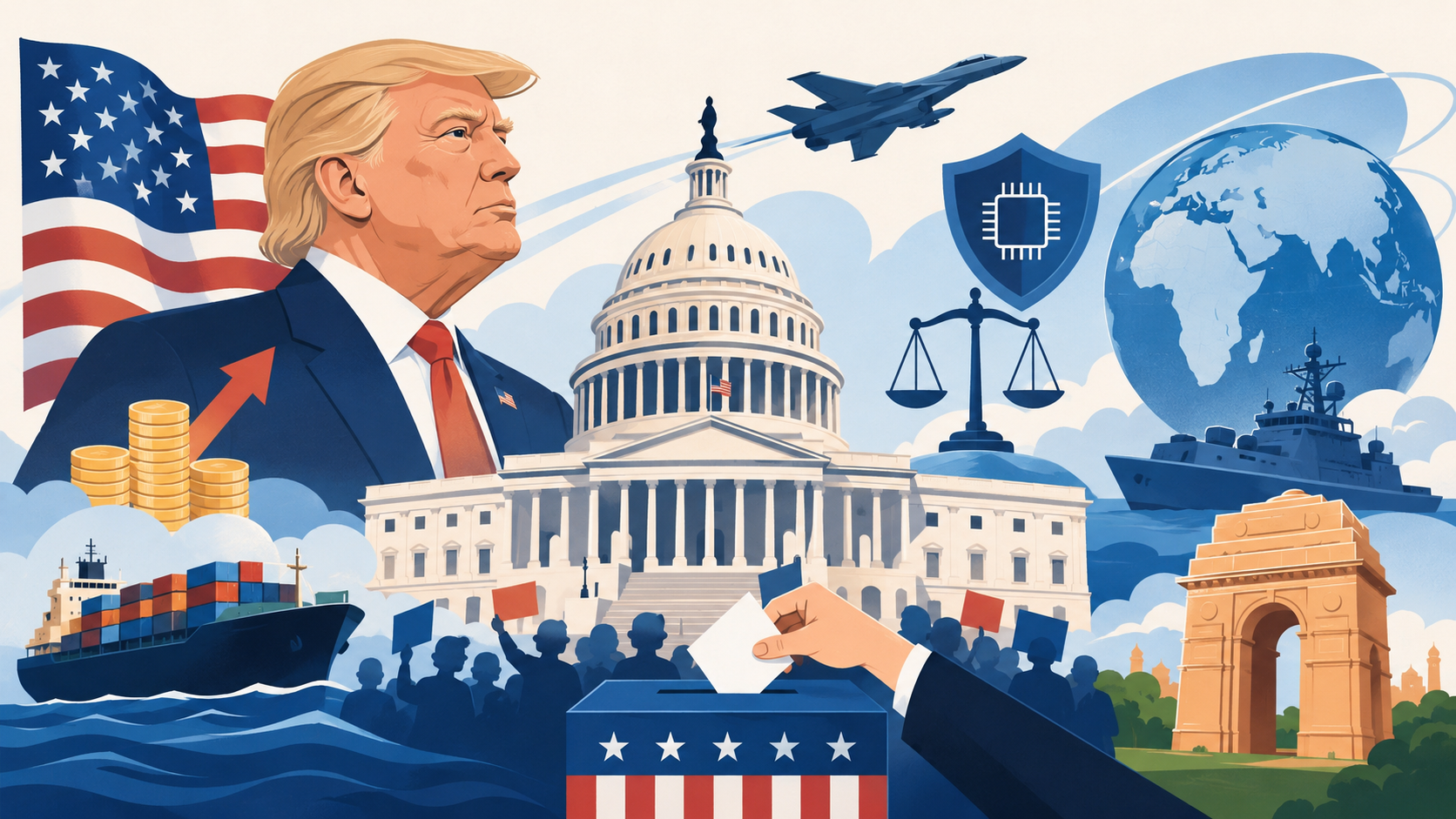
The US midterm elections are often viewed as a domestic political contest, but their implications extend well beyond American borders. Although President Donald Trump is not directly contesting the election, its outcome could influence his ability to implement policies during the remainder of his presidency. The recent midterm elections determined the composition of Congress, which has the authority to pass legislation, approve government expenditure and oversee the executive branch.
With Republicans currently controlling Congress, the Trump administration has enjoyed considerable legislative support. However, a Democratic majority could introduce greater scrutiny of presidential decisions and influence policy across trade, national security, technology and public spending. This shift could have consequences for the wider international political and economic environment.
Challenging Trump’s Tariff Policy
Trump’s tariff policy has created uncertainty in global trade and strained economic relationships with several countries. Democratic lawmakers have criticised these measures, questioning their legality and the extent of presidential authority in imposing trade restrictions.
A change in congressional control could strengthen efforts to challenge the administration’s tariff policies. Congress holds constitutional authority over foreign commerce, although presidents can exercise delegated powers to impose certain tariffs. Greater legislative scrutiny could therefore influence how these measures are implemented. The effects extend beyond the United States. Following the escalation of trade tensions, the International Monetary Fund cut its global economic growth forecast for 2025 from 3.3 to 2.8 per cent (Scroll Staff 2025). For countries such as India, greater predictability in US trade policy could support export growth, investment confidence and international business relations.
Military Engagements and Congressional Oversight
The division of military powers between the President and Congress is another important issue. While the President serves as Commander-in-Chief, Congress holds the constitutional power to declare war. Trump’s military actions involving Iran and Venezuela, without prior congressional consultation, have raised concerns about executive authority. A Democratic-controlled Congress could strengthen oversight through public hearings, investigations and greater scrutiny of military decisions. This could make it more difficult for the administration to pursue military operations without facing legislative opposition.
The implications are particularly relevant to energy security. Escalation involving Iran could disrupt oil production, shipping and energy markets. For India, which depends heavily on energy imports, developments in West Asia have direct implications for oil prices, maritime connectivity and economic stability.
The Future of Artificial Intelligence Regulation
AI regulation is emerging as another area of political disagreement in Washington. The Trump administration has favoured a less restrictive approach, prioritizing technological innovation, federal deregulation, and American competitiveness against global rivals. Democrats, however, have advocated stronger, legally enforceable regulatory safeguards and mandatory safety standard audits.
The debate also reflects a deep philosophical split within the technology industry. Anthropic and OpenAI have broken with industry peers to support certain forms of legally binding statutory frameworks, arguing that voluntary safety pledges are insufficient for advanced frontier models. On the other side, companies like Meta and xAI oppose restrictive pre-release statutory frameworks, warning that excessive red tape will slow down structural innovation and weaken the United States’ competitive advantage.
As a global leader in AI development, changes in US regulatory policy could influence international technology standards. For India, which is actively expanding its local ecosystem under the IndiaAI Mission, these Washington developments will heavily shape future technology partnerships, cross-border infrastructure innovation, and multilateral discussions on responsible AI governance.
Budgetary Deadlocks and Economic Uncertainty
Although the President proposes the federal budget, Congress must approve government spending. A change in congressional control could therefore create disagreements over budgetary priorities, increasing the possibility of legislative deadlocks and government shutdowns. Such disruptions can delay payments to federal employees, affect public services and reduce domestic economic activity. Given the central position of the US economy in global financial markets, prolonged fiscal uncertainty could also affect investor confidence and raise concerns about wider economic growth.
Domestic Political Constraints and Global Implications
A Congress controlled by the opposition could require Trump to devote greater attention to domestic negotiations, legislative disagreements and congressional investigations. This may limit the administration’s capacity to pursue some of its international priorities, including military interventions and territorial ambitions such as Greenland. However, continued Republican control would give Donald Trump greater political room to advance his existing agenda, potentially resulting in further tariff measures and a more assertive foreign policy.
Looking Ahead
The 2026 midterm elections have reshaped the balance of power in American governance, with the Democratic Party securing control of both chambers of Congress on November 5, 2026. While this shift is expected to bring greater congressional scrutiny of the Trump administration’s policies on trade, military engagements and AI regulation, the scope for legislative change remains constrained by the presidential veto under Article I, Section 7 of the US Constitution.
Trump has indicated his intention to use this authority to block legislation that conflicts with his administration’s priorities, describing it as his “ultimate power”. Overriding a presidential veto requires a two-thirds majority in both the House of Representatives and the Senate, making bipartisan support essential for major legislative changes. This could result in prolonged legislative disagreements and a greater reliance on executive action. For countries such as India, the implications will extend beyond individual policy decisions to the institutional contest between the White House and Congress, shaping the direction of American trade, security and technology policies during the remainder of Trump’s presidency.
References
- Scroll Staff. 2025. “IMF Cuts Global Growth Forecast by 0.5 Percentage Point, Cites Trump Tariffs.” Scroll.in, April 23, 2025. https://scroll.in/latest/1081602/scroll_in.
Dr Dhritishree Bordolai, Senior Research Associate (International Relations), and Mukund T, Research Associate (International Relations), at the Centre for Public Policy Research, Kochi.
Views expressed by the author are personal and need not reflect or represent the views of the Centre for Public Policy Research.

Dr Dhritishree Bordalai holds a PhD from the Centre for European Studies (CES), School of International Studies (SIS), Jawaharlal Nehru University (JNU), New Delhi. She has a Certificate in Public Policy and Management from the Indian Institute of Management, Kozhikode (IIM-K), and has been awarded the UGC-DAAD Short-Term Scholarship during her PhD at the Otto-Suhr-Institut für Politikwissenschaft (OSI), Freie Universität Berlin, Germany.
She has attended several national and international conferences on her area of research and presented a paper at the Young Researchers Conference in JNU. Her core areas of research are migration, security and refugee studies.

Mukund T is an Associate, Research – International Relations at the Centre for Public Policy Research (CPPR), Kochi. He holds a postgraduate degree in International Relations from CHRIST (Deemed to be University), Bengaluru, and a bachelor's degree in English, Political Science, and History from the same institution.
