

Articles

“‘Kadakku Purathu’ vs ‘Irunda Kalam’: Can digital campaigns shape Kerala’s electoral narrative?” — D Dhanuraj of Centre for Public Policy Research weighs in on the online political battle ahead of the Kerala Assembly Elections 2026
March 5, 2026
Violence Against Women in India: Rethinking Institutional Responses and Accountability
March 6, 2026Disruptions in the Hormuz Strait and the Future of Oil Trade
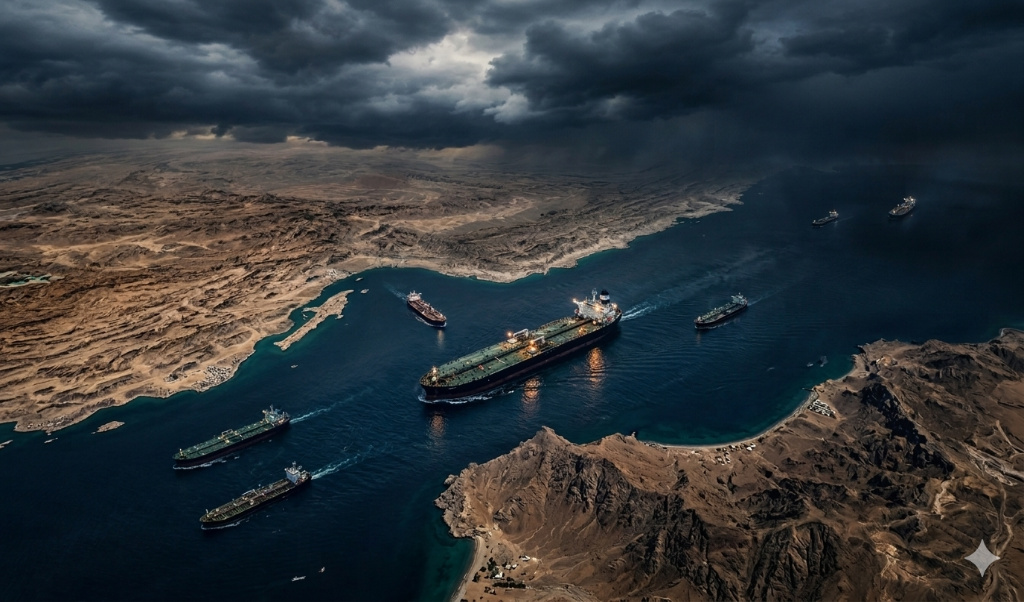
The announced closure of the Strait of Hormuz marks a decisive escalation in Gulf geopolitics, transforming a long-anticipated risk into an immediate economic shock. In the aftermath of the reported death of Iran’s Supreme Leader, Ayatollah Ali Khamenei, Iranian authorities have declared that commercial vessels will not be permitted to transit the corridor. Given that roughly one-fifth of globally traded crude oil and a significant share of liquefied natural gas pass through this narrow waterway, the implications extend far beyond energy markets. What is unfolding is not merely an energy price event. It is a structural disruption with the potential to reorder global oil flows, and reshape shipping logistics.
Oil markets respond quickly to risk, and benchmark prices have already reflected heightened uncertainty. The global oil system depends not merely on extraction but on transit. When shipping companies reroute vessels, insurers reprice war-risk coverage, and freight markets tighten due to longer voyage cycles, the deliverable supply of oil shrinks. Tankers that once completed Gulf-to-Asia rotations must detour around Africa, extending transit times and reducing fleet availability. Insurance premiums and freight surcharges embed geopolitical risk directly into the landed cost of energy.
The Limits of Alternative Routes
The critical analytical question is whether alternative routes and suppliers can meaningfully offset this contraction. There are bypass mechanisms, but their limits are often underestimated. Saudi Arabia’s East-West pipeline to the Red Sea and the UAE’s pipeline to Fujairah (Habshan-Fujairah Pipeline) allow partial circumvention of Hormuz, yet their combined capacity covers only a fraction of normal throughput. Sustainable loading rates at these terminals also depend on storage, berthing slots, and tanker availability, all of which are calibrated to normal operating conditions rather than emergency diversion. Moreover, once these routes become the primary arteries of export, they may themselves acquire strategic vulnerability. Energy traders and shipping operators have already expressed concern that these infrastructure could become a target in a broader regional escalation, introducing a new layer of risk rather than eliminating it.
Iraq’s northern pipeline infrastructure offers limited additional relief. Even if these routes operate at full capacity, they cannot fully substitute for the Hormuz strait. Moreover, redirecting supply is not easy. Export terminals, tanker configurations, and long-term contracts are structured around established Gulf shipping lanes. Scaling alternative corridors requires time, political coordination, and commercial renegotiations.
Supplier Realignment and Strategic Redistribution
If the disruption proves prolonged, the adjustment would extend beyond rerouting toward supplier realignment. Producers whose exports do not depend on Hormuz would gain relative strategic weight. The United States, with its flexible shale production and Atlantic Basin export routes, would be well positioned to expand deliveries to Asian buyers seeking to reduce Gulf exposure. Brazil and emerging Atlantic producers such as Guyana would find new demand opportunities in longer-haul trade corridors. Russia, already redirecting flows eastward in recent years, could deepen its market share in Asia under revised pricing arrangements. European refiners might increasingly rely on Norway and West African suppliers to mitigate Gulf risk. These shifts would not merely fill a temporary gap; they could alter contractual relationships and infrastructure investment patterns in ways that endure beyond the crisis.
From Efficiency to Resilience: A Changing Oil Order
Such redistribution carries implications for the existing oil supply order. For decades, the system has been optimised around geographic centrality and cost efficiency, with Gulf producers at its core. A prolonged Hormuz disruption would accelerate a pivot toward resilience over efficiency. Importers would intensify diversification strategies, embedding redundancy even at higher cost. Strategic petroleum reserves might play a more prominent stabilising role, not as emergency buffers alone but as routine shock absorbers. Insurance and freight markets would price geopolitical risk more conservatively, raising the structural floor for energy transport costs. In effect, the crisis could mark a transition from a highly centralised global oil architecture toward a more regionalised and risk-adjusted configuration.
India’s Structural Exposure
For energy-importing economies such as India, the exposure is both immediate and structural. A large share of its crude and liquefied natural gas imports historically transit Hormuz, making the country vulnerable to higher landed costs through freight escalation, insurance premium, and price increases. A sustained shock would widen the import bill, pressure the current account deficit, and complicate inflation management. Yet the longer-term concern lies in competitiveness. India is also a significant exporter of refined petroleum products to markets in West Asia and Africa. Higher logistics costs and scheduling uncertainty could erode margins and disrupt established trade relationships. While India has diversified sourcing in recent years, including increased purchases from Russia and the United States, these alternatives often entail longer shipping distances and currency risk, embedding higher structural costs into the energy mix.
Inflection Point or Episodic Shock?
The broader macroeconomic spillovers reflect more than cyclical price pressure; they signal how deeply geopolitical risk is embedded in contemporary growth models. Elevated energy costs transmit through transportation, manufacturing, and household consumption, complicating monetary policy and widening fiscal vulnerabilities. Currency volatility and deferred investment in energy-intensive sectors would not simply dampen short-term output but tighten financial conditions more broadly. In this sense, disruption in the Strait of Hormuz operates as a systemic transmission channel, linking regional conflict to global inflation, capital flows, and growth expectations.
Whether this episode remains a temporary disturbance or becomes a structural inflection point depends on duration and market response. A brief interruption may be absorbed as volatility; a prolonged closure would recalibrate the logic of global oil trade itself. Alternative suppliers would consolidate expanded market share, and importers would institutionalise diversification as a permanent strategy rather than a contingency measure. In that scenario, the crisis would not be remembered for the magnitude of its price spike, but for accelerating the transition from an efficiency-driven oil order to a resilience-driven one.
Kalyani S K, Associate, International Relations, at the Centre for Public Policy Research (CPPR), Kochi, Kerala, India.
Views expressed by the authors are personal and need not reflect or represent the views of the Centre for Public Policy Research (CPPR).

Kalyani S K holds a Master’s in International Relations from Loyola College, Chennai with her dissertation on George W Bush's administration and American soft power. She actively collaborates with think tanks, government agencies, UNHRC, and academic institutions, contributing to research, policy engagement, and strategic dialogues. Her core areas of interest include maritime security, climate diplomacy, and sustainable development.