

From the blog

A Roadmap for Gender Budgeting: Strengthening Institutional Capacity for Women’s Safety in 2026–2027
January 29, 2026
D Dhanuraj of CPPR raises concerns on allocation for the KMTA and Kochi Metro Phase 2
February 3, 2026Analysing India’s Defence Allocation in Budget 2026-27: Modernisation in the Shadow of Operation Sindoor
Introduction
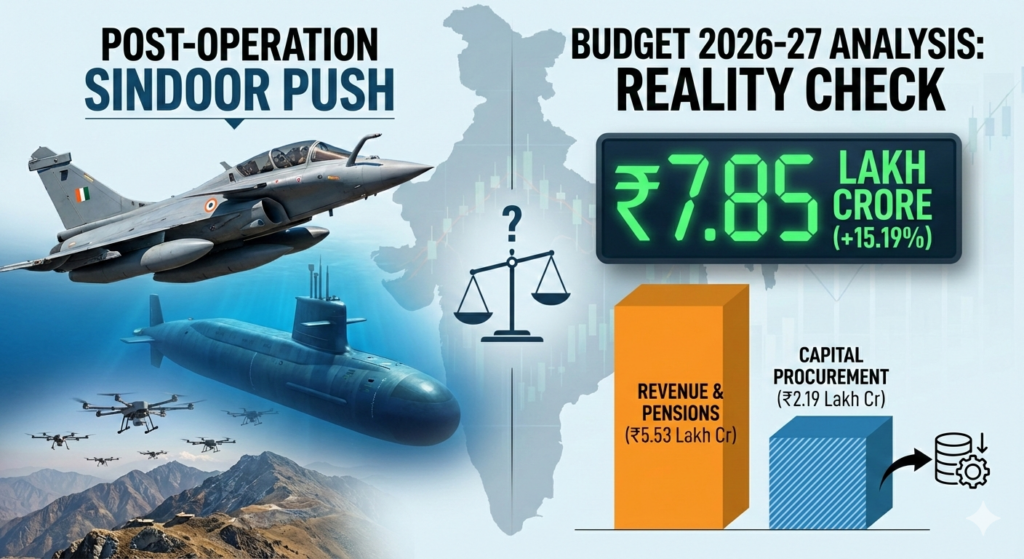
The Union Budget 2026-27 has allocated a historic Rs 7.85 lakh crore (approximately $93.5 billion) to the Ministry of Defence, marking a significant 15.19% increase over the previous year’s estimates (BE) of Rs 6.81 lakh crore. This allocation must be viewed through the lens of the Modi government’s long-term trajectory; since taking office in 2014, when the defence budget stood at roughly Rs 2.29 lakh crore, the outlay has more than tripled.
However, the context of this year’s budget is uniquely defined by the “historic success” of Operation Sindoor, the recent military engagement that seemingly vindicated specific tactical investments while exposing gaps in broader strategic capabilities. While the government frames this budget as a “post-Operation Sindoor push” to consolidate gains, a critical examination reveals a tension between headline-grabbing hikes and the persistent structural issues of pension burdens and slow procurement. Understanding this allocation is not merely an accounting exercise but a necessity for grasping India’s readiness in a volatile neighbourhood where “collusive threats” from China and Pakistan are no longer theoretical but operational realities.
Deep Dive: Capital Allocation and Modernization Priorities
A granular analysis of the Rs 2,19,306.47 crore total capital outlay reveals a strategic shift toward technology-intensive assets, though the structural challenge of balancing manpower costs against modernization persists.
Capital Expenditure (Capex) Growth
The total capital allocation for the 2026-27 fiscal year stands at Rs 2,19,306.47 crore, representing a significant 21.8% increase over the previous year’s Budget Estimate of Rs 1,80,000.00 crore. This increase is primarily distributed across the following key areas:
- Other Equipments: This remains the largest single head for modernization, allocated Rs 82,217.82 crore (BE 2026-27), up from Rs 63,099.03 crore in the 2025-26 BE. This reflects a massive 30.3% increase intended for network-centric warfare tools and ground-based hardware.
- Aircraft and Aero Engines: This sector received Rs 63,733.94 crore for 2026-27, a substantial jump from the Rs 48,614.06 crore allocated in the 2025-26 BE. While the previous year’s spending was revised upward mid-year to over Rs 72,000 crore, the new BE sets a high baseline for consistent procurement of fighter jets and engines.
- Research and Development (R&D): Spending under this head is set to rise to Rs 17,250.25 crore, compared to Rs 14,923.82 crore in the 2025-26 BE, indicating a continued push for indigenous technology under the Atmanirbhar Bharat
- Naval Fleet: Modernization for the Navy’s fleet is allocated Rs 25,023.63 crore, a modest increase from the Rs 24,390.95 crore set in the previous BE.
- Joint Staff and Services: Reflecting the government’s focus on theaterisation and jointness, the allocation for “Joint Staff” surged from Rs 2,352.82 crore (BE 2025-26) to Rs 3,138.72 crore (BE 2026-27).
Significance to India’s Defence Preparedness
The focused spending on these specific items addresses critical present-day challenges and lessons learned from recent operations:
- Air Superiority and Standoff Capability: The 31% BE-to-BE increase in the “Aircraft and Aero Engines” head is essential for maintaining a high state of readiness following Operation Sindoor. It ensures the IAF has the necessary funds for large-scale acquisitions (like the 114 fighter jet proposal) and sustaining the Rafale fleet’s electronic warfare capabilities.
- Maritime Deterrence: The steady funding for the Naval Fleet (Rs 25,023.63 crore) is significant for countering the growing presence of adversarial vessels in the Indian Ocean Region. It facilitates critical projects like the Project 75(I) submarine deal, which is vital for undersea surveillance.
- Modernizing Ground Forces: The jump in “Other Equipments” to over Rs 82,000 crore is the primary driver for digitizing the Army, improving situational awareness through drones and sensors, and upgrading infantry systems for high-altitude warfare.
- Building a Strategic Ecosystem: The increased R&D budget (over Rs 17,000 crore) and the Rs 1,707.81 crore allocated for technology development under “make procedures” signify a move toward reducing dependence on foreign supply chains, which is a major vulnerability during prolonged conflicts.
While the capital outlay shows a healthy upward trajectory, the overall ratio remains constrained by high revenue costs. However, by aggressively increasing BE-to-BE allocations for aircraft, sensors, and R&D, the government is prioritizing high-technology “force multipliers” necessary to meet the dual challenges of conventional borders and asymmetric threats.
Impact on Supply Chain and Industrial Base
The budget attempts to energize the defence industrial base, particularly MSMEs, by linking them to high-value “Make in India” projects.
- Submarines (Project 75-I): The imminent signing of the Rs 70,000+ crore deal with Germany’s ThyssenKrupp Marine Systems (TKMS) for six stealth submarines is a lifeline for Indian shipyards – specifically Mazagon Dock Shipbuilders Limited (MDL). The project envisages an Indigenous Content (IC) starting at 45% and scaling to 60%, which will force the integration of hundreds of Indian MSMEs into the global submarine supply chain for spares and sensors.
- Aerospace: The budget proposed customs duty waivers on raw materials for Maintenance, Repair, and Overhaul (MRO) of aircraft. This is a strategic move to ensure that the IAF’s growing fleet (including the upcoming 114 Multi-Role Fighter Aircraft) can be serviced domestically, reducing downtime during conflicts. France’s Safran is collaborating with the Indian private sector to establish a Maintenance, Repair, and Overhaul (MRO) facility for M-88 engines in Hyderabad, supported by this new customs duty waivers on aircraft components.
- Autonomous Warfare: The induction of weaponised unmanned interceptor crafts developed by Sagar Defence Engineering—a private firm—under the iDEX framework showcases the potential of agile startups in modernizing coastal security
- Comparative Spending: Despite the hike, India’s $93 billion defence budget pales in comparison to China, whose estimated 2025 defence spending hovered around $374 billion—nearly four times India’s. While India maintains a comfortable 9:1 lead over Pakistan’s ~$9 billion budget, the strategic challenge is the two-front threat. China’s naval expansion and Pakistan’s acquisition of Turkish drones and Chinese jets mean India’s purchase power is being stretched thin across two geographically distinct theatres.
The Defence Acquisition Procedure (DAP) 2020: A Critical Review
The DAP 2020 was heralded as a reformist document aimed at streamlining procurement and fostering “Atmanirbharta” (Self-Reliance). Six years on, its report card is mixed.
- Inefficiency in Strategic Partnerships: The Project 75(I) submarine deal is the prime exhibit of DAP 2020’s struggles. Conceived in the early 2000s, and processed under the “Strategic Partnership” model, it took nearly six years after DAP 2020 to reach the contract signing stage in 2026. A procurement cycle that spans 20 years from “Acceptance of Necessity” to “Contract Signing” is functionally obsolete in an era of drone swarms and AI warfare.
- Indigenization vs. Modernization: While the DAP has successfully prioritized domestic industry—evident in the funding for 156 Indigenous Light Combat Helicopters (LCH) and the AMCA fighter—it has often created a “negative list” blockade where foreign options are banned before domestic alternatives are fully mature. The budget’s heavy reliance on the future delivery of indigenous platforms risks leaving capability gaps today.
- Exports: The budget implicitly supports exports by strengthening the domestic manufacturing base, but specific “export promotion” allocations remain opaque. For India to emulate Turkey (which successfully exported drones to Pakistan), DAP 2020 needs to be far more aggressive in supporting private sector R&D, not just Public Sector Undertakings (PSUs).
Conclusion
In conclusion, the Union Budget 2026-27 serves more as a “stabilization budget” than a truly “transformational” one. While the government has significantly increased the capital outlay, it primarily addresses the immediate tactical gaps exposed by Operation Sindoor in air power and underwater domains. However, it stops short of the systemic financial restructuring required to move beyond a manpower-heavy force.
Critically, India’s total defence allocation remains at approximately 2% of the estimated GDP. This falls significantly short of the 2.5% to 3% benchmark consistently recommended by the Standing Committee on Defence and the Defence Secretary-led committees to achieve meaningful modernization. In the wake of a major military operation, failing to hit the 3% target may signal a lack of fiscal resolve to adversaries who are rapidly scaling their own technological capabilities.
Why Private Sector Incentivization is Non-Negotiable
Despite these successes, the budget reveals a persistent imbalance. For instance, the Investment in Public Enterprises (DPSUs) remains high at Rs 1,494.00 crore , while the total assistance for prototype development under “make” procedures for the Army and Air Force combined is only Rs 1,707.81 crore. To truly evolve, the government must:
- Share the R&D Burden: Private giants like L&T and Tata must be treated as strategic partners rather than mere vendors, allowing them to lead long-term R&D projects rather than just manufacturing build-to-print designs.
- Foster Global Competitiveness: For India to become a sought-after exporter, the private sector needs deeper fiscal incentives and a more streamlined Defence Acquisition Procedure (DAP) that rewards speed and innovation over bureaucratic compliance.
- Rationalize Revenue Costs: Until the pension bill—which stands at Rs 1,71,338 crore—is rationalized through long-term structural changes, the private sector’s role in providing cost-effective, tech-driven solutions becomes even more vital.
Ultimately, state-funded capital expenditure alone cannot modernize the Indian military. Without a decisive move to break the monopoly of traditional state entities and aggressively incentivize private R&D, India will continue to struggle with a “more with less” approach, potentially punching below its weight in the global hard power equation.
This blog by J Paul, Programme Officer at Centre for Public Policy Research is AI-assisted and Human-edited.
Views expressed by the author are personal and need not reflect or represent the views of the Centre for Public Policy Research.

J Paul Zachariah is Programme Officer (Chairman’s Office) at CPPR. He works with the Chairman on the strategic development of CPPR and building partnerships. Paul is a blogger and writes for CPPR blog on topics like international relations and security.
