
Articles

The Purge of Ma Xingrui and Its Political Implications: Manoj P V
July 16, 2026
Shared Mobility Services in Karaikal, Puducherry: Structural Constraints and Informal Adaptations Within the Permit Framework
July 21, 2026Why is Bus Transport Still Stuck in the Era of Nationalisation?
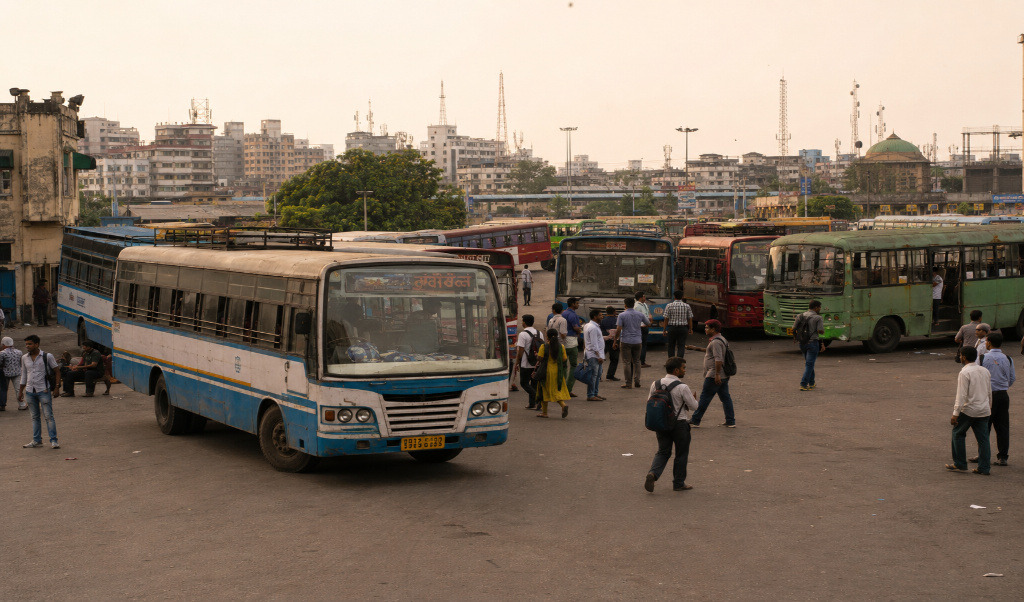
Travel across Indian cities today, and a stark contrast is impossible to miss. Booking a cab takes seconds, mobile data is among the cheapest in the world, and banking is a screen-tap away. But step onto a city bus, and you step back decades: long waits, unpredictable schedules, ageing fleets, and routes that seem designed more by administrative convenience than commuter needs.
Why does bus transport, used by millions every day, still operate under a model that the rest of the economy has moved away from?
A Sector Frozen in Time
India has not hesitated to reform sectors once considered too critical to be left to the market. Telecom, once a state monopoly, now delivers the cheapest and most accessible services globally. Banking, once nationalised, has expanded its reach while improving efficiency. Even aviation, once tightly controlled and considered elitist, is now accessible to the middle class through private participation. The logic was simple: competition improves service delivery.
But bus transport remains an exception. State Transport Undertakings (STUs) continue to dominate operations across states, often within a regulatory framework that restricts private participation. The question now is not whether nationalisation once served a purpose but whether the rationale for retaining it remains valid.
From Market Uncertainty to State Failure
The case for nationalisation emerged from genuine concerns. In the early years of road transport, private operators concentrated on profitable routes, neglected rural areas, and provided fragmented services with little coordination. Transport came to be viewed as an essential public service linked to economic development, social welfare, and territorial integration.
These concerns were eventually institutionalised through the Motor Vehicles Act, 1939. Under Chapter V and Chapter VI of the MV Act, 1988, Regional Transport Authorities (RTAs) are empowered to nationalise routes and grant monopolies to STUs. The objective was to ensure accessibility, affordability, and network coverage where market incentives alone were considered insufficient. However, 56 of 58 STUs are operating at a financial loss (MoRTH, 2022), indicating a systemic issue rather than isolated inefficiencies. Limited fleet expansion, dependence on subsidies, ageing assets, and slow service innovation have increasingly constrained their ability to meet growing mobility demands.
In several instances, route allocation and service planning are shaped less by demand patterns and more by administrative and political decision-making processes. The result is a system that neither achieves efficiency nor consistently ensures coverage. What began as a response to market uncertainty has gradually evolved into a case of state failure. Yet despite these persistent shortcomings, proposals to open bus transport to greater competition are often resisted on the grounds that public transport is a “public good.”
Public transport is often defended as a “public good,” implying that it must remain under state control. But this interpretation misses a critical distinction. The role of the state is to ensure access, not necessarily to operate services. Its responsibility is to guarantee affordability, accessibility, safety, and service standards. That does not necessarily require the state to be the sole operator. A service can retain its public purpose while being delivered by a mix of public and private actors under a strong regulatory framework.
India already applies this principle elsewhere. Private telecom operators function under state regulation; private banks operate under strict oversight; even infrastructure is increasingly developed through hybrid models. In each case, the state safeguards public interest without monopolising service delivery. Bus transport remains one of the few sectors where public provision is still widely equated with public operation.
The Cost of Excluding Competition
The consequences of route nationalisation extend beyond the financial health of STUs and are increasingly visible in service delivery itself. When private operators are excluded, service expansion becomes dependent on the financial and operational capacity of STUs. STUs lack resources and fail to expand services proportionately, creating service gaps, especially in peripheral and underserved areas.
Even where private operators continue to exist, extensive regulatory restrictions frequently limit their ability to innovate or expand. Consequently, neither the public nor the private sector operates at its full potential. The absence of competition has created a system with weak incentives for efficiency, innovation, and service improvement.
Rethinking the Model
The success of reforms in other sectors did not come from removing the state; it came from redefining its role. The state shifted from being the primary operator to becoming a regulator and facilitator, enabling competition while protecting public interests through clear rules and oversight. Bus transport has not undergone this transition. Instead, the state continues to plan, operate, and regulate simultaneously, often with limited capacity to do all three effectively.
India has already demonstrated that competition and public interest are not mutually exclusive. Banking, telecom, and aviation improved because the state redefined its role in these sectors. Bus transport deserves the same transition. Continuing to treat it as an exception has imposed growing costs on commuters and public finances alike. The challenge today is not to preserve a model designed for a different era but to build a system that combines public accountability with private efficiency. That requires moving beyond the legacy of nationalisation.
The opinion article was published in Navbharat Times on July 16, 2026.
Nikhil Ali is a Senior Research Associate (Urban) at the Centre for Public Policy Research (CPPR).
Views expressed by the authors are personal and need not reflect or represent the views of the Centre for Public Policy Research (CPPR).

Nikhil Ali is a Senior Research Associate (Urban) at the Centre for Public Policy Research. He completed his graduation in Civil Engineering from Sree Narayana College of Engineering and is a seasoned Civil Engineer with working experience at Tata Realty and Infrastructure Ltd. With a passion for urban planning, he acquired his master's degree in Urban Planning from Hindustan Institute of Technology and Science, Chennai. His expertise lies in Urban Mobility, land use planning/analysis, and water-sensitive planning.
