
Articles

Missing craft in India’s public policy classrooms
June 30, 2026
Youth Migration from Kerala: CPPR Study Featured in Deepika
July 1, 2026Reforming Fire Safety in India: An Urgent Policy Imperative
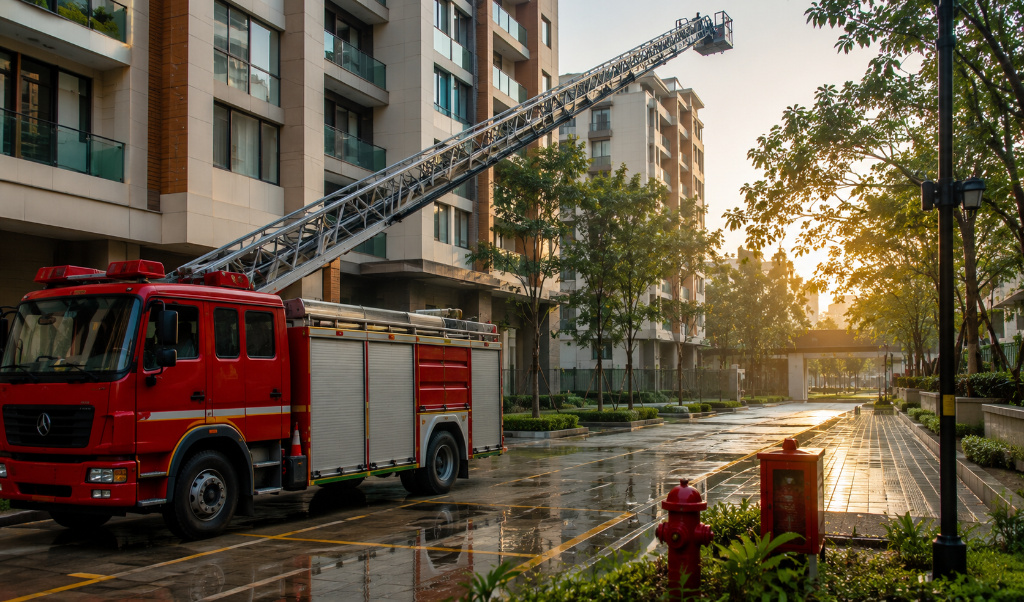
A total of 9 people died in a recent fire incident at a residential building in southwest Delhi’s Palam area. The National Crime Record Bureau data shows a decline in the number of fire accidents in India, a decrease from 27,976 fire accidents in 1999 to only 7,566 accidents in 2022. However, this decline in reported incidents must be interpreted with caution; the persistence of fatalities (7,435 in 2022) despite fewer incidents points to systemic weaknesses in response capacity and emergency preparedness rather than mere incidence reduction.
The major causes for the fire accidents are the electrical circuit failure and gas bursts in the residential buildings. In the Delhi incident too, electrical circuit failure is identified as the reason, and the poor maintenance of the hydraulic machine and ladder caused the firefighting difficulties.
Do we have enough institutional capacity?
Fire services is a municipal function in the schedule of the Constitution of India in terms of Article 243-W. Hence, the primary responsibility for strengthening and equipping the fire force through staffing, infrastructure and resources lies with the state governments and local governments. Given the case of Kerala, as per the Kerala Fire and Rescue website, the state has 111 fire stations with 190 water tenders and a staff of around 4500. If this data is matched to the actual requirement standards set by the Standing Fire Advisory Council (SFAC) (a body constituted by the Ministry of Home Affairs), there is serious undercapacity. SFAC prescribes norms and follows a population and risk-based approach to resource allocation. Up to a population of 3 lakh, one fire tender is required for every 50,000 persons, with an additional tender for every subsequent one lakh population or fraction thereof, along with a 20 percent reserve of total water tenders. In high-risk or industrial areas, provisioning must be based on specific hazard assessments. Operational standards mandate a crew strength of six personnel per fire vehicle. Spatial norms require one fire station per 10 square kilometres in urban areas and per 50 square kilometres in rural areas. Further, response time is capped at a maximum of 5 minutes in urban areas and 20 minutes in rural areas to ensure timely emergency intervention. However, as per available data, Kerala has only less than 50% of required fire-fighting vehicle capacity and only 14% of required fire station capacity, severely undermining the response time required as per SFAC norms. These estimates are derived by benchmarking existing infrastructure against SFAC norms on population, spatial coverage, and reserve capacity requirements. The divergence between prescribed norms and actual capacity highlights a persistent gap between regulatory intent and fiscal as well as administrative prioritisation at the state level.
The 15th Finance Commission had identified the serious lack in the fire services of the country and recommended an allocation of Rs 5,000 crore. In 2023, the central government had launched a “Scheme for Expansion and Modernisation of Fire Services in the States” with a 5,000 crore allocation. While these allocations signal policy recognition of the problem, their effectiveness depends on timely utilisation, institutional absorption capacity, and sustained operational expenditure, which remains uneven across states. The critical question remains – how can we improve the fire services capacity across staff and equipment considering the rapid urbanising trends?
What is the regulatory ecosystem?
Beyond capacity constraints, the effectiveness of fire safety outcomes is also shaped by the nature of the regulatory framework governing building design and safety compliance. There are primarily three regulatory approaches in fire safety. The prescriptive model, which specifies the specific active and passive fire protection standards to be followed in the buildings. It includes specific standards for access pathways, fire stairways, sprinkler systems, etc. The performative approach, on the other hand, focuses on outcomes rather than the ways to achieve the same. The third approach is a hybrid model where minimum prescriptive standards along with performative standards as an alternative option are provided for special, innovative buildings. The effectiveness of each regulatory approach is contingent upon the broader ecosystem of technical expertise, enforcement capacity, and accountability mechanisms within which it operates.
India follows a prescriptive approach in fire safety rules established under the National Building Code 2016, Part 4, which deals with Fire and Life Safety. Countries like the US and Germany have similar prescriptive standards for fire protection. New Zealand and Australia follow the performative approach, whereas Japan and Sweden follow the hybrid approach. While the prescriptive approach lacks flexibility, it helps in uniform implementation, especially for fire officers. The stricter the rules, the enforcement varies in the prescriptive approach. The performative approach relies on the fire risk assessments by professional fire engineers. Hence, countries that are not technologically advanced and lack technical knowledge and human resources tend to fail in its implementation. The implementation is costly and varies with buildings, making enforcement difficult in the current ecosystem. Out of the three approaches, hybrid models are considered better for their flexibility and innovation as well as ease of enforcement.
Do we need better fire safety rules?
In India, since the fire services come under the state, the rules and enforcement vary across states. The prescriptive nature and the lack of institutional capacity make the enforcement poor. The buildings follow the standards for procuring the completion and occupancy certificates; however, the lack of proper maintenance of fire extinguishers, hose reels, smoke detection systems, alarm warning systems, etc. affects firefighting operations during an incident, as in the case of the Delhi accident. In effect, fire safety in India is treated as a one-time certification requirement rather than a continuous risk management process. The prescriptive nature of law disincentivises the growth of fire safety engineering as a profession and limits the architectural possibilities and innovation. The intersection of regulatory rigidity, institutional undercapacity, and weak post-construction enforcement creates a systemic vulnerability that cannot be addressed through incremental reforms alone. Considering the rate of urbanisation in India, it is time to rethink the approach to the rules, the state’s institutional capacity and technology adoption for fighting fire accidents.
Anu Maria Francis is an Assistant Manager (Research and Project Management) at the Centre for Public Policy Research (CPPR), Kochi, Kerala, India.
Views expressed by the authors are personal and need not reflect or represent the views of the Centre for Public Policy Research (CPPR).

Anu Maria Francis is an Assistant Manager (Research and Project Management) at Centre for Public Policy Research (CPPR). She completed her graduation in Law from National University of Advanced Legal Studies, Kochi. She has worked as UPSC exam trainer and mentor with many coaching institutions in Kerala. She has also interned with a couple of organisations like Kerala State Information Commission, ACTIONAID India, Ceat Tyres Ltd, Biocon Pharma Ltd, Khaitan and Co Law Firm etc. Her academic interests pertain to legal and governance issues and education. She also has experience in handling business ventures.
