

Articles

Why Kerala’s Plantation Sector Needs a Policy Reset
May 22, 2026
Beyond Welfare: What Kerala’s New Government Must Prioritise for Fisheries and Coastal Communities
May 22, 2026What Assam’s Returning Government Must Deliver for its Tea Garden Community
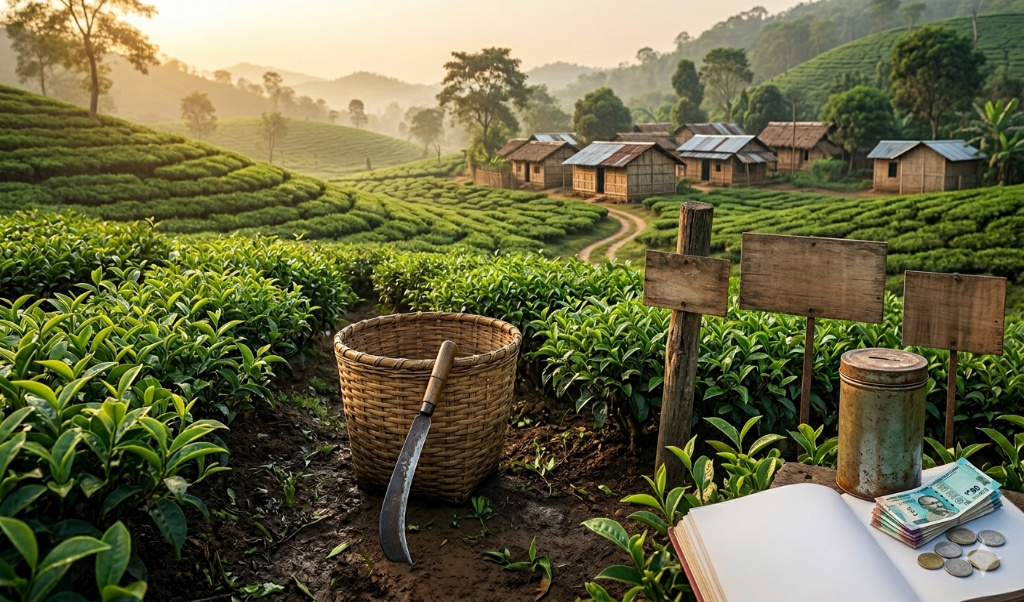
Sustained political will and timely implementation are essential to ensure that electoral promises translate into long-term dignity and security for Assam’s tea garden communities
Constituting nearly 20 per cent of the electorate and influencing outcomes in over 35 constituencies, Assam’s tea community was the most courted voting bloc of the 2026 Assembly election cycle. The Bharatiya Janata Party (BJP)-led alliance emphasised land ownership as its central offer, while the Congress-led opposition countered with wage promises. This raises a fundamental question: what does it mean to win the votes of a community whose daily wage, after years of protests, union demands, and electoral cycles, has moved up by ₹30? The BJP-led NDA swept the Assam polls, winning 102 of the 126 seats. The incumbent government had distributed land pattas before the polls, notified an interim wage hike, and launched the Orunodoi cash transfer scheme. Now, will this government treat this as political capital or as a governing obligation? Assam’s tea accounts for over half of India’s total production and contributes significantly to export earnings. The industry does not lack economic; what is lacks is a governance framework that ensures that value reaches the hands that create it.
Limits of Incremental Wage Politics
The Assam government officially notified an interim wage hike of ₹30 per day, effective from April 1, bringing the daily wage to ₹280 for Brahmaputra valley workers and ₹258 for those in the Barak Valley. At ₹280 per day, a tea garden worker earning a full month’s wages takes home less than what a mid-range urban household spends in a week. Trade unions are clear that working conditions and living standards need improvement despite this revision.
An interim hike without a roadmap is the ambiguous element. What is needed is a wage revision framework with fixed milestones, legislative backing and an independent monitoring mechanism. The new government has the administrative capacity to table such a roadmap within its first 100 days. The gap between what is promised and what is delivered is no longer a matter of intent but a matter of institutional will. Anything less than a time-bound, enforceable wage structure is a continuation of the status quo dressed in a new language.
Still With No Legal Ground
The pre-election distribution of land pattas to tea garden families was a politically significant gesture, but its legal foundations remain deeply contested. In most cases, the land on which garden communities have resided for generations belongs to the tea companies and not the State. Transfer of title requires resolution of the underlying ownership question, a process that cannot be bypassed by administrative order without inviting litigation. Two centuries of continuous residence on this land is not a weak claim. It simply needs to be made a legally enforceable one. The government must establish a time-bound legal task force with a specific mandate to resolve these title questions conclusively.
Women Sustain the Tea Industry, and Policies Must Reflect That
Over 60% of Assam’s tea plucking workforce is female. Policy responses to tea garden communities continue to address women primarily as beneficiaries of cash transfer schemes, most recently through the enhanced Orunodoi disbursement. Cash transfers do serve a purpose, but they are welfare instruments and not labour rights interventions.
The Plantation Labour Act of 1951 mandates crèches, healthcare facilities, and maternity benefits within estate premises. The new government must conduct a state-wide audit of the Plantation Labour Act compliance across all estates and establish a credible enforcement mechanism with penalties that carry genuine deterrence. Women who sustain an industry worth thousands of crores of rupees annually deserve labour protections that are not contingent on the discretion of the management. Overdue by a few decades, a compliance framework is the need of the hour.
Way Forward
The 2026 Assembly polls in Assam confirmed that its tea garden communities are one of the most courted vote banks. The returning government inherits a legislative majority, functional administrative machinery, and a legal framework to follow through with set priorities. Three concerns must drive the policy: a statutory wage revision framework with fixed milestones, a legal force to conclusively settle land title questions, and a statewide compliance audit of plantation labour protections.
At this juncture, sustained political will and timely implementation are essential to ensure that electoral promises translate into long-term dignity and security for Assam’s tea garden communities.
Dr Dhritishree Bordalai is a Senior Research Associate (International Relations) at the Centre for Public Policy Research (CPPR).
Views expressed by the authors are personal and need not reflect or represent the views of the Centre for Public Policy Research (CPPR).

Dr Dhritishree Bordalai holds a PhD from the Centre for European Studies (CES), School of International Studies (SIS), Jawaharlal Nehru University (JNU), New Delhi. She has a Certificate in Public Policy and Management from the Indian Institute of Management, Kozhikode (IIM-K), and has been awarded the UGC-DAAD Short-Term Scholarship during her PhD at the Otto-Suhr-Institut für Politikwissenschaft (OSI), Freie Universität Berlin, Germany.
She has attended several national and international conferences on her area of research and presented a paper at the Young Researchers Conference in JNU. Her core areas of research are migration, security and refugee studies.
