

Articles

Climate Action in Indian Cities: From Readiness Assessment to Measurable Outcomes
August 21, 2026
Finding the Right Space for Kochi’s Street Vendors: D Dhanuraj
September 1, 2026Rethinking Kerala’s Pollution Control Fees for Flats and Apartments
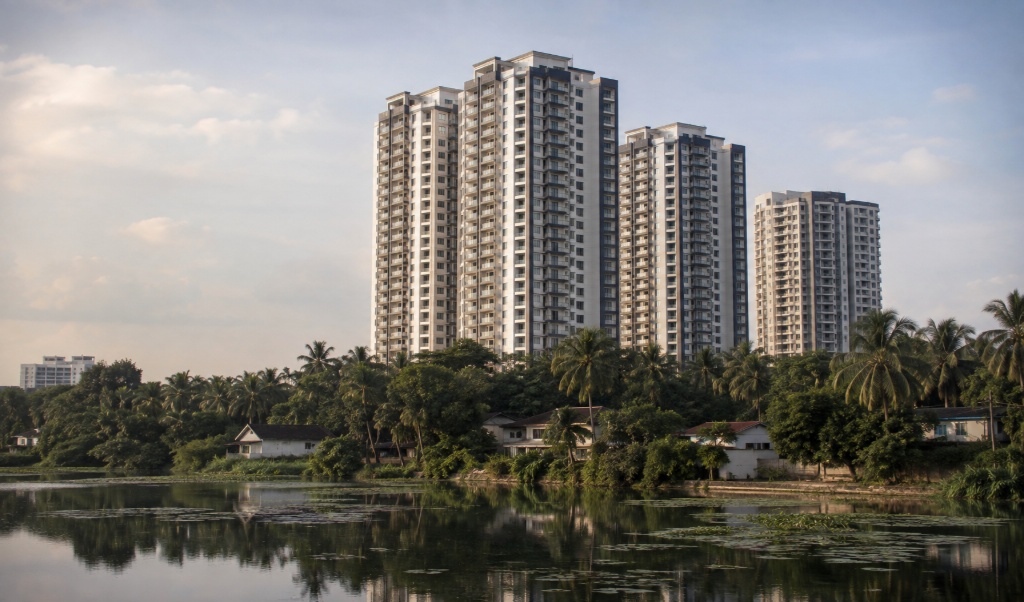
High-rise apartments are becoming increasingly important to Kerala’s urban housing landscape as urbanisation expands and the distinction between urban and rural areas continues to diminish. With limited developable land, a long coastline and extensive ecologically sensitive areas, the scope for horizontal expansion is constrained. Infopark (Kochi) and Technopark (Thiruvananthapuram, near Kazhakootam) created concentrated white-collar job hubs that created demand for urban housing concentrated near those areas. A large share of high-rise apartment demand comes from NRIs (especially from the Gulf) buying flats as investments or retirement homes. Vertical development is therefore likely to remain an important part of meeting the state’s growing housing demand.
The development of such housing, however, is closely linked to the regulatory framework governing construction and operation. Pollution control requirements, electricity regulations, fire safety norms and building rules impose compliance costs that ultimately form part of the cost of development. When regulatory requirements become more stringent or their costs are structured without reference to the actual regulatory burden imposed by a project, the additional cost can feed into housing prices. This is particularly relevant in a state where the need for more affordable urban housing is increasing.
Among these regulations, the consent requirements of the Kerala State Pollution Control Board (KSPCB) have a direct bearing on apartment projects. The 2023 KSPCB Standard Operating Procedure (SOP) provides that the Board’s consent requirements apply to buildings with a built-up area of 2,000 sq. m. or more, irrespective of whether they are high-rise or low-rise. They also apply to buildings generating 20,000 litres or more of wastewater per day, including sewage and sullage, irrespective of built-up area. For villa projects, the combined built-up area of all villas and their total wastewater generation are considered.
The pollution categorisation of residential projects is broadly linked to wastewater generation and built-up area. Projects generating up to 20 kilo Litres per day (KLD) fall under the Green category, those generating above 20 KLD and up to 100 KLD fall under the Orange category, and those exceeding 100 KLD fall under the Red category. Residential apartment- projects generating up to 50 KLD may, however, be treated as Green.
The regulatory process also operates before the construction stage. The KSPCB mandates Consent to Establish (CTE) to ordinarily be obtained before work begins at the proposed site. Before commissioning, Consent to Operate (CTO) must also be obtained under the Water (Prevention and Control of Pollution) Act, 1974 and/or the Air (Prevention and Control of Pollution) Act, 1981. Environmental compliance is therefore not merely a post-construction obligation as the philosophy for pre- and post-compliance stems from the precautionary principle of environmental law. It can affect the approval and construction process itself. It includes both design-stage risk prevention and operational-stage compliance verification. The KSPCB’s integrated consent framework also places residential apartments within the broader regulatory framework applicable to establishments such as hotels, offices and commercial buildings, based on the built-up area.
The more important policy question, however, concerns the basis on which the consent fee is calculated.
The consent fee is charged as part of the KSPCB’s regulatory functions under the Water Act and Air Act. Under Kerala’s fee structure, the amount payable is linked to the capital investment (CI) of the establishment as well as its pollution category of green, orange or red. Capital investment is essentially based on the gross value of fixed capital assets, including land, buildings, machinery and equipment, without depreciation. The application process similarly requires documentation, such as an affidavit or Chartered Accountant’s certificate, establishing the gross fixed capital investment, including the value of land and buildings. The inclusion of the gross fixed capital investment creates a potential mismatch between the basis of the fee and the environmental footprint being regulated.
For a ₹1–5 crore capital investment, the annual consent fee is ₹25,000 + ₹5,000 for each additional crore in the Red category, ₹22,000 + ₹4,000 for each additional crore in the Orange category, and ₹17,000 + ₹2,500 for each additional crore in the Green category.
Consider two residential apartment projects, A and B. Both have broadly the same number of residents and generate similar quantities and qualities of wastewater. Project A, however, has a capital investment of ₹200 crore, while Project B has a capital investment of ₹100 crore, perhaps because the land and building values are higher. For instance, under the current fee structure, increasing the capital investment of a project from ₹100 crore to ₹200 crore increases the annual consent fee by 54.5% in the Red category, 41.7% in the Orange category and 27.8% in the Green category, even where the projects have comparable wastewater generation and environmental loads. If the environmental burden created by the two projects is broadly comparable, the regulatory fee may nevertheless differ substantially because the fee calculation incorporates capital investment.
This raises a fundamental policy question: should the cost of environmental regulation be determined primarily by the value of the assets involved, or by the environmental burden that the regulator is actually required to manage?
The latter would appear to provide a stronger regulatory rationale. Parameters such as wastewater generation, sewage treatment capacity, emissions, diesel generator capacity etc have a more direct relationship with the environmental footprint associated with a residential project. Capital value, by contrast, does not necessarily indicate how much pollution a building generates.
Kerala does provide some relief to residential flats/apartments which are eligible for a 90 per cent concession in the fee payable at the time of CTO renewal. This can substantially reduce the recurring compliance burden. However, the concession does not alter the underlying basis on which the fee is calculated.
A comparison with Karnataka provides a useful alternative. Karnataka’s regulatory framework distinguishes residential projects, including standalone apartments, layouts, integrated projects and townships, from ordinary industrial establishments. For these projects, consent fees are linked to the capacity of the sewage treatment plant (STP), measured in KLD, as well as the location of the project. Consent to Operate fees are similarly linked to STP capacity, although at lower rates.
This approach has a clearer connection between the regulatory charge and the environmental infrastructure that the project requires. A project with a greater wastewater treatment requirement would generally impose a greater regulatory burden, irrespective of whether its land happens to be more expensive.
Kerala could consider moving towards a similar principle without necessarily abandoning categorisation by environmental risk. A revised fee framework could incorporate measurable parameters such as the number of dwelling units, estimated population or occupancy, wastewater generation in KLD, STP capacity, DG-set capacity, built-up area and the applicable environmental risk category. Such a model would better align the cost of regulation with the environmental footprint being regulated. It could also improve predictability for developers by linking fees to objective project characteristics rather than fluctuations in land and property values.
The broader issue is not whether apartment projects should be subject to environmental regulation. They should. The question is whether the regulatory cost imposed on them is proportionate to the environmental risks they create.
This article was originally published on 31st August 2026 in Mathrubhumi Online. Click here to read the article.
Anu Maria Francis is an Assistant Manager (Research and Project Management) at the Centre for Public Policy Research (CPPR), Kochi, Kerala, India.
Views expressed by the authors are personal and need not reflect or represent the views of the Centre for Public Policy Research (CPPR).

Anu Maria Francis is an Assistant Manager (Research and Project Management) at Centre for Public Policy Research (CPPR). She completed her graduation in Law from National University of Advanced Legal Studies, Kochi. She has worked as UPSC exam trainer and mentor with many coaching institutions in Kerala. She has also interned with a couple of organisations like Kerala State Information Commission, ACTIONAID India, Ceat Tyres Ltd, Biocon Pharma Ltd, Khaitan and Co Law Firm etc. Her academic interests pertain to legal and governance issues and education. She also has experience in handling business ventures.
