
Articles

Globalization of Inflation or Monetary Policy: What Explains the Price Rise in India
October 14, 2022
Govt must start a broadbased anti-smoking policy
October 25, 2022Cost-of-living crisis Destabilising the Political Bastions
The war is always a human tragedy and in today’s globalised world, its ripple effects transverse far beyond its borders. The recent Russian invasion of Ukraine is no exception which has exacerbated the global cost-of-living crisis generated by rising food and energy prices, skyrocketing inflation and tightening financial conditions. Grappling with depleted fiscal reserves and high levels of sovereign debt, the developing world is at the receiving end of this global crisis, and more people of developing and low-income countries are expected to be pushed into food insecurity and extreme poverty by the end of 2022.
Due to the ripple effects of the Ukraine war, up to 71 million have already been pushed into poverty (UNDP), and there will be an additional 47 million people suffering from acute hunger across 82 countries (WFP). Consequently, governments are under stress to absorb the global economic shocks, as citizen protests and riots against cost-of-living crises are rocking many political bastions. Frustrated with high tax rates and persistently high inflation, people all over the world have been protesting peacefully in large numbers against government incompetency in mitigating the economic crisis, rising prices for agricultural goods (Global Protest Tracker by Carnegie). Furthermore, the number of riots, violence acts against citizens by state and non-actor forces increased between the first and the second quarters of 2022 (Armed Conflict Location and Event Data Project).
Rajapakshe’s Bastion collapsed
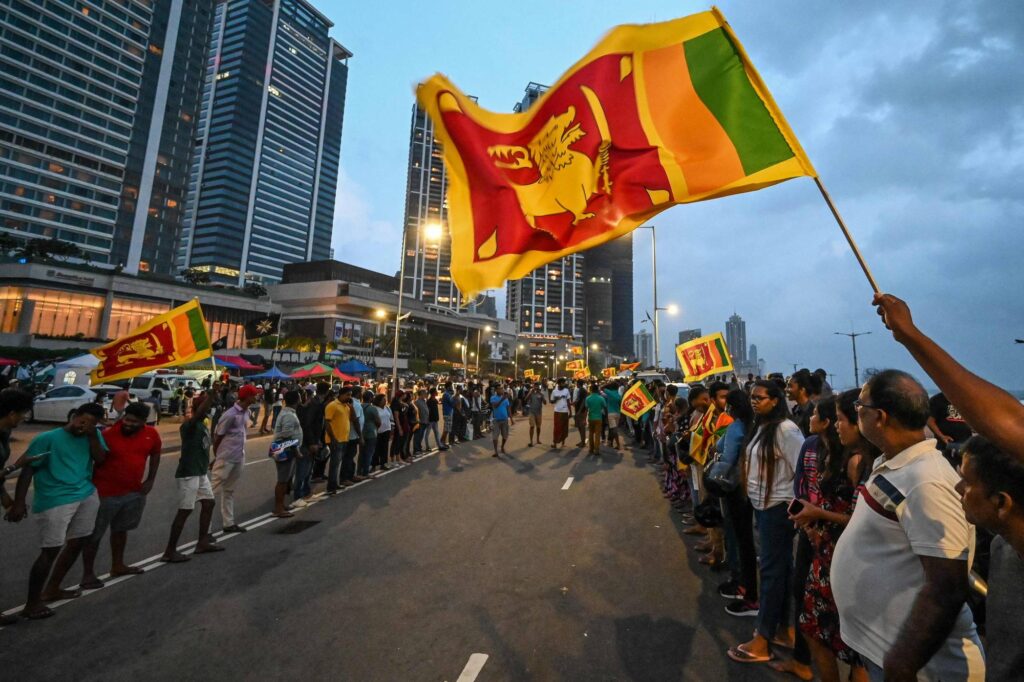
Disruption of global supply chains and consequent supply side inflation had ensued an unforeseen economic crisis across the globe. One of the many probable political bastions to fall prey to the economic uncertainty was the powerful and autocratic regime of Rajapakse owing to the anguished protest against the crippled economy and hiked up commodity prices as a corollary of the global supply chain disruption. The national meltdown translated to political chaos and loss of state control, rendering it a perfect recipe for burgeoning estrangement within an already divided nation on the ethnic and linguistic lines which could revive the national memory of the civil war.
Food shortages and resultant spike in the cost-of-living have been caused by the reduced domestic agricultural production, scarcity of foreign exchange reserves and depreciation of the local currency, pushing families into hunger and poverty. Now, with year-on-year food inflation surging at more than 90% in July, an estimated 4.9 million people – 22 percent of the population – are currently food insecure and unsure of their next meal, facing an imminent threat of starvation. In fact, the worsening humanitarian and economic crisis in the island nation with 6.7 million people in urgent need of humanitarian aid would prove to be a hotbed for fault lines along religious lines, as witnessed in the Easter Bombings of 2019.
But now, Sri Lanka seems to be not the exception, rather a rule-setter when it comes to economic and political trends globally owing to internal policy blunders corroborated by some global geopolitical factors. Bangladesh is imploring the International Monetary Fund (IMF) for a $4.5 billion bailout package; Pakistan is expected to receive its own $1.2 billion rescue deal from IMF; and Bhutan is soon to ban the import of non-utility vehicles and heavy machinery to salvage their fast-depleting foreign exchange reserves and avoid a Lanka-like forex situation and, consequently, political crisis.
How the Ukraine war kickstarted a global commodity crisis
Russian invasion of Ukraine caused major disruptions in supply of commodities as both countries contributed to a major chunk of global market shares of energy and agricultural products. Alongside, higher input costs, and geopolitical risk factors further aggravated the already strained commodity market, which was recovering from the Covid-19 pandemic, contributing to an upsurge of commodity prices.
Russia and Ukraine together supply 27 percent of the wheat, 20 percent of maize, three-quarters of sunflower oil and one-third of barley exports to the global markets. The Russian blockade of Ukrainian transit waters and western sanctions on Russia have effectively left the developing countries extremely vulnerable to disruption of food supply. Over-concentration on single grain in the household consumption basket, heightened levels of inflation and declining purchasing power all contribute to increasing food insecurity in the developing countries.
As the world’s third-largest producer and second-largest exporter of crude oil, and the largest natural gas exporter, plummeting oil supply from Russia to the global markets elevated the energy prices to a 14-year high. Upshooting of energy prices also added to the annual price increase of wheat by 40 percent and corn and sunflower seed oil by 60 to 75 percent in the post-invasion sub period.
The two countries are critical players in the fertiliser market accounting for 28% exports of nitrogen and phosphorus fertiliser. Higher natural gas prices and trade restrictions have led to fertiliser prices spiralling even faster than food prices, jumping around 30% since the war broke. This naturally translates to low crop yields and food inflation, thus engendering malnutrition, rising poverty and political unrest.
Owing to the feedback loop pressures, price surges in essential commodities have been feeding into global inflation as well, which is projected to reach 6.6 percent in advanced economies and 9.5 percent in developing countries.
Conflict is coming
The world is at a critical juncture where the global food crisis fuelled by war rendered 800 million people vulnerable to hunger around the world, especially in the developing world. Besides Sri Lanka, disruption and shocks of global commodities supplies have also impacted other countries across the globe, especially in the Indo-Pacific region aforementioned, already undergoing several economic and political challenges.
Hunger, political insecurity, and violence are often recognised to be involved in a vicious circle, wherein food insecurity and hunger could flare up conflict and trigger the use of violence. In fact, the UN Security Council had recognised manufactured starvation, unlawful denial of humanitarian access to civilians, and forced displacement as methods of warfare. The global grain and energy markets are the primary driver in exacerbating the global food insecurity which will have detrimental impact on global peace and potential arenas for blooming of conflicts in the developing world. The onset of the war has aggravated this vicious circle which could possibly result in more Sri Lankas and rise of conflict arising out of food insecurity.
Today, the world has been squeezed between crises, not just crisis. The picture of the global energy market doesn’t look promising. Europe’s ban on Russian oil will come into force in November, the US strategic oil reserves will also end in October and the possibility of imposing price caps on Russian oil import, potentially putting restrictions on shipping and insurance of Russian oil exports will create a vacuum in the global oil market and raise the prices at record high levels. The developing countries like Pakistan and Bangladesh are already losing gas shipments due to concentration of LNG supplies in Europe to replace Russian natural gas supplies. The energy insecurity in developing countries germinate the seeds of political and social unrest and thus, procreate an environment for potential conflict.
In the historical progression of state-building, developing countries are still in their initial stages. Therefore, security problems arising out of war don’t confine to commodity crises in the third world but easily ignite sectarian politics making it an internal security predicament. Hence, developing countries will need to swim these tough waters through maintaining their strategic autonomy along with strengthening their state institutions without falling into the trap of acquiring political power through unfair means as we’ve witnessed that it just needs a ‘crisis’, in faraway land to depose their political bastions.
Navjit Singh is Research Intern, CPPR
Views expressed by the author are personal and need not reflect or represent the views of the Centre for Public Policy Research.
