
Podcasts

Gendered Restrictions in Kerala’s Factory Labour Rules: An Assessment of Missed Reforms
December 17, 2025
‘A Redressal Cell and a Data System” D Dhanuraj of CPPR writes for the Mathrubhumi on priorities for Kochi
December 18, 2025EP 68 | Power, Interest, and Incentives in Politics — Public Choice Theory | Policy Beyond Politics
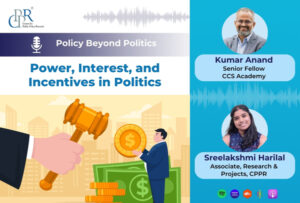
Public Choice Theory Podcast Series
Public Choice Theory offers a powerful framework to understand how political decisions are made—not in theory, but in practice. In Episode 68 of Policy Beyond Politics, titled “Power, Interest, and Incentives in Politics,” the discussion builds on Public Choice: A Primer by Eamonn Butler to examine how power, interests, and incentives operate within democratic systems.
Drawing from Chapters 5 to 9 of the book, this episode explores how collective decision-making processes are frequently shaped by interest groups, political bargaining, and bureaucratic incentives. It highlights the subtle yet influential ways in which concentrated interests and institutional mechanisms shape policy outcomes—often at the expense of broader public welfare.
Tyranny of Minorities and Collective Decision-Making
The episode begins with the concept of the tyranny of minorities, a key idea in Public Choice Theory. It illustrates how small, well-organised interest groups can exercise disproportionate influence over policies that affect large, diffuse populations. The discussion examines coalition-building, vote trading (logrolling) in legislatures, and the democratic trade-offs that emerge from these practices.
Rent-Seeking and Political Bargains
Moving further, the episode delves into rent-seeking behaviour, explaining how political actors and interest groups compete for economic privileges through lobbying, regulation, and state intervention. These activities, central to Public Choice Theory, often distort market efficiency and undermine democratic fairness.
Incentives of Politicians and Institutions
The discussion then turns to the economic incentives faced by politicians, including political profits, personal motivations, and the role—or absence—of institutional checks. It analyses how these incentives shape governance outcomes and policy priorities within democratic systems.
Bureaucracy, Incentives, and Accountability
The final segment focuses on the bureaucratic dimension of politics, unpacking how public officials navigate incentives related to budgets, authority, and career advancement. It explores how these dynamics affect efficiency, accountability, and performance in the public sector.
By the end of the episode, listeners gain a deeper understanding of:
-
How incentives drive political and bureaucratic behaviour
-
Why collective decisions are vulnerable to special interest influence
-
How institutional design, as explained by Public Choice Theory, can either mitigate or amplify these distortions
About the Podcast:
This episode of Policy Beyond Politics is the third of a five-part series exploring the concept of Public Choice Theory, in the context of the book, “Public Choice: A Primer” authored by Dr Eamonn Butler and published by the Institute of Economic Affairs (IEA), United Kingdom. Designed to make public choice theory accessible to wider and regional audiences, the series builds on its Malayalam translation to connect academic ideas with everyday political and economic experiences.
Tune in for an insightful conversation on Public Choice Theory and its application in understanding power, interest groups, incentives, and institutional, political and public policy decision-making in democratic systems.
KEY DISCUSSION POINTS
- Role of concentrated interests and public interests in policymaking
- Logrolling, vote trading and their influence on legislative decisions
- Rent-seeking and its influence on markets and governance
- Motivations of politicians, and how incentives shape their behaviour
- Bureaucratic incentives and how they can be aligned with public welfare and accountability
Speaker:
Kumar Anand, Economist & Public Policy Professional; Senior Fellow, Academy, Centre for Civil Society (CCS), New Delhi
Moderator:
Sreelakshmi Harilal, Associate, Research & Projects, Centre for Public Policy Research (CPPR), Kerala
Click to read the Malayalam-translated eBook of “Public Choice: A Primer” by Dr Eamonn Butler, published by CPPR.
#PolicyBeyondPolitics is available on
