
Podcasts

Kerala assembly elections: D Dhanuraj analyses Kerala polls: UDF likely to struggle with compressed campaign period
March 18, 2026
Kerala Assembly Polls 2026: D Dhanuraj on key issues shaping the poll narrative
March 23, 2026EP 23 | Navigating the West Asia Crisis: India, the GCC and the Kerala Connect
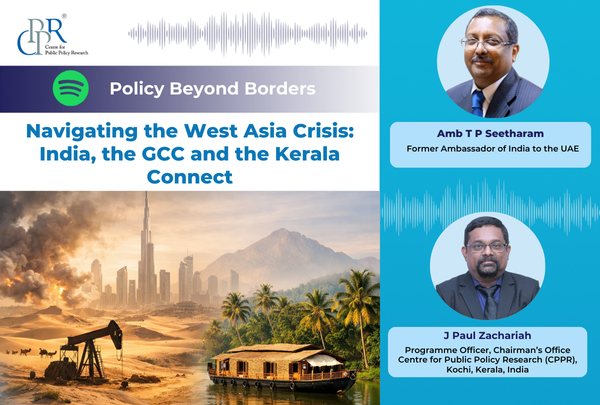
As escalating tensions in West Asia involving the United States, Iran, Israel, and regional actors reshape global economic and security dynamics, India finds itself directly exposed to the crisis. With critical chokepoints like the Strait of Hormuz and Suez Canal under strain, India’s long-standing engagement with the Gulf Cooperation Council (GCC) faces an unprecedented test.
The episode examines how this evolving conflict intersects with India’s strategic priorities and deeply embedded socio-economic linkages, particularly with Kerala.
About the Episode
In this episode of Policy Beyond Borders by CPPR (Centre for Public Policy Research), titled “Navigating the West Asia Crisis: India, the GCC and the Kerala Connect,” we explore:
- The strategic and diplomatic balancing act underpinning India’s engagement with competing actors in West Asia
- The Indo-Pacific spillover effects, including shifting naval responsibilities and emerging security vacuums
- The vulnerabilities and resilience of the Indian diaspora, with a focus on Kerala’s Gulf-dependent socio-economic structure
- Energy security risks, trade disruptions, and the implications of chokepoint instability on India’s economy
- The long-term question of economic diversification and whether this crisis marks an inflection point for Kerala and India
SPEAKER:
Ambassador T.P. Seetharam
Former Ambassador of India to the UAE
HOST:
J Paul Zachariah
Programme Officer, Chairman’s Office
Centre for Public Policy Research (CPPR), Kochi, Kerala, India
Key Discussion Points:
- The West Asia crisis has escalated beyond a regional conflict into a global economic and security disruptor with direct implications for India
- India’s “Link West” policy is under stress as it balances relations between the U.S., Iran, and the GCC
- Growing risks to Indian shipping and seafarers raise concerns about maritime security and possible naval escort roles
- The safety and financial security of the Indian diaspora in the Gulf, emerge as a critical concern
- India’s heavy dependence on the Strait of Hormuz exposes it to energy supply disruptions, particularly LPG
- Trade disruptions due to instability in the Suez Canal and Gulf routes are increasing logistics costs and delays
- The crisis challenges the viability and timeline of the India-Middle East-Europe Economic Corridor (IMEC)
- A spike in remittances may indicate financial insecurity among Gulf-based workers, not economic strength
- Kerala’s economy faces structural risks due to overdependence on Gulf remittances
- The crisis could act as a trigger for economic diversification, skill upgradation, and reduced reliance on external labour markets
🎧Listen now to explore whether the ongoing West Asia crisis is a short-term disruption or a deeper structural shift, testing India’s strategic autonomy, straining its energy and trade lifelines through the Strait of Hormuz and Suez Canal, and raising critical questions about diaspora security, maritime risk, and Kerala’s long-term economic dependence on the Gulf.
#PolicyBeyondBorders is available on
